This year i didn't send and receive as many Christmas cards as i use to. Like i said, the Christmas season is about to end and now is time to shows the cards.
Friday, January 6, 2012
Benedictine Monastery - Tucson
The Christmas season is about to end. Carol sent me a Christmas card and this card from Tucson with the local Benedictine Monastery.
Photo by Sr. Lenora Black OSB
The Benedictine Sisters Monastery, in Tucson, Arizona, is a landmark church and working monastery for the Benedictine Sisters of Perpetual Adoration. The building is widely acknowledged as a classic of mission style architecture.
The Benedictine Sisters first came to Tucson in 1935 at the invitation of the local bishop, the Right Reverend Daniel Gercke. In 1940, they moved into the Spanish-Renaissance-style Benedictine Sisters Monastery, which was designed by architect Roy Place.
Thursday, January 5, 2012
San Juan National Historic Site - Puerto Rico
Lídia also visited Puerto Rico and brought me these 2 cards. I only had 1 Puerto Rico card and it was an old one of the San Cristóbal Fort. San Cristóbal and San Felipe del Morro forts are two of the features included in San Juan National Historic Site.
San Juan National Historic Site in San Juan, Puerto Rico, includes colonial-era forts, bastions, powder houses, and three fourths of the old city wall.
On December 6, 1983 the park was added to the list of World Heritage Site. Only 12 national park areas in the United States are considered World Heritage Sites. - in: wikipedia
Photos by Richard Spenceley & Angela SpenceleyEl Morro, started in 1540, is the oldest European construction in the National Park Service. It is part of a massive fortification system developed on the island of Puerto Rico to help Spain control access and commerce into the Caribbean until the Spanish American War in 1898.
Projecting strength and power, Fort San Cristóbal dates back to the early 17th century. It defended San Juan from landward attacks and is the largest Spanish fortification in the New World.
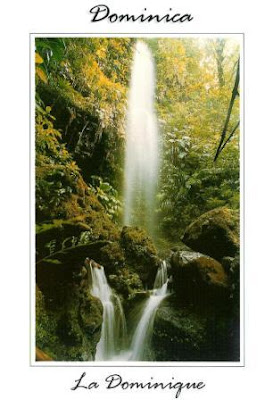
Morne Trois Pitons - Dominica
Dominica was one of the countries Lídia visited a few weeks ago. This is my 1st card from there and at the same time a card from a new Unesco site, the only one in this country, Morne Trois Pitons National Park. This park is a Unesco WHS since 1997.
Luxuriant natural tropical forest blends with scenic volcanic features of great scientific interest in this national park centred on the 1,342-m-high volcano known as Morne Trois Pitons. With its precipitous slopes and deeply incised valleys, 50 fumaroles, hot springs, three freshwater lakes, a 'boiling lake' and five volcanoes, located on the park's nearly 7,000 ha, together with the richest biodiversity in the Lesser Antilles, Morne Trois Pitons National Park presents a rare combination of natural features of World Heritage value. - in: http://whc.unesco.org/en/list/814
Tuesday, January 3, 2012
Bridgetown - Barbados
I'm getting Unesco cards from a few very hard-to-get countries. I've traded again with Lídia and this time she sent me card from Barbados, Dominica, Puerto Rico and Sri Lanka.
This card is from Bridgetown, Barbados capital city, which was added to the Unesco World Heritage Site List last year.
Historic Bridgetown and its Garrison, an outstanding example of British colonial architecture consisting of a well-preserved old town built in the 17th, 18th and 19th centuries, which testifies to the spread of Great Britain's Atlantic colonial empire. The property also includes a nearby military garrison which consists of numerous historic buildings. With its serpentine urban lay-out the property testifies to a different approach to colonial town-planning compared to the Spanish and Dutch colonial cities of the region which were built along a grid plan. - in: http://whc.unesco.org/en/list/1376
Colombian Coffee
The Colombian coffee is considered by some as the best coffee in the world. Last year, the Unesco classified the Coffee Cultural Landscape of Colombia as World Heritage Site.
An exceptional example of a sustainable and productive cultural landscape that is unique and representative of a tradition that is a strong symbol for coffee growing areas worldwide - encompasses six farming landscapes, which include 18 urban centres on the foothills of the western and central ranges of the Cordillera de los Andes in the west of the country. It reflects a centennial tradition of coffee growing in small plots in the high forest and the way farmers have adapted cultivation to difficult mountain conditions. - http://whc.unesco.org/en/list/1121
Colombian Coffee-Growers Axis (Spanish: Eje Cafetero), also known as Coffee Triangle (Spanish: Triángulo del Café) is a part of the Colombian Paisa region which is famous for growing and production of a majority of the Colombian coffee, considered by some as the best coffee in the world. There are three departments in the area: Caldas, Quindío and Risaralda.
Armenia is the capital of Quindío, a department in Colombia. It's one of the three that forms the Colombian Coffee-Growers Axis. - in: wikipedia
Both cards were sent by "thebluemorpho".
Monday, January 2, 2012
Purmamarca - Argentina
This card from Argentina, sent by Nicole, is another great Unesco acquisition for my collection. The card shows the Cerro de los Siete Colores, Seven Colours Hill, in Purmamarca, part of the Quebrada de Humahuaca, on the Unesco World Heritage List, for its cultural and historical and its stunning scenery, since 2003.
The word “quebrada” means deep valley or ravine. It’s famous for its multi-coloured mountains: each colour is the result of a different layer of sediments deposited over the last 600 million years. Successive tectonic plate movements gave them the shapes we see today.
One of the most important geomorphologic unit in Jujuy is EL Cerro de los siete Colores, located in Purmamarca. (The Seven Colours Hill) The Seven Colours Hill The multi-coulored sediments from the Mesozoic have been folded and eroded into strange shapes on this hill. Colour 1: light orange; composed with red clay, mud and sand; Age: 3 - 4 million years. Colour 2: white, composed with lime rock. Age: 400 million years. Colour 3: brown, purple and violet. The violet is composed with lead and the others are rich in calcium. Age: 80 – 90 million years. Colour 4: red, composed with clay & iron. Age: 3 – 4 million years. Colour 5: Green, composed with copper oxide. Colour 6: brown, composed by rock with manganese. Age: 1 – 2 million years. Colour 7: Yellow, composed with brimstone. Age: 80 – 90 million years. - http://www.quebradadehumahuaca.com/en
Subscribe to:
Posts (Atom)