Showing posts with label Croatia. Show all posts

Sunday, June 9, 2024

Dubravka - Croatia

 This card from Croatia was one of the 4 much desired cards from UNESCO missing sites that I mentioned in the previous post and now I also have all the UNESCO sites from Croatia. 
The card was sent by Nikola.
 
The site of St. Barbara is located in the village of Dubravka, in the northeast part of the Konavle region, where Croatia shares borders with Montenegro and Bosnia and Herzegovina.
In the area of Dubrovnik-Neretva County, there are 115 sites with stećci, out of which 24 are found in Konavle. The most famous among them is the site of St. Barbara in Dubravka, which was added to the UNESCO World Heritage List in 2016, together with 27 other sites in Croatia, Bosnia, and Herzegovina, Serbia, and Montenegro. 
 
Apart from the graveyard with stećci, the site includes the church of sv. Barbara built in 1889 at the site of an older church.
The necropolis has 104 stećak tombstones. Two types of stećci dominate: chests and slabs. Ornaments include motifs of stylized vines, rosettes and crosses, bow and arrow, arm and hand. No inscriptions were recorded.
The site has been developing almost continually since prehistoric times. It is a complex archaeological site with several development stages. - in:
https://www.stecciwh.org

Sunday, July 16, 2023

Split - Croatia

Split is the second largest city in Croatia, the largest city in Dalmatia and the largest city on the Croatian coast. It is located on the east coast of the Adriatic Sea and extends over a central peninsula and its surroundings.
 

Since ancient Rome, Split has proved to be an irresistible setting for emperors, kings and master artists to build great buildings. The result is a city full of architectural treasures that sublimate us as soon as we admire the richness of this historical heritage.

Split feels like a city that time has forgotten. The ancient centre is like nothing you’ll have seen before, with a whole district taken up by a sprawling Roman palace, going strong after 1700 years. Over the centuries this architecture has been kept intact and then incorporated into newer buildings, like St. Duje’s Cathedral, the heart of which is a 4th-century mausoleum.
 
Split’s Old Town is bursting with history and culture.  Everywhere you look, you’ll find stunningly well preserved Roman and medieval architecture. it is no wonder that it is a UNESCO World Heritage Site. The Historical Complex of Split with the Palace of Diocletian has been classified in 1979.
 
The Emperor, Diocletian constructed his retirement palace in about 300AD where he resided until his death. After his death, the palace became home to the various expelled emperors and their family. Diocletian’s Palace is an example of the most magnificent Roman architecture on the Adriatic coast. It is important to mention that the palace also serves as a residential area today and is therefore open to all. 
 
The statue of Gregory of Nin by Ivan Meštrović in Split is a heavily trafficked tourist site in the town, which the toe of the statue shows. Rubbing the statue's toe is said to bring good luck. The toe has been worn smooth and shiny as a result. Currently, the statue sits to the east of the Palace and Old Town of Split, just outside the Golden Gate.

Thursday, July 13, 2023

Dubrovnik - Croatia

 Long before Game of Thrones, Dubrovnik was already known as the "Pearl of the Adriatic". The squares, the narrow alleys, the red tile roofs, its imposing walls and cathedrals, the architecture, make it one of the most famous and popular destinations on the Adriatic coast.  
Raquel visited the city last month and sent me the first postcard. The others were sent by Christina, Christa and Natalia.
 
"The 'Pearl of the Adriatic', situated on the Dalmatian coast, became an important Mediterranean sea power from the 13th century onwards. Although severely damaged by an earthquake in 1667, Dubrovnik managed to preserve its beautiful Gothic, Renaissance and Baroque churches, monasteries, palaces and fountains. Damaged again in the 1990s by armed conflict, it is now the focus of a major restoration programme co-ordinated by UNESCO." - in: http://whc.unesco.org

 Dubrovnik has always been one of the most important coastal cities in the Mediterranean. It was a city-state in the Middle Ages and its fame and influence rivaled that of Venice in the heyday of the 16th and 17th centuries. Much of the fortune came from the prosperous maritime trade. 
 Those coming from the sea had to respect the two kilometers of solid 17th-century walls that surrounded an evolved, clean city of unique beauty. Despite being coveted, the Walls of Dubrovnik were never crossed by enemies, even Ottoman attacks were thwarted.
 
The old city walls of Dubrovnik are one of its best-known features, now more than ever thanks to being featured in the hit TV series, Game of Thrones. Built in the 10th century and modified in the 13th and 14th centuries, these formidable walls–as high as six meters in places, and up to six meters thick–provided a solid defense against invaders. Totaling nearly two kilometers in length, Dubrovnik's city walls make a great spot for a casual stroll and offer numerous excellent views over the Adriatic and inwards over the old city center. 
 
Another fun thing to do when visiting Dubrovnik is to head to the hills–via cable car. The Dubrovnik Cable Car whisks visitors high above the Old Town, up Srd Hill, with the views only getting better and better as you climb. - in: https://www.planetware.com
The journey lasts less than 10 minutes and you're rewarded with this view.

Sunday, January 9, 2022

Monthly Fav. Surprise RR * October '21

This new year has just started but I still have some some unfinished business in 2021, meaning that I still have a few cards to show from last year. This 1st one from China was actually the last one to arrive in 2021. It was supposed to arrive in October but it took a bit longer and only arrived in the last days of December.

It was worth to wait for this card. Eels sent me a card from my favorites, grassland in Inner Mongolia region. 
Inner Mongolia is the land of endless green grass with grazing herds of sheep and horses decorating the landscape.

Photo: Pihla Liukkonen - Postcard Design: Marku Kulmala
 
In October Finland celebrated 150 years of postcards in the country and a few meetings were held in a several cities. In November I posted the cards that I've got from Helsinki, Sastamala, Jyväskylä and Kuopio meetings, only the card from Mikkeli was missing. It was sent by Flora and it shows the city's harbor.

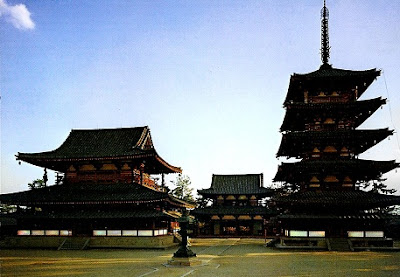
Hōryū-ji is a Buddhist temple in Ikaruga, Nara Prefecture, Japan. In 1993, Horyu-ji Temple, along with Hokki-ji, was registered as Japan's first UNESCO World Heritage Site under the name of Buddhist Monuments in the Hōryū-ji Area.  
The temple was founded in 607 by Prince Shotoku, who is credited with the early promotion of Buddhism in Japan. Horyuji is one of the country's oldest temples and contains the world's oldest surviving wooden structures. - in: https://www.japan-guide.com
This card was sent by Sawako.

 
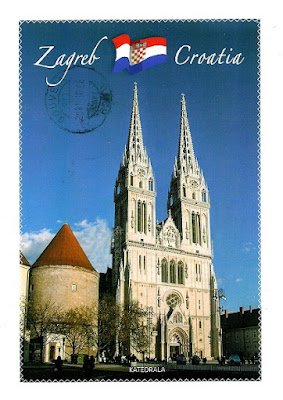
Zagreb Cathedral was one of the historic buildings damaged by a 5.3-magnitude earthquake on the morning of 22 March 2020. One of its two spires broke off and crashed onto the roof of the adjacent Archbishop's Palace. The second, which was significantly damaged, on expert recommendations, was partly removed a few days later.
Card sent by Anja.

Tuesday, January 4, 2022

HR-95874

Hello and happy new year!! 
Have you already received any mail this year? Today I've received 2 Christmas cards and a letter, I'm still waiting for my 1st official. 
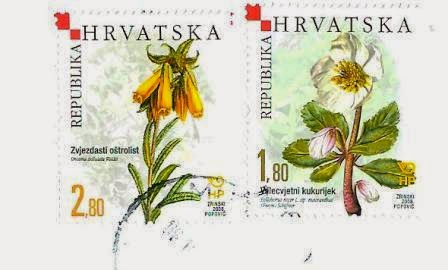
Speakinf of officials, is now time for some stats.  In 2021 my mailbox was happy 62 days, with a total of 114 official cards. I've sent 112. These numbers are slightly better than in 2020. One thing didn't changed, most of the sent and received cards are from Germany, USA and Russia. Besides these three countries, I've received cards from 23 other countries and sent to 21 others. One of the received was this one from Croatia, my 2nd official from there.


HR-95874, sent by Nada. 
Labin and Rabac are two cute, not overcrowded Istrian towns.
Labin is a medieval town located in the southeastern part of Istria, on a 320 meters high hill above Rabac. The town developed on the site of a Roman settlement called Albona (“alb” meaning hill), which was first mentioned in 285 AD. Labin consists of two parts: the old town, which is located on top of the hill, and the new settlement, the so-called Podlabin (“Underlabin”). The combination of the old and new town makes the walk through the streets like a visit to a museum. You can see the town gates from the 15th century, the lodge from the 17th century, renaissance details and baroque facades.
 
Known as “Pearl of the Kvarner Bay”, Rabac is a famous tourist resort that was a small fishermen village until the middle of the 19th century. Due to its location (beautiful bay and splendid surroundings), Rabac started to attract visitors, including the English writer Richard Francis Burton, who even wrote a book called “The Istrian coast”. - in: https://www.myistria.com

Saturday, May 15, 2021

FOTW Croatia

In the last weeks I've got new FOTW cards. One of the newest is this one from Republika Hrvatska, Republic of Croatia. 
The card was sent by Anja.

www.postcardsmarket.com

Croatia has an area of 56.594 km², a population of 4.284.889 and its capital is Zagreb.
Unique: 
* Horseriding adventures - riding and swimming with horses in the lakes of Croatia is a tradition;
* Croat Archipelago - with more than 1200 islands, that is the 4th in Europe as per size after Sweden, Finland and the British Isles;
Famous:
* The Plitvice Lakes - one of the most beautiful natural landscapes in Europe;
* Pula Arena (Amphitheater) - the 6th largest surviving Roman arena and one of the best preserved Roman monuments in Croatia;
History:
* Formation: 8th century, Duchy of Croatia;
* The Branimir Inscription - is the oldest preserved monument defining a Croatian medieval ruler, Duke Branimir - Dux Cruatarvm.  

Friday, August 30, 2019

Plitvice Lakes National Park - Croatia

I really wouldn't mind to pack my bags and travel to Croatia to visit the beautiful Plitvice Lakes, one of the places on my must visit list and also on the UNESCO WHS list. 
I got my 1st card from there back in 2008, sent by Gosia and a few weeks ago got another one sent by Celina.

The Plitvice Lakes National Park is renowned for its sixteen beautiful lakes, linked to each other by cascading waterfalls. Founded in 1949 and located in Croatia’s mountainous north, the stunning park has been recognised as a World Heritage Site by UNESCO since 1979. 


Its status as a UNESCO site comes from its unusual geology, which is the result of thousands of years of water flowing over limestone and chalk to create natural travertine dams. As well as creating the park’s famous lakes and waterfalls, this geological process has also formed some impressive caves that make for wonderful photo opportunities amidst the dense forest. - in: https://venezialines.com/blog/plitvice-lakes-unesco-world-heritage-site-croatia/

Sunday, December 23, 2018

Stari Grad - Croatia

There are so many places that I want to visit in Croatia that one trip is probably not enough to see all of them. I definitely want to visit Stari Grad one day. 
When visiting this city one has the possibility to discover an old city and its beautiful historical center and also Stari Grad Plain, a UNESCO site, one of the hardest of the croatian sites to get cards from, even if you manage to go to Stari Grad, it won't be easy to get cards, that's what Agata said. Fortunately she found a few showing not only the city but also the plain. That was in 2014 and a couple of weeks ago I got another card from this city sent by Theresa. 

Stari Grad is a town on the northern side of the island of Hvar in Dalmatia, Croatia. One of the oldest towns in Europe, its position at the end of a long, protected bay and next to prime agricultural land, has long made it attractive for human settlement. Stari Grad is also a municipality within the Split-Dalmatia County.
The most ancient part of Stari Grad falls within the UNESCO Protected World Heritage Site of the Stari Grad Plain, while the entire municipality lies within the surrounding buffer zone. - in: wikipedia


The Church of St. Stephen stands on the eastern side of a small square, Trg sv. Stjepana (St. Stephen’s Square), in the historical centre of Stari Grad.  It was built from 1605 onward at the site of an earlier church also dedicated to the martyred Pope Stephen I.
The bell tower stands apart from the church. The inscription above its door indicates that it was completed in 1753. 

Saturday, November 17, 2018

Zadar - Croatia

I've many trips planned in my head and one of them is a road trip in Croatia, starting in Zagreb, heading next to the beautiful Plitvice Lakes National Park and from there, many stops along the Adriatic Coast. Zadar is definitely one of the places I want to visit. The city center seems quite interresting and now that its defensive system is classified as UNESCO site, I'm even more interrested in visiting this ancient city. I'm also curious about the sea organ
Thanks Agata for another great card. 

Foto: A. Carli
In 2017 Zadar's Defensive System  made it to the UNESCO’s list of World Heritage Sites as one of the Venetian Works of Defence between the 16th and 17th Centuries. Apart from Zadar’s defensive system, the property also lists the Fort of St Nicholas in Šibenik and other defensive systems in Italy and Montenegro. 

The 15th and 17th centuries was the golden age of the mighty Republic of Venice, whose rule also included some of what is now Croatian territory such as Zadar region. It was an important maritime republic and a leading trading power of that time.
During the Venetian rule, Zadar used to be the military and administrative centre on the Adriatic coast and the defensive system reflects its important role. Situated on the historical peninsula, the system follows the coastline and consists of the bastioned city walls and gates such as the Land Gate, an example of Renaissance works of the famous Venetian architect Michele Sanmicheli. - in: https://www.zaton.hr/en/blog/155/zadar-s-defensive-system-on-unesco-s-list

Friday, September 7, 2018

St Nikola Fortress, Sibenik - Croatia

We all love surprise cards and I like them even a bit more when they are from missing UNESCO sites. Agata surprised me with this beautiful view of Sibenik with St. Nikola Fortress, one of the 2 croatian places classified by UNESCO as part of the Venitian Works of Defense. 
Hvala Agata.

The unusual island fortress of St Nikola in Sibenik is part of the Venetian Defensive System that Unesco has recently inscribed on its list of World Heritage Sites. Like Zadar's Walls, the Republic of Venice built St Nikola's fortress in the 16th century to protect the town from attacks by Ottoman Turks.

With its unique triangular shape and sturdy construction, it became the strongest fort on the Croatian coast.
Sibenik was important to La Serenissima for its agricultural products and nearby salt pans. The fortress was erected to protect Sibenik's vital port and thus was situated at the entrance to the narrow milelong channel of St Anthony (Sv Ante) which connected Sibenik to the open sea. Like other forts in the Venetian Defensive System, St Nikola was a bastioned fort in the alla moderna style. The celebrated Venetian architect, Michele Sanmicheli, designed it and his nephew, Giangirolamo Sanmicheli, built it between 1540 and 1547. - in: https://www.croatiatraveller.com/central%20dalmatia/St-Nikola.html

Starigrad Paklenica - Croatia

Any postcard collector of UNESCO sites complains every now and then about how hard it its to get cards from certain sites; the Primeval Beech Forests of the Carpathians and Other Regions of Europe is definitely one of them. These forests can be found in 12 countries but so far I only have cards from 3 of them, Germany, Ukraine and now Croatia. In Croatia the classified forests are located in Northern Velebit and Paklenica National Parks, where this card sent by Antonella is from. 

Paklenica National Park is located slightly inland from the coast of North Dalmatia, situated about 47 kms northeast of Zadar. The nearest coastal town is Starigrad Paklenica.
The park is south of Velebit  range of mountains (the largest in Croatia) and covers an area of just under 100 square km. It has a mixture of high peaks with stunning views, deep gorges and beech and pine forest. - in: https://www.visit-croatia.co.uk/croatia-destinations/north-dalmatia/paklenica-national-park/

Thursday, December 28, 2017

Sibenik's Cathedral - Croatia

When I finally decide to visit Croatia again, I want to travel along the Adriatic coast and visit a few towns along the way. Sibenik is one of those towns. One of the main sights in Šibenik is the Cathedral of St. James, classified as UNESCO World Heritage Site. 
Sunny and Mirna sent me these cards. 

Photo by A. Carli
Sibenik's Cathedral of St James is the largest and most beautiful building of the transitional Gothic-Renaissance period in Dalmatia. Named a UNESCO World Heritage Site in 2000, the Cathedral reflects influences of Northern Italy, Tuscany Dalmatia which combined to solve the considerable technical, structural and artistic challenges in building a vaulted church entirely in stone.  No bricks or timber were used in the church's construction.

The building was begun by local and Venetian builders in 1431 but when, after ten years, their work hadn't progressed very far, the great Dalmatian master-builder, Juraj Dalmatinac (who also designed Pag Town) took over. He devoted most of his life to the cathedral before passing away in 1473. He worked predominantly in the Gothic Flamboyant style but many sculptural works (such as the exterior frieze of 71 sculpted heads) already show Renaissance elements.  He gave the cathedral its basic monumental plan such as the transept, domes, sacristy and baptistery. After his death, the work was taken over by Nikola Firentinac who introduced the elements of the Tuscan Renaissance. The cathedral was finally completed in 1536. - in: https://www.croatiatraveller.com/Heritage_Sites/CathedralSibenik.htm

Zagreb's Cathedral - Croatia

Exactly 11 years ago I was in Zagreb and spent a few nice days there. Can't wait to visit the city again. 
Zagreb was one of Lina's last trips, she sent the 1st card and Nives sent the 2nd 4 years ago.

Zagreb Cathedral of the Assumption of the Blessed Virgin Mary is a Zagreb landmark. As a matter of fact, it is the most monumental sacral building in Neo-Gothic style southeast of the Alps.
The cathedral is typically Gothic, as is its sacristy, which is of great architectural value. Its spires can be seen from many locations in the city. 

Tisak MORE
Construction on the cathedral started in 1093, but the building was destroyed by the Tatars in 1242. At the end of the 15th century, the Ottoman Empire invaded Bosnia and Croatia, triggering the construction of fortification walls around the cathedral, some of which are still intact. In the 17th century, a fortified renaissance watchtower was erected on the south side, and was used as a military observation point, because of the Ottoman threat.

www.atlasax.net
The cathedral was severely damaged in the 1880 Zagreb earthquake. The main nave collapsed and the tower was damaged beyond repair. The restoration of the cathedral in the Neo-Gothic style was led by Hermann Bollé, bringing the cathedral to its present form. As part of that restoration, two spires 108 m (354 ft) high were raised on the western side, both of which are now in the process of being restored as part of an extensive general restoration of the cathedral.
The cathedral is depicted on the reverse of the Croatian 1000 kuna banknote issued in 1993.
When facing the portal, the building is 46 meters wide and 108 meters high. - in: wikipedia

Friday, November 3, 2017

St. Mark's Church, Zagreb

I've been to Zagreb but I didn't get to see this church ☹ I'm pretty sure I'll visit Zagreb again and then, I'll definitely see St. Mark's Church. The card was sent by Antonella.

This 13th-century church is one of Zagreb’s most emblematic buildings. Its colourful tiled roof, constructed in 1880, has the medieval coat of arms of Croatia, Dalmatia and Slavonia on the left side, and the emblem of Zagreb on the right. - https://www.lonelyplanet.com/croatia/zagreb/attractions/st-marks-church/a/poi-sig/425175/358800

From the Romanesque period, in the 13th century, when it was originally built, only a window in the south wall and the bell-tower foundation are preserved. Gothic arches and the shrine were built in the second half of the 14th century, when the church got its most valuable part - luxurious Gorhic south portal. In terms of figures it contains, that Gothic portal is one of the most beautiful one in Croatia. It was made in the Parler workshop, one of the most famous medieval sculpting workshops. The north - western wall contains the oldest known coat - of - arms of Zagreb from 1499.
The church was thoroughly reconstructed in the second half of the 19th century, based on the designs of Viennese architects Friedrich Schmidt and Hermann Bolle. It underwent another reconstruction in the first half of the 20th century. At that time, renowned painter Jozo Kljakovic (1888 - 1969) painted its walls, while the altar was decorated with works of famous sculptor Ivan Mestrovic. - in: http://www.infozagreb.hr/explore-zagreb/attractions/architectural-monuments/st-marks-church

Thursday, September 7, 2017

Pula - Croatia

Last month my penpal Gemma went on a road trip from Spain to Italy, Slovenia and Croatia. I'm pretty sure it was great. She has been to some places that I really want to visit, especially in Slovenia. These cards are not from there but from my beloved Croatia. Both cards are from Pula but only the 1st was sent by her, the other one was sent by Andrzej. 

 Pula is the largest city in Istria County, Croatia and the eighth largest city in the country, situated at the southern tip of the Istria peninsula. It is known for its multitude of ancient Roman buildings, the most famous of which is the Pula Arena, one of the best preserved Roman amphitheaters, and its beautiful sea. The city has a long tradition of wine making, fishing, shipbuilding, and tourism. It has also been Istria's administrative centre since ancient Roman times. - in: wikipedia

The most famous sight in Pula – of course – is the Roman amphitheatre, which is called The Arena. Built during the 1st century AD and completed under the reign of Emperor Flavius, this amphitheatre is the sixth largest in the world (of those that still exist). The three-storey structure held 23,000 spectators in Roman times and today hosts numerous concerts and events throughout the year, including Pula Film Festival screenings. - in: http://www.visit-croatia.co.uk/index.php/croatia-destinations/istria/pula/