Showing posts with label Mexico. Show all posts

Tuesday, June 16, 2026

MX-85284

 In almost 20 years of postcrossing, this is my 1st official card from Mexico and I just love it. You can't go wrong with a postcard of a beautiful church.
Aguascalientes is the capital city of one of the smallest in Mexico, located in North-Central Mexico. 

The Aguascalientes Cathedral, officially known as the Cathedral Basilica of Our Lady of the Assumption, is a historic landmark located in Aguascalientes.
 
MX-85284, sent by Rose.
Construction of this stunning Baroque-style cathedral began in the late 16th century and was completed in the 18th century. The cathedral is renowned for its twin towers, intricate facade, and the beautiful interior that houses several significant religious artworks. It stands as a testament to the city’s rich cultural and architectural heritage, attracting both worshippers and tourists alike. The cathedral is not only a place of spiritual significance but also a symbol of the historical and cultural evolution of Aguascalientes. - in: https://ontheroadin.ca

Tuesday, April 7, 2026

US-12167858

 This is another American official card, it was sent from Seattle, but Basílica de Guadalupe is located in Mexico. I've never heard of it before but this basilica is the second most important site for the Catholic world after Rome. I had no idea.

It is said that the Virgin appeared before Juan Diego on four occasions on the Hill of Tepeyac. These apparitions occurred ten years after the fall of Tenochtitlán, in 1531. According to tradition, the Virgin appeared to Juan Diego and asked him to have a temple built there. The remains of a small adobe temple can still be seen in the old parish for Indigenous people, which is believed to have been this first temple. - in: https://visitmexico.com

 US-12167858, sent by Leo.
In response to our Blessed Mother request, the first Bishop of Mexico, Fray Juan de Zumárraga, ordered the construction of a small hermitage in 1531, which became a place of pilgrimage from its very beginnings.
However, with the increasing number of faithful, the need for a larger space became evident, so in 1709, the first basilica was inaugurated, today known as the Old Basilica of Guadalupe.
Due to the structural deterioration of the old basilica and the continuous increase in visitors, it was decided to construct a new building.
 The New Basilica of Guadalupe was designed by the architects Pedro Ramárez Vázquez, José Luis Benlliure, Alejandro Schoenhofer, Fray Gabriel Chávez de la Mora, and Javier García Lascuráin.
It was consecrated on October 12, 1976, as the most modern house of Our Lady of Guadalupe. This modern building can accommodate thousands of faithful and features a circular architecture that allows a clear view of the image of the Virgin of Guadalupe from any point inside. - in:
https://guadalupe500mexico.com

Thursday, April 24, 2025

Whale Sanctuary of El Vizcaino - Mexico

 This big whale is a grey-whale, which found in the lagoons of El Vizcaino, the perfect place to reproduce. This whale sanctuary, a UNESCO site since 1993, is actually recognized as the World's most important place for the reproduction of the once endangered Eastern subpopulation of the North Pacific Grey Whale. The protection of these winter breeding grounds has been paramount in the remarkable recovery of this species after near-extinction as a result of commercial whaling, including in these very lagoons.
This site is new in my collection and the card was sent from Germany by Svenja. 
 
Getty images/Bruce Shafer
The Whale Sanctuary of El Vizcaino is a serial property on the Pacific Coast of the central part of Mexico's Baja California Peninsula. It comprises two coastal lagoons, Laguna Ojo de Liebre and Laguna San Ignacio, and their surroundings (...).
The total extent of the two components of the property is of 370,950 hectares, embedded in the much larger El Vizcaino Biosphere Reserve, Mexico's largest protected area (...).
The lagoons are home to numerous other marine mammals, such as Bottlenose Dolphin, California Sea Lion and Harbor Seal and four species of the endangered marine turtle. - in
: https://whc.unesco.org

Sunday, April 10, 2022

Aqueduct of Padre Tembleque - Mexico

Aqueduct of Padre Tembleque in Mexico was added to the UNESCO WHS list in 2015 and this is a new site in my collection. It was sent by Óscar.

The aqueduct of Padre Tembleque, named after the friar Francisco de Tembleque, was constructed between 1555 and 1572 and constitutes a hydraulic system located between the states of Mexico and Hidalgo in the Mexican Central Plateau.

The heritage canal system encompasses its water catchment area, springs, main and secondary canals, distribution tanks, arcaded aqueduct bridges, reservoirs and other auxiliary elements, which extend over a maximum distance of 48.22 kilometres. The aqueduct structures were built with supporting structures of earthen adobes in the Mesoamerican construction tradition, but at the same time referencing European models of water conduction developed during the Roman era.
The hydraulic system is an outstanding example of water conduction in the Americas and integrates along its 48 kilometres’ extent impressive architectural structures, such as the main arcaded aqueduct at Tepeyahualco, which reaches a total height of 39.65m, with its central arch of 33.84m height. The system was built by Franciscan friars with support from the local communities and as a result is a unique representation of the ingenious fusion of Mesoamerican and European construction traditions, combining the mestizo tradition with the tradition of Roman hydraulics. As an ensemble of canals and auxiliary structures, the system is exceptionally well-preserved and one branch remains operational up until today. - in: https://whc.unesco.org

Monday, March 14, 2022

Mexican UNESCO Sites

I usually get super excited when I receive cards from UNESCO sites but these from Mexico didn't impress me much. The quality of the pictures, the paper, even the cut, isn't that good, it really seems an homemade kind of thing. Homemade or not, there are four sites that I'm not missing anymore. 
The three cards with Mexican stamps were sent by Gabino and the other one was sent by Óscar.


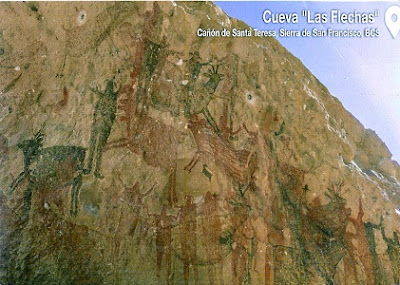
Cueva "Las Flechas" is part of the group of cave paintings in the canyon of Santa Teresa in the San Francisco mountain range. The canvas on the rock wall describes some human figures, apparently a female and a male representation. These paintings are among the most visually attractive in the region.
From c. 100 B.C. to A.D. 1300, the Sierra de San Francisco (in the El Vizcaino reserve, in Baja California) was home to a people who have now disappeared but who left one of the most outstanding collections of rock paintings in the world. They are remarkably well-preserved because of the dry climate and the inaccessibility of the site. Showing human figures and many animal species and illustrating the relationship between humans and their environment, the paintings reveal a highly sophisticated culture. Their composition and size, as well as the precision of the outlines and the variety of colours, but especially the number of sites, make this an impressive testimony to a unique artistic tradition. - in: https://whc.unesco.org

 
El Pinacate and Gran Desierto de Altar Biosphere Reserve (EPGDABR) is located in the Sonoran Desert.
EPGDABR has a surface of 714,566 hectares with 354,871 hectares of buffer zone. It is a large and relatively undisturbed protected area which comprises two very distinct broad landscape types. To the East, there is a dormant volcanic area of around 200,000 ha, comprised of the Pinacate Shield with extensive black and red lava flows and desert pavement. The volcanic shield boasts a wide array of volcanic phenomena and geological formations, including a small shield-type volcano. The most visually striking feature is the concentration of a total of 10 enormous, deep and almost perfectly circular Maar (steam blast) craters.
In the West towards the Colorado River Delta and South towards the Gulf of California, is the Gran Altar Desert, North America's largest field of active sand dunes and only active Erg dunes. - in: https://whc.unesco.org

The Prehistoric Caves of Yagul and Mitla in the central valley of Oaxaca is an extensive cultural landscape that includes caves and shelters, one of which, the Guilá Naquitz cave has provided extraordinarily well preserved botanical evidence of bottle gourds, beans and squash and the earliest known maize cobs, and two others, Cueva Blanca and Gheo Shih siteshave provided evidence of Pleistocene animals and stone tools and the seasonal use of the abundant summer resources of fruit and small mammals.
The gradual shift from social groups based primarily on hunting to ones that were primarily based on settled agriculture took place in multiple areas at the same time across the Mesoamerican region. The property is an exceptional reflection of the evolution from hunter-gathering to more settled communities in this area of the Oaxaca valley. - in: https://whc.unesco.org

 
Xochicalco is a pre-Columbian archaeological site in the western part of the Mexican state of Morelos.   Xochicalco is an exceptionally well-preserved example of a fortified political, religious and commercial centre from the troubled period of 650–900 that followed the break-up of the great Mesoamerican states such as Teotihuacan, Monte Albán, Palenque and Tikal. - in: https://whc.unesco.org

Tuesday, November 9, 2021

Cholula - Mexico

A day when you get a card from your favorites, is always a great day. I'm really happy to finally have this mexican card that has been on my favs wall for quite some years. I got it thanks to Desireé who was offering some cards on FB. 
Cholula is located in the central Mexican state of Puebla. The city  is best known for its Great Pyramid (the largest pyramid by volume known to exist in the world today), with the Iglesia de Nuestra Señora de los Remedios sanctuary on top, as well as its numerous churches. 
In the background there's Popocatépetl,  one of the most active volcanoes in Mexico.

Foto: Luis G. Aguirre R.
The Iglesia de Nuestra Señora de los Remedios (Our Lady of Remedies Church) is a 16th-century Mexican Catholic parish church built atop the Tlachihualtepetl pyramid. The church was built with carved stone and embellished with 24-carat gilded panels and shims, called laminilla. It has an altar in the neoclassical style. It was built between May 1574 and August 1575 and consecrated on March 25, 1629. The base on which the church is built is one of the largest pyramids of the ancient world, being 54 metres (177 ft) high, covering 54 acres and shaped by several superimposed structures over the course of six centuries. - in: wikipedia

Tuesday, September 1, 2020

Tehuacán-Cuicatlán Valley - Mexico

Sometimes it is not that easy to decide whether a postcard is from a UNESCO site or not. This one, for example, raises some doubts but after some research, Oscar, who sent it, and I decided to include it in our collections and thus remove one more place from our missing lists.
This painting by José María Velasco shows a cactus in the Tehuacán-Cuicatlán Valley, the originary habitat of Mesoamerica. This Mexican site has been classified as a World Heritage Site since 2018.

Reproducción Autorizada por el Instituto Nacional de Bellas Artes y Literatura 2018
Tehuacán-Cuicatlán Valley, part of the Mesoamerican region, is the arid or semi-arid zone with the richest biodiversity in all of North America. Consisting of three components, Zapotitlán-Cuicatlán, San Juan Raya and Purrón, it is one of the main centres of diversification for the cacti family, which is critically endangered worldwide. The valley harbours the densest forests of columnar cacti in the world, shaping a unique landscape that also includes agaves, yuccas and oaks. Archaeological remains demonstrate technological developments and the early domestication of crops. The valley presents an exceptional water management system of canals, wells, aqueducts and dams, the oldest in the continent, which has allowed for the emergence of agricultural settlements. - in: https://whc.unesco.org/en/list/1534/

Wednesday, November 16, 2016

Mérida - Mexico

I've already mentioned a 37 cards swap with Andrzej but I didn't said that those 37 cards are from 18 countries!! From Mexico I only chose this one from Mérida, the capital and largest city of the Mexican state of Yucatán as well as the largest city of the Yucatán Peninsula. 
The building on the card is the Town Hall, the seat of the city council. 

Foto: Luís Gomez C.
 The building is located to the west side of the main square of the city of Mérida. It was built during the government of Santiago Aguirre, between 1734 and 1736.
In 1871 the 1st clock of the city was placed in this building.

Wednesday, September 23, 2015

Monarch Butterfly Biosphere Reserve - Mexico

5th and last card sent by Marco. Now I've 20 of the 32 mexican UNESCO sites. The Monarch Butterfly Biosphere Reserve was added to the WHS list in 2008. 

Foto: Encar
The 56,259 ha biosphere lies within rugged forested mountains about 100 km northwest of Mexico City. Every autumn, millions, perhaps a billion, butterflies from wide areas of North America return to the site and cluster on small areas of the forest reserve, colouring its trees orange and literally bending their branches under their collective weight. In the spring, these butterflies begin an 8 month migration that takes them all the way to Eastern Canada and back, during which time four successive generations are born and die. How they find their way back to their overwintering site remains a mystery. - in: http://whc.unesco.org/en/list/1290

Friday, September 18, 2015

Cabo San Lucas - Mexico

Cabo San Lucas is one of the areas classified and identified on the UNESCO list as Islands and Protected Areas of the Gulf of California. The site was classified in 2005 and comprises 244 islands, islets and coastal areas that are located in the Gulf of California in north-eastern Mexico. 
This 4th card sent by Marco shows the Arch of San Lucas, the exact place where the Pacific Ocean becomes the Gulf of California, also known as Sea of Cortez.

The Sea of Cortez and its islands have been called a natural laboratory for the investigation of speciation. Moreover, almost all major oceanographic processes occurring in the planet’s oceans are present in the property, giving it extraordinary importance for study. The site is one of striking natural beauty in a dramatic setting formed by rugged islands with high cliffs and sandy beaches, which contrast with the brilliant reflection from the desert and the surrounding turquoise waters. - in: http://whc.unesco.org/en/list/1182

© Claude Vogel
The distinctive landmark of Cabo San Lucas is the rugged taffy-colored El Arco (The Arch) rock formation that erupts from the sea at the tip of the Baja Peninsula. the arch is also known as Land's End because, as the crow flies, if you followed a line south from here, you would not touch land again until you reached the South Pole.

Thursday, September 17, 2015

Morelia - Mexico

Here it comes the 3rd mexican card sent by Marco. The Historic Center of Morelia was classified as UNESCO WHS in 1991.

Built in the 16th century, Morelia is an outstanding example of urban planning which combines the ideas of the Spanish Renaissance with the Mesoamerican experience. Well-adapted to the slopes of the hill site, its streets still follow the original layout. More than 200 historic buildings, all in the region's characteristic pink stone, reflect the town's architectural history, revealing a masterly and eclectic blend of the medieval spirit with Renaissance, Baroque and neoclassical elements. Morelia was the birthplace of several important personalities of independent Mexico and has played a major role in the country's history. - in: http://whc.unesco.org/en/list/585

This beautiful aqueduct of quarry pink, measure 1810 meters and consists of 253 arches and two boxes of water. 
Construction take us to the days of the golden age of the former Valladolid. In 1785 Bishop Fray Antonio de San Miguel commanded  to built an aqueduct with two purposes: to bring drinking water to the city which was hit by a terrible drought for two years and to provide work for the indigenous people of the region. The stone was transported from the village of Santa María (now part of the city) and goes to the old Calle Real. Today, Madero avenue. - in: http://www.travelbymexico.com/morelia/atractivos/index2.php?nom=bmoracueducto

Tuesday, September 15, 2015

Querétaro - Mexico

The 2nd card sent by Marco was from Querétaro, the capital capital and largest city of the state of Querétaro, located in central Mexico.

© www.exploworld.com
The city has preserved its historic downtown and taken steps to beautify many areas. The Historic Monuments Zone of Queretaro was named a UNESCO World Heritage site in 1996. The property was inscribed on the basis of two of its cultural criteria and considering that the site is of outstanding universal value and an exceptional example of a colonial town whose layout symbolizes its multiethnic population. It is also endowed with a wealth of outstanding buildings, notably from the 17th and 18th centuries.
Queretaro holds several treasures, and a friendly sense of civic pride prevails. The historic city center is filled with lovely colonial mansions, immaculate pedestrian  alkways (andadores) and quaint plazas little changed since colonial days. - in: http://www.visitmexico.com/en/queretaro

Monday, September 14, 2015

San Miguel de Allende - Mexico

Some time ago Marco, a mexican living in Austria, asked me if I could get some portuguese stamps and souvenir sheets. I didn't find any of his wishes in my local post office but I managed to get waht he wanted online. In return I got 5 of my missing mexican UNESCO sites. I couldn't be happier. 
Lets start with a card from San Miguel de Allende. 

Located in Guanajuato state, 265 km (165 miles) northeast of Mexico City and 96 km (60 miles) from the state capital, Guanajuato city, San Miguel is located within Mexico's hilly central highlands.
Once an important stop on the silver route between Zacatecas and Mexico City, its historic center is filled with well-preserved buildings from the 17th and 18th centuries. With its narrow cobblestone streets, leafy courtyards, fine architectural details and sumptuous interiors, San Miguel de Allende is arguably the prettiest town in Mexico.
In 2008 UNESCO recognized San Miguel de Allende and the neighboring Sanctuary of Jesus de Atotonilco as World Heritage of Humanity sites, citing the town's religious and civil architecture as a demonstration of the evolution of different trends and styles, from Baroque to late 19th century Neo-Gothic. - in: http://www.visitmexico.com/en/san-miguel-de-allende

Fotografia: Jüpgen Bavoni * Diseño: G. Escobedo
La Parroquia de San Miguel Arcángel, the current parish church of San Miguel, is unique in Mexico and the emblem of the town. It has a Neo-gothic façade with two tall towers that can be seen from most parts of town. It is one of the most photographed churches in Mexico. The church was built in the 17th century with a traditional Mexican façade. The current Gothic façade was constructed in 1880 by Zeferino Gutierrez, who was an indigenous bricklayer and self-taught architect. It is said Gutierrez's inspiration came from postcards and lithographs of Gothic churches in Europe; however, the interpretation is his own and if more a work of imagination than a faithful reconstruction. - in: wikipedia

Sunday, June 14, 2015

San Cristóbal de Las Casas - Mexico

This is probably the most colorful church I've ever seen and it looks great!! The Cathedral of San Cristóbal Martir is the most representative monument of San Cristóbal de Las Casas, in the mexican state of Chiapas. 
The card was sent by Nan. 

The construction of the cathedral began in 1528. The original building underwent some changes and was rebuilt in the 17th century. Its facade dating from the 18th century in baroque style, decorated with plant motifs made of mortar. 
The interior contains interesting pieces of art such as the pulpit, from the 16th century, the altar of the Kings, two beautiful altarpieces of Solomonic Baroque style and beautiful paintings with religious themes.

Saturday, June 13, 2015

Luis Barragán House - Mexico

This month the UNESCO I'll add new sites to the World Heritage List. I'm looking forward to know which sites will be added this year and hoping to have some of them. 
Luis Barragán House was added in 2004 and I got this card last April. It was a nice surprise from Óscar. 

www.casabarragan.org
Built in 1948, the House and Studio of architect Luis Barragán in the suburbs of Mexico City represents an outstanding example of the architect’s creative work in the post-Second World War period. The concrete building, totalling 1,161 m2, consists of a ground floor and two upper storeys, as well as a small private garden. Barragán’s work integrated modern and traditional artistic and vernacular currents and elements into a new synthesis, which has been greatly influential, especially in the contemporary design of gardens, plazas and landscapes. - in: http://whc.unesco.org/en/list/1136

Wednesday, March 5, 2014

US-2636847

What a great volcano card!! Carlos read that I like volcanoes and sent me this card from his home country, Mexico. 

Karten Collection * Photo by Erick Schnabel
US-2636847, sent by Carlos.
Volcán Popocatépetl, whose name is the Aztec word for smoking mountain, towers to 5426 m 70 km SE of Mexico City to form North America's 2nd-highest volcano. The glacier-clad stratovolcano contains a steep-walled, 250-450 m deep crater. The generally symmetrical volcano is modified by the sharp-peaked Ventorrillo on the NW, a remnant of an earlier volcano. 

Popocatepetl is one of Mexico's most active volcanoes. After almost 50 years of dormancy, "Popo" came back to life in 1994 and has since then been producing powerful explosions at irregular intervals. 
In the past centuries befor European invasions, large eruptions produced giant mud flows that have buried Atzteque settlements, even entire pyramids. - in: http://www.volcanodiscovery.com/popocatepetl.html

Wednesday, May 15, 2013

Mexican Unesco cards

I'm so glad i got these cards. Both are new Unesco WHS from Mexico. The Mexico Unesco list is so big that every single card from there is very appreciated.
Historic Centre of Oaxaca and Archaeological Site of Monte Albán was inscribed in 1987 and the Archaeological Zone of Paquimé, Casas Grandes in 1998.

 Photo by A & P Giberstein
Monte Albán is a large pre-Columbian archaeological site in the Santa Cruz Xoxocotlán Municipality in the southern Mexican state of Oaxaca.
Monte Albán is an outstanding example of a pre-Columbian ceremonial centre in the middle zone of present-day Mexico, which was subjected to influences from the north - first from Teotihuacan, later the Aztecs - and from the south, the Maya. With its pelota court, magnificent temples, tombs and bas-reliefs with hieroglyphic inscriptions, Monte Albán bears unique testimony to the successive civilizations occupying the region during the pre-Classic and Classic periods. For more than a millennium, it exerted considerable influence on the whole cultural area. Latter-day Oaxaca is a perfect example of a 16th-century colonial town. Its monumental heritage is one of the richest and most coherent in the area that was known as New Spain. - in: http://whc.unesco.org/en/list/415

© Published and distributed by Tarjetas Sonora
Casas Grandes is the contemporary name given to a pre-Columbian archaeological zone and its central site, located in northwestern Mexico in the modern-day Mexican state of Chihuahua. It is one of the largest and most complex sites in the region. Developed as multi-storied dwellings about 1350, the community was abandoned approximately 1450. Regarded as one of the most significant archaeological zones in the northwestern region, Casas Grandes is located in a wide, fertile valley on the Casas Grandes or San Miguel River, 35 miles (56 km) south of Janos and 150 miles (240 km) northwest of the state capital, the city of Chihuahua. The settlement relied on irrigation to support its agriculture. - in: wikipédia

Thursday, August 30, 2012

Mexican Unesco cards

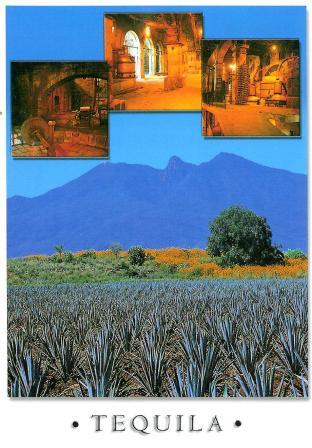
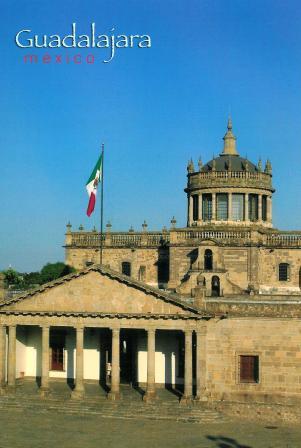
I've recentely arranged a trade with Irma from Mexico in order to get new Unesco sites from this country. She was offering Agave Landscape and Ancient Industrial Facilities of Tequila and Hospicio Cabañas.

 Photo by Albert Gomez Barbosa
The 34,658 ha site, between the foothills of the Tequila Volcano and the deep valley of the Rio Grande River, is part of an expansive landscape of blue agave, shaped by the culture of the plant used since the 16th century to produce tequila spirit and for at least 2,000 years to make fermented drinks and cloth. Within the landscape are working distilleries reflecting the growth in the international consumption of tequila in the 19th and 20th centuries. Today, the agave culture is seen as part of national identity. The area encloses a living, working landscape of blue agave fields and the urban settlements of Tequila, Arenal, and Amatitan with large distilleries where the agave ‘pineapple' is fermented and distilled. The property is also a testimony to the Teuchitlan cultures which shaped the Tequila area from AD 200-900, notably through the creation of terraces for agriculture, housing, temples, ceremonial mounds and ball courts. - in: http://whc.unesco.org/en/list/1209

 Photo by Erik Schnabel
The Hospicio Cabañas in Guadalajara, Jalisco, a World Heritage Site since 1997, is one of the oldest and largest hospital complexes in Spanish America.

Photo by Alberto Gomez Barbosa
The Hospicio Cabañas was built at the beginning of the 19th century to provide care and shelter for the disadvantaged – orphans, old people, the handicapped and chronic invalids. This remarkable complex, which incorporates several unusual features designed specifically to meet the needs of its occupants, was unique for its time. It is also notable for the harmonious relationship between the open and built spaces, the simplicity of its design, and its size. In the early 20th century, the chapel was decorated with a superb series of murals, now considered some of the masterpieces of Mexican art. They are the work of José Clemente Orozco, one of the greatest Mexican muralists of the period. - in: http://whc.unesco.org/en/list/815

Monday, August 27, 2012

Xochimilco - Mexico

This card was sent from Mexico by Ana Racic. It was a complete surprise because i didn't know she traveled to Mexico!! Its always nice to know that our friend remembered and had time to send us a card. Many thanks Ana :D
Xochinilco is known for its canals and traditional flat boats, trajineras. This canal and chinampa system, as a vestige of the area’s pre-Hispanic past, has made Xochimilco a World Heritage Site together with the Historic Centre of Mexico City.

 Photo by Adriana Barri Rosas
In the past trajineras were mostly used for the transport of goods, but today, they are almost exclusively used for tourism. These are popular not only with tourists coming into Mexico City, but also with locals, especially on Sundays.
 “Trajineras,” which look similar to gondolas, but are modeled after pre-Hispanic vessels called acallis. The current name is an old Spanish word for “canoe.” Originally, trajineras were decorated with floral arches and branches of ahuejote juniper trees. This was eventually changed to an arch affixed to a roof, added on for protection from the sun. The arches often have female names on them such as “María” or “Juanita,” which may refer to someone special or simply be the name of the boat. They can be still decorated with flowers but more often they are painted with floral and other designs. Under the trajineras used for tourists, there is a long table with chairs to allow for eating and drinking. - in: wikipedia

Saturday, April 28, 2012

BY-410931

Another mexican card but this is actually an official card from Belarus!!

 Photo by A & P Giberstein
BY-410931, sent by Sergey.
Puerto Vallarta is a Mexican balneario resort city situated on the Pacific Ocean's Bahía de Banderas, in the state of Jalisco.
Around the Bay, beautiful beaches, lush jungles and sparkling waterfalls offer many opportunities for the adventurous, while five star resorts, world-class shopping and gourmet restaurants satisfy even the most sophisticated traveler. Stretching from the south end of Old Town to central downtown, a newly extended and refurbished boardwalk along the ocean, called the Malecon, passes by any number of shops, restaurants, and hotels, and often plays host to mimes, breakdancers, clowns and artists.
The residents of Puerto Vallarta are very friendly and generally willing to help with directions and other requests. Old TownVallarta (or the Zona Romantica district) south of the River Cuale is more like a Mexican town and less like a tourist trap.
English is widely spoken, and as a tourist destination prices are higher than many other places in Mexico. - in: wikitravel