Saturday, April 30, 2022

NO-229166

Yesterday I came home after a few days on holidays on Madeira island and I was hoping to find a lot of mail in my mailbox but only found 3 cards. Only 3 but nice cards, including this official from Norway, my 5th official from this country and a new card to the FOTW collection.

 
© concept by Postcardsmarket.com 
NO-229166, sent by Marit.
Norway has an area of 385.178 km², a population of 5.214.900 and its capital is Oslo.
 Unique:
 * Longest european coastline - 53.199 km, according to the World Resources Institure;
 * Laerdal Tunnel - 24.5 km, the longest road tunnel in the world, on European route E16;
 Famous:  
* Winter Olympic Kings - Norway has won the most medals with a total of 303 medals (107 gold medals);
* The most olympic medals - 451 medals, the higest number of Summer and Winter Olympics per capita;
 History:
* Formation - 872, Kingdom of Norway with Harald Fairhair as its first king (872 - 930);
* Ahrensburg culture - 11th to the 10th millennia BC, the first inhabitants of Norway. 

FOTW Northern Ireland

The FOTW collection is getting bigger and bigger. This one from Northern Ireland was sent by Monika.

 
© concept by Postcardsmarket.com 
Northern Ireland has an area of 14.130 km², a population of 1.868.700 and its capital is Belfast.
 Unique:
 * Samson and Goliath - Belfast's twin shipbuilding cranes are the biggest free-standing cranes in the world;
 * 46% under 30 years old - almost 46% of the total population of Northern Ireland is under 30 years old;
 Famous:  
* The Pneumatic Tire - invented by John Wood Dunlop;
* The Giant's Causeway - area of about 400000 interlocking basalt columns, the result of an ancient volcanic eruption;
 History:  
* Government of Ireland Act 1920 - British Parliament partitioned Northern and Sourhern Ireland, creating Northern Ireland;
* The unfortunate ship Titanic - built and launched from Belfast in 1911.

Friday, April 29, 2022

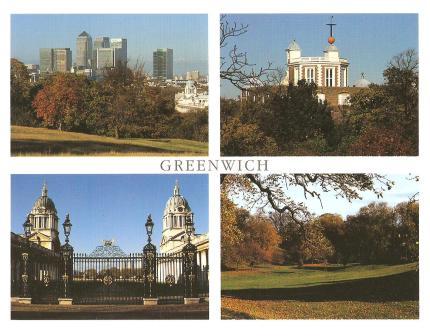
Greenwich - England

Greenwich is a town in south-east London, England, located in the historic county of Kent and the ceremonial county of Greater London. It is situated 5.5 miles (8.9 km) east-southeast of Charing Cross.
Greenwich is notable for its maritime history and for giving its name to the Greenwich Meridian (0° longitude) and Greenwich Mean Time.
In 1997 Maritime Greenwich was added to the list of World Heritage Sites, for the concentration and quality of buildings of historic and architectural interest. These can be divided into the group of buildings along the riverfront, Greenwich Park and the Georgian and Victorian town centre. - in: wikipedia
 
GB-1519362, sent by Sally.
Symmetrically arranged alongside the River Thames, the ensemble of the 17th century Queen’s House, part of the last Royal Palace at Greenwich, the palatial Baroque complex of the Royal Hospital for Seamen, and the Royal Observatory founded in 1675 and surrounded by the Royal Park laid out in the 1660s by André Le Nôtre, reflects two centuries of Royal patronage and represents a high point of the work of the architects Inigo Jones (1573-1652) and Christopher Wren (1632-1723), and more widely European architecture at an important stage in its evolution. It also symbolises English artistic and scientific endeavour in the 17th and 18th centuries.
Greenwich town, which grew up at the gates of the Royal Palace, provides, with its villas and formal stuccoed terraces set around St Alphege’s church rebuilt to Hawksmoor’s designs in 1712-14, a setting and approach for the main ensemble. 

 Inigo Jones’ Queen’s House was the first Palladian building in Britain, and also the direct inspiration for classical houses and villas all over the country in the two centuries after it was built.
The Royal Hospital, laid out to a master plan developed by Christopher Wren in the late 17th century and built over many decades by him and other leading architects, including Nicholas Hawksmoor, is among the most outstanding group of Baroque buildings in England.
The Royal Park is a masterpiece of the application of symmetrical landscape design to irregular terrain by André Le Nôtre. It is well loved and used by residents as well as visitors to the Observatory, Old Royal Naval College and the Maritime Museum.
The Royal Observatory’s astronomical work, particularly of the scientist Robert Hooke, and John Flamsteed, the first Astronomer Royal, permitted the accurate measurement of the earth’s movement and also contributed to the development of global navigation. The Observatory is now the base-line for the world’s time zone system and for the measurement of longitude around the globe. - in: https://whc.unesco.org

Saturday, April 23, 2022

Kinderdijk - The Netherlands

Kinderdjik was one of the many places I got to know about because of postcards. I never had much interrest on windmills, that's something we don't have in my region, but after visiting the Kinderdjik once and the Netherlands twice, I'm an huge fan now. 

The Mill Network at Kinderdijk-Elshout is a group of buildings in an exceptional human-made landscape in which the centuries-long battle of the Dutch people to drain parts of their territory and protect them against further inundation is dramatically demonstrated through the survival of all the major elements of the complex system that was devised for this purpose.

Construction of hydraulic works for the drainage of land for agriculture and settlement began in the Middle Ages and has continued uninterruptedly to the present day. 

© www.postcards-for-postcrossing.com
NL-5213522, sent by Frieda.
 
The property illustrates all the typical features associated with this technology: polders, high and low-lying drainage and transport channels for superfluous polder water, embankments and dikes, 19 drainage mills, 3 pumping stations, 2 discharge sluices and 2 Water Board Assembly Houses. The beautifully preserved mills can be divided into three categories: 8 round brick ground-sailers, 10 thatched octagonal smock mills, and one hollow post mill.

NL-4610496, sent by Janneke.
 The installations in the Kinderdijk-Elshout area demonstrate admirably the outstanding contribution made by the people in Netherlands to the technology of handling water.

© Aad Schenk
NL-2234384, sent by Martha.
The landscape is striking in its juxtaposition of its horizontal features, represented by the canals, the dikes, and the fields, with the vertical rhythms of the mill system. There is no drainage network of this kind or of comparable antiquity anywhere else in the Netherlands or in the world. - in: https://whc.unesco.org/en/list/818/

Friday, April 22, 2022

LU-84096

I've already posted a few Luxembourg cards here but this is the 1st time I'm posting an official card from this country.

LU-84096, sent by Sandra.
Notre-Dame Cathedral is the Roman Catholic Cathedral of Luxembourg City. It was originally a Jesuit church, and its cornerstone was laid in 1613. It is the only cathedral in Luxembourg.
The church is a noteworthy example of late gothic architecture; however, it also has many Renaissance elements and adornments. At the end of the 18th century, the church received the miraculous image of the Maria Consolatrix Afflictorum, the patron saint of both the city and the nation.
Around 50 years later, the church was consecrated as the Church of Our Lady and in 1870, it was elevated by Pope Pius IX to the Cathedral of Notre-Dame. - in: wikipedia

DE-11662831 & DE-11662819

Offcial cards from the German states of Mecklenburg-Vorpommern and Hesse.

 
© Weidelsburg Verlag
DE-11662831, sent by Marion.
The city centre of Neustrelitz is characterised by Baroque architecture. This Baroque church was part of the complex of the Neustrelitz Palace, which was destroyed in 1945. The church was built between 1855-1859.
 
 
© Schöning GmbH & Co. KG
  
DE-11662819, sent by Arno.
The small town of Bad Arolsen has also some examples of Baroque architecture. 
Arolsen Castle is a baroque-style schloss, built during the early 18th century. The castle is now a museum, and is still inhabited by Wittekind, Prince of Waldeck and Pyrmont and his family.

Tuesday, April 19, 2022

St. Peter's Square - Vatican

I've been to the Vatican in 2010 and that's when I sent from there my 1st written & stamped card from this independent city-state. The other cards were sent by Rita (2nd) and Eduardo (4th). Eduardo's card is also written & stamped from there. The 3rd card is an official french card which arrived with no stamps

St. Peter's Square is one of the largest and most beautiful squares in the world. It is located in Vatican City, at the feet of St. Peter's Basilica.
The dimensions of the square are spectacular: 320 meters long and 240 meters wide. In the liturgies and more noticeable events St. Peter's Square has held more than 300,000 people.

Photo: Massimo Cirilli
The construction of the square was carried out between 1656 and 1667 at the hand of Bernini, with the support of Pope Alexander XII.
 
FR-1408273, sent by Philo.
The most impressive part of the square, besides its size, are its 284 columns and 88 pilasters that flank the square in a colonnade of four rows. Above the columns there are 140 statues of saints created in 1670 by the disciples of Bernini.

2009 © Copyright by Plurigraf - Narni (Tr) Italy
In the centre of the square the obelisk and the two fountains, one of Bernini (1675) and another of Maderno (1614) stand out. The obelisk, which is 25 meters in height, was carried to Rome from Egypt in 1586.
The most spectacular way to arrive at St. Peter's Square is along the Via della Conciliazione, a long street that begins in the Castel Sant'Angelo. - in: https://www.rome.net/st-peters-square