Tuesday, April 23, 2019

ES-560414

The Greetings From cards have never really caught my attention, that's why I only have 5 of them. Is not that I don't like them, I like (don't worry Iria), I just never thought about starting to collect them. Right now I've Portugal, Spain, Poland, Germany and Finland cards. 

Designed by Ewa Slocinska
ES-560414, sent by Iria.
Facts about Spain:
- It has an area of 505 944 km² and a population of 46 423 064;
- Penélope Cruz, Salvador Dali, Pedro Almodóvar and Rafael Nadal Parera are some of the most famous spaniards;
- Spanish is the 2nd most spoken language in the world with 329 million native speakers worldwide;
- Tomatoes, potatoes, avocados, tobacco and cacao were all brought to Europe by the spaniards from their american colonies;
- The name "Spain" comes from the word "Ispania", which means "the land of rabbits";
- Mount Teide in Tenerife, is the highest mountain in Spain and Europe's largest volcano;
- Flamenco is a mix of a few cultures, namely Andalusian; Arabic; Sephardic; Islamic and Gipsy;
- There are over 6200 Postcrossing members in Spain. 

Friday, April 19, 2019

iSimangaliso Wetland Park - South Africa

Justyna put a lot of effort on this south african card. Even though the card was sent from Canada, she managed to use a Nelson Mandela stamp and wild african animal stickers and washi tape to decorate it. It was worth to wait for this new UNESCO card. 

Greater St. Lucia Wetland Park was how this park was known till 2007. Since then it's name is iSimangaliso Wetland Park and that's how you can find it on the WHS list.  

iSimangaliso Wetland Park is situated on the east coast of KwaZulu-Natal, South Africa, about 275 kilometres north of Durban. It is South Africa's third-largest protected area, spanning 280 km of coastline, from the Mozambican border in the north to Mapelane south of the Lake St. Lucia estuary, and made up of around 3,280 km2 of natural ecosystems.
The park was proclaimed a world heritage site because of the rich biodiversity, unique ecosystems and natural beauty occurring in a relatively small area. The reason for the huge diversity in fauna and flora is the great variety of different ecosystems on the park, ranging from coral reefs and sandy beaches to subtropical dune forests, savannas, and wetlands. Animals occurring on the park include elephant, African leopard, black and southern white rhino, buffalo, and in the ocean, whales, dolphins, and marine turtles including the leatherback and loggerhead turtle.
The park is also home to 1,200 Nile crocodiles and 800 hippopotami.
In December 2013, after 44 years of absence, African lions were reintroduced to iSimangaliso.[6]
There are large outcroppings of underwater reefs which are home to brightly coloured fish and corals. Some of the most spectacular coral diversity in the world is located in Sodwana Bay. The reefs are inhabited by colour-changing octopuses and squid ready to ambush unsuspecting prey. Occasionally gigantic whale sharks can be seen gliding through the water, mouth agape to scoop up tiny plankton.
Twenty-four species of bivalve molluscs are recorded in St. Lucia Lake, which constitutes a considerable portion of the park. - in: wikipedia

Tuesday, April 16, 2019

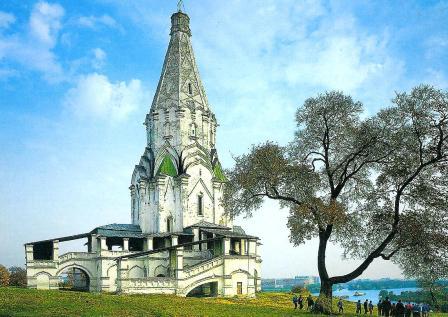
Church of the Ascension, Kolomenskoye - Russia

The Church of the Ascension in Kolomenskoye is one of the most significant architectural monuments of the XVI century in Russia. It is a part of the large architectural museum complex "Kolomenskoye".
The church was inscribed on the UNESCO WHS list in 1994. 

RU-7223219, sent by Maria.
The Church of the Ascension was built in 1532 on the imperial estate of Kolomenskoye, near Moscow, to celebrate the birth of the prince who was to become Tsar Ivan IV ('the Terrible'). 

One of the earliest examples of a traditional wooden tent-roofed church on a stone and brick substructure, it had a great influence on the development of Russian ecclesiastical architecture. - in: https://whc.unesco.org/en/list/634

St. Alexander Nevsky Cathedral - Bulgaria

I didn't receive any postcards from Bulgaria since 2015!! After 4 years,  I finally received another card from there thanks to Ana who visited the country a few weeks ago. I don't really know why but I also would like to visit the country, it has been on my must visit for some years now. 

Ana sent the postcard of the aerial view of the Alexandre Nevsky Cathedral. The other two were sent in 2011 by Christina and Lilia.

Photo: BulFoto Agency
The gold-domed Alexander Nevsky Cathedral was built in the early 20th century in memory of the 200,000 Russian, Ukrainian, Belorussian and Bulgarian soldiers, who died in the Russo-Turkish War, 1877–1878. It is one of the largest Eastern Orthodox cathedrals in the world. 

The St. Alexander Nevsky Cathedral is a Bulgarian Orthodox cathedral in Sofia, the capital of Bulgaria. Built in Neo-Byzantine style, it serves as the cathedral church of the Patriarch of Bulgaria and is one of the largest Eastern Orthodox cathedrals in the world, as well as one of Sofia’s symbols and primary tourist attractions.
The St. Alexander Nevsky Cathedral in Sofia occupies an area of 3,170 square metres (34,100 sq ft) and can hold 10,000 people inside. It is the second biggest cathedral located on the Balkan Peninsula after the Cathedral of Saint Sava in Belgrade.


The Alexander Nevsky Cathedral is a cross-domed basilica featuring an emphasized central dome. The cathedral’s gold-plated dome is 45 m high (148 ft),
with the bell tower reaching 53 metres (174 ft).The temple has 12 bells with total weight of 23 tons, the heaviest weighing 12 tons and the lightest 10 kilograms (22 lb). The interior is decorated with Italian marble in various colours, Brazilian onyx, alabaster, and other luxurious materials. The central dome has the Lord’s Prayer inscribed around it, with thin gold letters. - in: http://www.sofia-guide.com/attraction/alexander-nevsky-cathedral/

Thursday, April 11, 2019

Spiš Castle - Slovakia

Another well preserved medieval town to add to a list of places to visit in Slovakia, is Spišská Kapitula. This ecclesiastical town is located on the outskirts of Spišské Podhradie and overlooks Spiš Castle. The town consists of St. Martin's Cathedral (dedicated to St. Martin of Tours); a former monastery; and a single street, all of mediaeval construction and enclosed by a wall.
The cathedral was built between the 13th and 15th centuries in the Romanesque and Gothic styles. It is one of the largest and most interesting Romanesque monuments in Slovakia. It contains many mediaeval carved altars and is the resting place of many lords of Spiš Castle. - in: wikipedia

Photo by Alexander Jirousek
SK-21635, sent by Natasa.
Classified as a National Cultural Monument, Spiš Castle with its area of more than four ha, and partially in ruins, is one of the largest castle compounds in Central Europe.
Construction of the medieval castle on a travertine hill dates back to the beginning of the 12th century.
In the second half of the 15th century the reconstruction of the castle fell upon its new owner Štefan Zápoľský whose intention was to remake it into a stately aristocratic residence. He had made a palace, a knight hall and chapel of St Elisabeth in the castle. His son Ján, later King of Hungary was born at the Castle.
The last building works at the Upper Castle were made under the orders of the Thurzos' and the Csákys'.

In 1780 the castle compound was destroyed by fire and the proud Spiš Castle gradually fell into ruins. The total decay of the castle was prevented only through the intervention of conservationists who in 1970 got down to the difficult job of preserving the walls and palaces threatened by the instability of its rocky base.
At present there are the collections of the Spišské múzeum placed in the castle documenting its history, along with medieval arms and feudal jurisdiction. - in: http://www.slovakia.travel/entitaview.aspx?l=2&idp=2105

Bardejov - Slovakia

Collecting UNESCO cards has made my must visit list much longer than I ever thought. A medieval town like Bradejov really fits the category of places I like to visit. Maybe one day I get to explore some of Slovakia's UNESCO sites. 

The town of Bardejov, located in north-eastern Slovakia, is a small but exceptionally complete and well-preserved example of a fortified medieval town, which typifies the urbanisation in this region. 

Bardejov is dominated by the monumental church of St. Aegidius, mentioned for the first time in 1247. A three nave basilica with multiple chapels was completed by the 15th century. It hosts eleven precious Gothic winged altars with panel paintings. - in: wikipedia

Foto © Alexander Jirousek
SK-176246, sent by Branislav.
The unspoiled town cobbled square is a picture postcard view of town life in late medieval and early renaissance Europe. The dominant theme is rows of affluent merchants’ houses of German influence, each with its own variations of pastel colouring, roofing and other details. - in: https://www.slovakia.com/bardejov/

Jægersborg Dyrehave - Denmark

One of the most frustrating things for an UNESCO card collector is probably to visit a missing site and can't find any cards of it. That was what happened to visit when I visited Jægersborg Dyrehave, a park north of Copenhagen. This park was one of the three forests included on the UNESCO WHS list inscribed as Par force hunting landscape in North Zealand in 2015. 
I've never seen cards from this place before and they seem quite hard to get. I was hoping to find some cards there but came back empty handed :( I actually saw a few oldish black and white cards in a... closed store. 
Doris had the same problem, couldn't find cards, so she had a few cards printed with some pictures she took there. This one shows a burial mound in Jægersborg Hegn.

Photo by Doris
Dyrehaven, which literally means "the deer park", is a natural resort filled with lush forests, small lakes and wide, open landscapes. As the name might reveal, Dyrehaven is renowned for the more than 2000 free range deer that inhabit the park, and you'll surely come across a herd of grazing deer on your way through. 
Besides from the beautiful landscape, Dyrehaven also has a significant history that dates back hundreds of years. In 2015, Dyrehaven was recognized as a UNESCO World Heritage Site as part of the par force landscape that was once used for hunting by the Danish royalty. - in: https://www.visitcopenhagen.com/copenhagen/deer-park-gdk414367
Bronze Age burial mounds are scattered throughout the large Dyrehaven park. In the forests near the amusement park, by the palace and dotted about individually and in groups. The landscape surrounding the Eremitage Palace is also interesting because is clearly resembles the open landscape of the Bronze Age, with scattered trees, copses and the clearly visible burial mounds. Farther north, in Jægersborg Hegn, the burial mounds have been embraced by the forest. - in: http://www.kulturarv.dk/1001fortaellinger/en_GB/jaegersborg-dyrehave-and-jaegersborg-park