Tuesday, February 25, 2020

Uluru - Australia

Another Australian symbol can be seen in the  in the Northern Territory of Australia. The huge monolith of Ayers Rock, which the Aborigenes call Uluru in their own language, is one of the most visited places in the country. Uluru is protected in the Uluṟu-Kata Tjuṯa National Park. The park classified as  UNESCO World Heritage Sites since 1987.

This park, formerly called Uluru (Ayers Rock – Mount Olga) National Park, features spectacular geological formations that dominate the vast red sandy plain of central Australia. Uluru, an immense monolith, and Kata Tjuta, the rock domes located west of Uluru, form part of the traditional belief system of one of the oldest human societies in the world. The traditional owners of Uluru-Kata Tjuta are the Anangu Aboriginal people. - in: https://whc.unesco.org/en/list/447


AU-100909, sent by Kevin.
Don't test your eyes, i'll copy the text on the card: "Found 350 km south-west of Alice Springs, the world's largest monotlith lies in stark contrast to its flat desert surrounds. Uluru is 343 metres high, 3.6 kms long, 2.4 kms wide, 8 kms in circumference and contrary to popular belief is not a single stone, but one of three surviving peaks of an ancient mountain range.
Steeped in ancient aboriginal mythology, Uluru means Meeting Place, sacred home to the many Dreamtime legends which are decipted in paintings and carvings around the rock.
The colour of the rock appears to change continuously, with sunrise and sunset, the best time to capture the most powerful reads and golds. Thought to be 600 million years old, visitors see just a small fraction of what must be under the surface. Some geologists believe that the roots actually go down more than 600 metres."

Koalas - Australia

The fires, which started in early September in Australia, killed 25 people, destroyed more than 2,000 homes and left thousands and thousands of animals dead. One of the most affected was the koala, one of the country's symbols. It is estimated that more than 25,000 koalas have died, and Australians fear that the fate of their favorite animal may end in functional extinction.
If someone wants to help a Koala, it is possible to adopt rescued animals from the fires, through Koala Hospital and Australia Koala Foundation.

Photo: C. Andrew Henley / LARUS
AU-348150, sent by Lisa.
Along with the kangaroo, the koala is the most famous animal ambassador of Australia.
Though often called the koala "bear," this cuddly animal is not a bear at all; it is a marsupial, or pouched mammal. After giving birth, a female koala carries her baby in her pouch for about six months. When the infant emerges, it rides on its mother's back or clings to her belly, accompanying her everywhere until it is about a year old.
Koalas live in eastern Australia, where the eucalyptus trees they love are most plentiful. In fact, they rarely leave these trees, and their sharp claws and opposable digits easily keep them aloft. During the day they doze, tucked into forks or nooks in the trees, sleeping for up to 18 hours.
When not asleep a koala feeds on eucalyptus leaves, especially at night. Koalas do not drink much water and they get most of their moisture from these leaves. Each animal eats a tremendous amount for its size—about two and a half pounds (one kilogram) of leaves a day. Koalas even store snacks of leaves in pouches in their cheeks.


Photograph: Constantin Stanciu
AU-705297, sent by Julia.
A special digestive system—a long gut—allows koalas to break down the tough eucalyptus leaves and remain unharmed by their poison. Koalas eat so many of these leaves that they take on a distinctive odor from their oil, reminiscent of cough drops.
These plump, fuzzy mammals were widely hunted during the 1920s and 1930s, and their populations plunged. Helped by reintroduction, they have reappeared over much of their former range, but their populations are smaller and scattered. Koalas need a lot of space—about a hundred trees per animal—a pressing problem as Australia's woodlands continue to shrink. - in: http://animals.nationalgeographic.com/animals/mammals/koala/

Friday, February 21, 2020

Olympia - Greece

Rita and Joaninha have been to Greece in 2011 and 2012. Rita spent a weekend in Athens, where she found Olympia cards and Joaninha was there on a cruise and visited the archaeological site, a new UNESCO on her visited list. 

Summer Dream Editions
The sanctuary of Olympia, in the North West of the Peloponnese, in the Regional Unit of Eleia (Elis), has been established in the valley created by the confluence of the Alpheios and Kladeos rivers in a natural setting of beauty and serenity. The Pan-Hellenic sanctuary has been established in the history of culture, as the most important religious, political and sports centre, with a history that dates back to the end of the Neolithic times (4th millennium BC). The famous sanctuary became the centre of worship of Zeus, the father of the twelve Olympian gods. 

Summer Dream Editions
For the Altis, the sacred grove and the centre of the sanctuary, some of the most remarkable works of art and technique have been created, constituting a milestone in the history of art. Great artists, such as Pheidias, have put their personal stamp of inspiration and creativity, offering unique artistic creations to the world. In this universal place, the Olympic Idea was born, making Olympia a unique universal symbol of peace and competition at the service of virtue. Here, too, prominence was given to the ideals of physical and mental harmony, of noble contest, of how to compete well, of the Sacred Truce; values, which remain unchanged in perpetuity. - in: https://whc.unesco.org/en/list/517/

Archaeological Site of Philippi - Greece

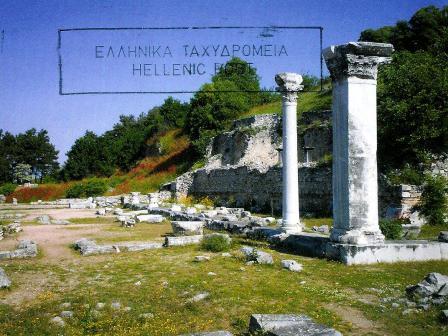
New UNESCO site in my collection, thanks to Miguel. 
The Archaeological Site of Philippi, the most important one in the Eastern Macedonian area of Greece, is on UNESCO’s list of World Heritage Monuments since 2016. 

Photo by A. Pistevou
The remains of this walled city lie at the foot of an acropolis in north-eastern Greece, on the ancient route linking Europe and Asia, the Via Egnatia. Founded in 356 BC by the Macedonian King Philip II, the city developed as a “small Rome” with the establishment of the Roman Empire in the decades following the Battle of Philippi, in 42 BCE. The vibrant Hellenistic city of Philip II, of which the walls and their gates, the theatre and the funerary heroon (temple) are to be seen, was supplemented with Roman public buildings such as the Forum and a monumental terrace with temples to its north. Later the city became a centre of the Christian faith following the visit of the Apostle Paul in 49-50 CE. The remains of its basilicas constitute an exceptional testimony to the early establishment of Christianity. - in: https://whc.unesco.org/en/list/1517

Baltic Sea - Poland

Poland may not be the first seaside destination that comes to mind when booking your summer holiday, but the country’s northern coast, bathed by the Baltic Sea, is filled with wide sandy beaches and charming coastal towns.


Baltic coastline in Poland is 788 kilometers long and is a tourist heaven. 

Apart from the usual golden beaches, studded with pieces of amber, the windy call of the sea and photogenic cliffs, the coastline is dotted with historical towns and cute fishing hamlets-each providing a wonderful opportunity to get lost, willingly, from the hustle-bustle of a calibrated lifestyle, for a couple of days. - in: http://www.polandforvisitors.com/travel_poland/baltic_resorts

Tuesday, February 18, 2020

PL-1664040

The royal Castle Bobolice is one of the most beautiful fortresses on the Eagles' Nests trail.
It was built around 1350 by king Casimir the Great as part of the defense system of the western border of the Kingdom of Poland.

Foto: Krzysztof Kaminski
PL-1664040, sent by Hark.
The castle and its surrounding suffered heavily during repeated invasions. The most dramatic of the invasions was the Swedish Deluge, which took place in the 16th century and left the castle in a state of great destruction. From that time onwards the castle continued to deteriorate in its state. 
Now, after years of reconstructions, Bobolice Castle has been returned to its former glory. As in the centuries before, the development of the castle provokes the development of the whole neighbourhood. Not only does the village of Bobolice now boast a hotel and restaurant, but it has also become one of the most popular and attractive places on the tourist map of Poland. - in: http://www.zamekbobolice.pl/history.html

Monday, February 17, 2020

DE-8963600

The ID on this card is German but the card is from Sweden. 

Christian Bäck
DE-8963600, sent by Jörg.
Lysekil is a town in the western coast of Sweden.
Originally a small fishing village, it developed into a town for fishing industries, commercial shipping and trade during the 18th and 19th centuries. 
During the 19th century, Lysekil was established as a prominent spa and bathing resort and tourism still makes up a large part of the town's economy. - in: wikipedia