Monday, July 1, 2013

EE-156543

The last time i've received a card from Estonia, was probably more than 1 year ago :o I've sent a couple of official cards to Estonia not so long ago but getting cards from there doesn't happen that often.

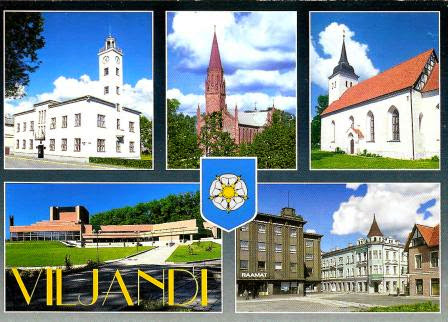
EE-156543, sent by Ly.
Viljandi is a town and municipality in southern Estonia. It is the capital of Viljandi County. The town was first mentioned in 1283, upon being granted its town charter by Wilhelm von Endorpe. The town became a member of the Hanseatic League at the beginning of the 14th century, and is one of five Estonian towns and cities in the league. - in: wikipedia

Thursday, June 27, 2013

FI-1775209, FI-1762622 & FI-1787674

After finnish Unesco sites, i've finnish official cards.

 Photos by: Seppo I. Myllyviita
FI-1775209, sent by Tiina.
Lauhanvuori National Park is a national park in the Southern Ostrobothnia region of Finland, on the border of Kauhajoki and Isojoki. It was established in 1982 and covers 53 square kilometres (20 sq mi).
The park is characterized by its pine forestland, spring brooks, and swamps. - in: wikipedia

 Photo by: Markku Roisko
FI-1762622, sent by Marja-Leena.
This is Hämeenlinna's Lutheran Church. It was built in 1798 as a rotunda modelled on the Pantheon in Rome.

FI-1787674, sent by Eeva.
Interresting facts about Helsinki:
  • In Helsinki, the population of women is greater than that of men, with men constituting around 46.6 per cent of the population and women making up around 53.4 percent.
  • Helsinki is one of the coldest cities in the world, as it does not receive sunshine for about consecutive 51 days in winters.
  • Helsinki has the highest cellphone-to-resident ratios in the world. The world’s leading manufacturer of cell phones, Nokia, is based in Finland.
  • Between June and mid-September, there are special teams of uniformed men deployed all over the city known as the ‘Helsinki Helpers’. These forces are identified by their green uniforms and are meant to dispense advice or information about the city, the city’s maps and everyday life in Helsinki.
  • The city of Helsinki was founded at the mouth of the river Vantaa, by the decree of the King Gustav Vasa of Sweden, in the year 1550. However, the city was eventually moved from there to the present location, in the year 1643.
  • Helsinki has been the capital of Finland since 1812. - in: http://lifestyle.iloveindia.com/lounge/facts-about-helsinki-1917.html
  • Finnish Unesco WHS

    I already have all the finnish Unesco sites but that's always great to receive different views of those places. Both of these cards were sent by Katy.

     The Bronze Age cairn cemetery of Sammallahdenmäki in Lappi was the first Finnish archaeological site to be included in the UNESCO World Heritage List in December 1999. Sammallahdenmäki was chosen to the list as the finest Western Bronze Age site in Finland and Scandinavia.
    The Sammallahdenmäki site is located in Lower Satakunta in the village of Kivikylä, Lappi parish. The site consists of a cluster of 33 stone cairns spread out over an area nearly one kilometre in length.
    Sammallahdenmäki is an exceptionally valuable example of Finland’s Bronze Age culture because it presents the ancient monuments in a well-preserved natural milieu. The area contains nearly all known types of Bronze Age cairns known from Finland and the surroundings still have an air of the original archipelago landscape with its lichen-covered cliffs and gnarled, weather-beaten pines. -in: http://www.nba.fi/en/cultural_environment/archaeological_heritage/maintenance/maintained_sites/sammallahdenmaki
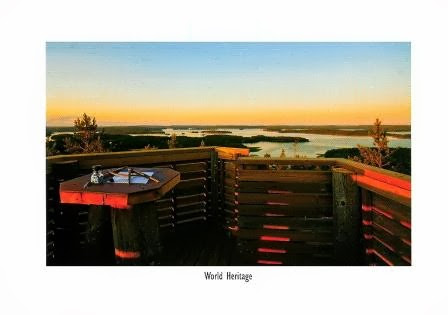
    A nice view from the Oravivuori triangulation tower, one of the six Struve Geodetic Arc points in Finland.

    Wednesday, June 26, 2013

    Flekkefjord - Norway

    Last month Joaninha traveled to Norway (envy) and she sent me this card from there.
    Flekkefjord is a town in the county of Vest-Agder, southern Norway.

    © Aune Forlag AS - Foto: Arne Lunde
    Flekkefjord church it is an octagonal wooden church drawn by the architect H. F. D. Linstow and built in 1833.  

    Tuesday, June 25, 2013

    Norwegian's Unesco WHS

    A few months ago Jo was offering some of Norway's Unesco sites and he accepted to trade with me. Now i'm only missing 1 site from this country, the Vega Archipelago.
    The Rock carvings at Alta were inscribed on the Unesco WHS in 1985 and the Struve Geodetic Arc in 2005.

    © TO-FOTO AS. - Photo by Tommy Simonsen
     The Rock art of Alta are located in and around the municipality of Alta in the county of Finnmark in northern Norway. Since the first carvings were discovered in 1972, more than 6000 carvings have been found on several sites around Alta. The largest locality, at Jiepmaluokta about 4 kilometres outside of Alta, contains many thousand individual carvings and has been turned into an open-air museum. The site, along with the sites Storsteinen, Kåfjord, Amtmannsnes and Transfarelv, was placed on the UNESCO list of World Heritage Sites on 3 December 1985. It is Norway's only prehistoric World Heritage Site. - in: wikipedia

    © Aune Forlag AS - Photo by Lars Mathisen
    This is the northernmost station of the Struve Geodetic Arc, located in Fuglenes, Hammerfest.

    4th Annual London Meeting @ Oxford

    Last May in Oxford took place the 4th Annual London PC Meeting, which gathered a few postcrossers from different countries. Heidi and Laerke sent me these 2 great Oxford cards, my 1st from this university city.

     © 2012 Chris Andrews Publications Ltd.
    Oxford is a city in central southern England, known worldwide as a university town and home of the University of Oxford, the oldest university in the country and the English-speaking world. Although its exact date of foundation is unclear, there is evidence of teaching as far back as 1096.
    This card shows Christ Church Cathedral, a romasnesque-gothic temple built between 1160-1200. It is also the chapel of Christ Church, a college of the University of Oxford.


    © 2012 Chris Andrews Publications Lta
    This one shows Radcliffe Camera and St. Mary's Church.
    The Radcliffe Camera, built 1737–1749 as Oxford's science library, now holds books from the English, History, and Theology collections.
    The University Church of St Mary the Virgin is the largest of Oxford's parish churches and the centre from which the University of Oxford grew. It is situated on the north side of the High Street, and is surrounded by university and college buildings. - in: wikipedia

    Saturday, June 22, 2013

    Scotish Castles

    If i had to chose a few favorites among my more than 6000 cards, these would be in my top 20. They're soooo beautiful. That's because of places like these that i want to visit Scotland.
    These cards were sent by Gracinha.

     © David Lyons
    As one of the most iconic images of Scotland, Eilean Donan is recognised all around the world. Situated on an island at the point where three great sea lochs meet, and surrounded by some majestic scenery, it is little wonder that the castle is now one of the most visited and important attractions in the Scottish highlands.
    Although first inhabited around the 6th century, the first fortified castle was built in the mid 13th century and stood guard over the lands of Kintail. Since then, at least four different versions of the castle have been built and re-built as the feudal history of Scotland unfolded through the centuries.
    Partially destroyed in a Jacobite uprising in 1719, Eilean Donan lay in ruins for the best part of 200 years until Lieutenant Colonel John MacRae-Gilstrap bought the island in 1911 and proceeded to restore the castle to its former glory. After 20 years of toil and labour the castle was re-opened in 1932. - in: http://www.eileandonancastle.com/

     © Andy Williams
    Ben Nevis is the highest mountain in the British Isles. The castle shown on the card is the Inverlochy Castle Hotel, a baronial mansion was built in 1863 by James Scarlett, 1st Baron Abinger. It is located about two miles away from the 13th century Inverlochy Castle, after which it was named.
     Queen Victoria spent a week at Inverlochy during an 1873 visit to Balmoral, remarking "I never saw a lovelier or more romantic spot". The house has been used as a hotel since 1969. It was voted "best hotel in Europe" by Travel + Leisure magazine in 2006. - in: wikipedia