Monday, November 29, 2010
Almeirim - Portugal
Typical Frisian House

The 2nd german card of the day is this christmasy RAS card from Claus. He went to spend a few days on the Amrum Island, one of the North Frisian Islands on the German North Sea coast. Even if i don't like Christmas, this typical house with a snowy tree outside, makes me wish for a white Christmas.DE-755932

Sunday, November 28, 2010
FI-954620
FI-954620, sent by Jenni.Déa's cards
This 1st card is from Belém, the capital city of the northest state capitals, located in the delta of Amazonas river. These are beautiful colorful colonial houses situated by the old port. Some of them have been restored to serve as museums and others as restaurants.
And now a beautiful view of Campos do Jordão, a city in the interior of São Paulo state.
This is another card from São Paulo.Wednesday, November 24, 2010
Budapest - Hungary
Indonesia's cards

This 1st card is from Bali with a black sand beach on the east of the island.
Pangandaran is a small town in West Java, located on the southern coast of Java. Pangandaran is a popular tourist destination, having a beach which is considered to be one of the finest in Java and which offers excellent surfing.
"Mount Merapi is an active stratovolcano located on the border between Central Java and Yogyakarta. It is the most active volcano in Indonesia and has erupted regularly since 1548. It is located approximately 28 kilometres (17 mi) north of Yogyakarta city, and thousands of people live on the flanks of the volcano, with villages as high as 1,700 metres (5,600 ft) above sea level.On the afternoon of 25 October 2010 Mount Merapi erupted lava from its southern and southeastern slopes.
After a period of multiple eruptions considered to exceed the intensity and duration of those in 1872 on 10 November 2010 the intensity and frequency of eruptions was noticed to subside. By this time 153 people had been reported to have been killed and 320,000 were displaced. Later the eruptive activities again increased requiring a continuation of the Level 4 alert and continued provision of exclusion zones around the volcano. By 18 November the death toll had increased to 275." - in: wikipedia
RU-261028
After the war, the cathedral remained a burnt out shell and Kneiphof was made into a park with no other buildings.
Friday, November 19, 2010
US-896274

FI-946252

FI-946252, sent by Pirjo.PL-144065

PL-144065, sent by Judyta.The card shows the town hall, a neogothic building planned by Karld Friedrich Schinkel as a substitute for the destroyed predecessor. It was built 1829-1832.
Birka - Sweden

Chengde Mountain Resort - China

Built between 1703 and 1792, the Mountain Resort took 89 years to complete. It covers a total area of 5.6 km², almost half of Chengde's urban area. It is a vast complex of palaces and administrative and ceremonial buildings. Temples of various architectural styles and imperial gardens blend harmoniously into a landscape of lakes, pastureland and forests.
The Kangxi, Qianlong and Jiaqing Emperors often spent several months a year here to escape the summer heat in the capital city of Beijing. It consists of two parts: a court in front, where the emperor received high officials, nobles of various minority nationalities, and foreign envoys; and bed chambers in the rear, which were the imperial family's living quarters.
The Mountain Resort is most famous for the 72 scenic spots which were named by the Kangxi and Qianlong Emperors. Many of the scenic spots around the resort's lake area were copied from famous landscaped gardens in Southern China. The resort's plain area also possesses characteristics of the scenery of the Mongolian grasslands. Forested mountains and valleys are dotted with various buildings. This includes a 70 m tall stone Chinese pagoda, one of the tallest in China, built in the year 1751 during the reign of the Qianlong Emperor.
In December 1994 the Mountain Resort was listed by Unesco on its list of World Heritage Sites. On May 8, 2007, the Mountain Resort and its Outlying Temples, Chengde was approved by the China National Tourism Administration as one of the "5A-class tourist attractions" which represents the highest standards for China's tourist attractions." - in: wikipedia
Thursday, November 18, 2010
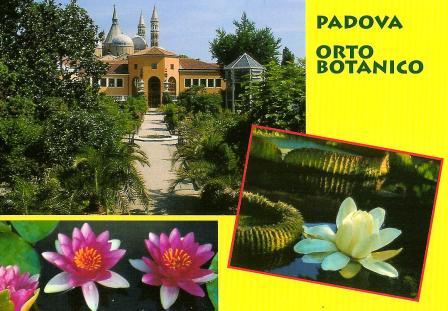
Padua's Botanical Garden
The Orto Botanico di Padova is the world's oldest academic botanical garden that is still in its original location. It is located in Padua, Italy and was founded in 1545. The garden, affiliated with the University of Padua, currently covers roughly 22,000 square meters, and is known for its special collections and historical design.

The Garden at Padova was founded upon deliberation of the Senate of the Venetian Republic. It was devoted to the growth of medicinal plants, the so-called "simple plants" which produced natural remedies, and also to help students distinguish legitimate medicinal plants from false ones.Wednesday, November 17, 2010
The Great Barrier Reef

"The Great Barrier Reef is the world's largest reef system composed of over 2,900 individual reefs and 900 islands stretching for over 2,600 kilometres (1,600 mi) over an area of approximately 344,400 square kilometres (133,000 sq mi). The reef is located in the Coral Sea, off the coast of Queensland in north-east Australia.Monday, November 15, 2010
Anne's Unesco cards
The Residences of the Royal House of Savoy is a group of structures in Turin and its province, in Piedmont (northern Italy, added to the UNESCO World Heritage Sites list in 1997. The Palazzo Madama in Turin is one of the classified proporties. "At the beginning of the first century BC, the site of the palace was occupied by a gate in the Roman walls. After the fall of the Western Roman Empire, the gate was used as a fortified stronghold in the defences of the city. Later the building became a possession of the Savoia-Acaja, a secondary branch of the House of Savoy; in the early fourteenth century, they enlarged it into a castle. After the extinction of the Acajas, the edifice became a residence for guests of the house of Savoy.
In 1637 the regent for Duke Charles II Emmanuel, Christine Marie of France, chose it as her personal residence. She commissioned the covering of the court and a revamping of the inner apartments. Sixty years later another regent, Marie Jeanne of Savoy, lived in the palace, conferring upon it definitively the nickname of Madama (Italian for Madame).
Later the palace had various uses, and housed the headquarters of the provisional French government during the Napoleonic Wars. In the 19th century King Charles Albert selected it as seat of the Pinacoteca Regia, the royal art gallery, and, later, of the Subalpine Senate (the Parliament of the Kingdom of Sardinia) and of the High Court. Since 1934 it has housed to the City Museum of Ancient Art." - in: wikipedia
I wanted this card just because its beautiful. Not so long ago i've received another Edinburgh Castle card. After 2 cards and after hearing 2 friends talking about Edinburgh, i really believe that the city is a place worth to visit. This view of the castle can be seen from the Princes Street Gardens, a public park in the centre of Edinburgh, in the shadow of Edinburgh Castle. The Gardens were created in the 1820s following the long draining of the Nor Loch and the creation of the New Town. The Nor Loch was a large loch in the centre of the city. It was heavily polluted from centuries of sewage draining downhill from the Old Town.
Unescos from FR & BE
"The Saline Royale (Royal Saltworks) is a historical building at Arc-et-Senans in the department of Doubs, eastern France. The architect was Claude-Nicolas Ledoux (1736–1806), a prominent Parisian architect of the time. The work is an important example of an early Enlightenment project in which the architect based his design on a philosophy that favored arranging buildings according to a rational geometry and a hierarchical relation between the parts of the project.
"The Plantin-Moretus Museum is a museum in Antwerp, Belgium honouring the famous printers Christoffel Plantijn and jan Moretus. It is located in their former residence and printing establishment, Plantin Press, at the Friday Market.Felix Romuliana - Serbia
"Early explorers believed the ancient ruins to have been a Roman military camp, because of their size and numerous towers. Systematic archaeological excavations conducted since 1953 revealed that the site was, in fact, an Imperial palace. It was conceived and built by one of the Tetrarchs, Emperor Galerius, the adopted son and son-in-law of the great Emperor Diocletian. Galerius started construction in 298 (after a victory over the Persians that brought him admiration and glory) to mark the place of his birth. The name Felix Romuliana was given in memory of his mother Romula, who was also a priestess of a pagan cult. The complex of temples and palaces served three main purposes - a place of worship of his mother’s divine personality, a monument to his deeds as emperor, and a luxurious villa for Galerius. Romuliana survived until it was plundered by the Huns in the mid 5th century. Later the site became a humble settlement of farmers and craftsmen, finally to be abandoned at the beginning of the 7th century with the arrival of the Slavs.
Archaeological excavations on the site have unearthed the remains of a Roman compound with 2 temples, 2 palaces and a building with corridor including exceptionally fine mosaics depicting Greek gods Dionysos and Medusa, figural capitals of Hercules, baths and impressive gates. Several valuable hoards of Roman gold coins have been unearthed at the site, which continues to yield important Roman treasures and artifacts." - in: wikipediaMoscow cards
"The Moscow Kremlin is a historic fortified complex at the heart of Moscow, overlooking the Moskva River (to the south), Saint's Basil's Cathedral and Red Square (to the east) and the Alexander Garden (to the west). It is the best known of kremlins (russian citadels) and includes four palaces, four cathedrals and the enclosing Kremlin Wall with Kremlin Towers. The complex serves as the official residence of the President of Russia.

The existing Kremlin walls and towers were built by Italian masters over the years 1485 to 1495. The irregular triangle of the Kremlin wall encloses an area of 275,000 square meters (68 acres). Its overall length is 2235 meters (2444 yards), but the height ranges from 5 to 19 metres, depending on the terrain. The wall's thickness is between 3.5 and 6.5 meters. Originally there were eighteen Kremlin towers, but their number increased to twenty in the 17th century. All but three of the towers are square in plan. The highest tower is the Spasskaya.The Spasskaya Tower is the main tower with a through-passage on the eastern wall of the Moscow Kremlin, which overlooks the Red Square. It was built in 1491. The Spasskaya Tower was the first one to be crowned with the hipped roof in 1624–1625 by architects Bazhen Ogurtsov and Christopher Galloway. According to a number of historical accounts, the clock on the Spasskaya Tower appeared between 1491 and 1585. It is usually referred to as the Kremlin clock.
In 1935, the Soviets installed a red star instead of a two-headed eagle on top of the Spasskaya Tower. The height of the tower with the star is 71 m. In August 2010 above the gate the icon of Savior Smolensky was restored.
Cathedral Square is the heart of the Kremlin. It is surrounded by six buildings, including three cathedrals. The Cathedral of the Dormition was completed in 1479 to be the main church of Moscow and where all the Tsars were crowned. Several important metropolitans and patriarchs are buried there, including Peter and MakariiFriday, November 12, 2010
Anchorage - Alaska
Poznan's Cathedral

"fficially called the Archicathedral Basilica of St. Peter and St. Paul, but commonly referred to as just The Cathedral, the cathedral is the oldest not only in Poznan, but in all of Poland. Some of the important historical Polish rulers buried here include Mieszko I and II, Boleslaus the Brave, Casimir the Restorer, and Przemysl I and II. The pre-Romanesque cathedral was built in the second half of the 10th century, and was rebuilt and added onto many times throughout its more than thousand year history." - in: http://www.poznan-life.com/culture/culture_details/84-The_CathedralThursday, November 11, 2010
Terracotta Army - China

"The Terracotta Army is a collection of terracotta sculptures depicting the armies of Qin Shi Huang, the First Emperor of China.
The figures, dating from 210 BC, were discovered in 1974 by some local farmers near Xi'an, Shaanxi province, China near the Mausoleum of the First Qin Emperor.
The figures vary in height 1.83–1.95 metres (6.0–6.4 ft), according to their roles, with the tallest being the generals. The figures include warriors, chariots, horses, officials, acrobats, strongmen, and musicians. Current estimates are that in the three pits containing the Terracotta Army there were over 8,000 soldiers, 130 chariots with 520 horses and 150 cavalry horses, the majority of which are still buried in the pits." - in: wikipedia
Unesco cards from Morocco
The Medina of Fes, Fes el Bali, is the oldest and walled part of Fez, Morocco. Fes el Bali is the larger of the two medinas of Fes. Fes el Bali was classified as a Unesco World Heritage Site in 1981.The workers stand in the stone vessels arranged like honeycombs, filled with different dyes, dying the arms and legs of the men. The hides are first soaked in diluted acidic pigeon excrement and then transferred to other vessels containing vegetable dyes such as henna, saffron and mint. When the dying process has been completed the hides are dried on the roofs of the Medina." - in: http://www.technologystudent.com/culture1/fez1.htm

On this card there's the gate and the palace of the Alorna Farm. The history of this farm dates back to the 18th century.


RU-261028, sent by Stef.