Showing posts with label Albania. Show all posts

Friday, September 2, 2022

PT RR - Surprise Group * July 22

 Cards written in Portuguese but from different countries.


Nídia sent me a card from Castro Daire, a city I've never been to. 
The Pedrinha Bridge, built in the 2nd half of the 19th century, replaced another that existed previously, built by the Romans, allowing the connection from Lamego to Viseu, overcoming the barrier that the Paiva River represented. 
On the card is also possible to see the roof and the millstone of an old watermill.


Lake Maggiore extends from the Italian-speaking part of Switzerland far into the Italian regions of Piedmont and Lombardy. Thanks to its mild climate, there is lush, Mediterranean vegetation along its shores. In the hinterland is a wild and romantic mountain landscape with breathtaking views. - in: https://www.myswitzerland.com 
Card sent by Pedro. 

 
© concept by Postcardsmarket.com

Once again Eric surprised me with a new FOTW card. He has been helping me a lot on this collection.
Albania has an area of 28.748 km², a population of 2.886.026 and its capital is Tirana. 
Unique: 
* Religious tolerance - the Muslim majority and other minorities like Catholics and Orthodox live in peace;  
* Hospitality - Albania is one of the friendliest countries in the world;  
Famous:  
* Mother Teresa - Roman Catholic nun and missionary. 1979 Nobel Peace Prize winner;
* Ferid Murad - physician co-winner of the 1998 Nobel Prize in Medecine; 
History:  
* Formation - 1190 - Principality of Albanon; 1368 - Princedom of Albania; 1912 - Proclamation of the Independence from the Ottoman Empire; 1928 - Albanian Kingdom; 1998 - current constitution.

Saturday, October 19, 2019

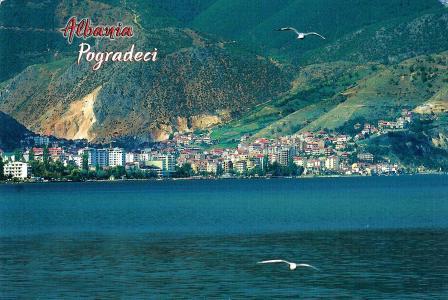
Pogradec - Albania

The Macedonian side of Lake Ohrid was declared a World Heritage Site by UNESCO in 1979, with the site being extended to also include the cultural and historic area of Ohrid in 1980. The Albanian side of Lake Ohrid was also designated UNESCO world heritage status in 2019.
The towns situated at the lakeside are Ohrid and Struga in Macedonia along with Pogradec in Albania. - in: wikipedia
This card was also sent by Boris.

Photo: Armando Baguca
The city of Pogradec lies on the western shore of Lake Ohrid, which is the heart and soul of this city. 
Ohrid is the deepest (285m) lake in the Balkans, and is split between Macedonia (in Ohrid and Struga), and Albania. It took around 4 million years for this lake to form its present shape, from the moment the soil began to shift on the western side of the Dinaric Alps. Now, it is a veritable, picture-perfect swan lake, as well as an ecosystem that includes over 200 species – making it a real national treasure. - in: https://www.intoalbania.com

Valbona Valley National Park - Albania

Last month, I think, Boris went on a trip to Albania, hoping to visit all the UNESCO sites in the country. That's my kind of trip. He wanted to visit and, of course, get and send cards from the sites, I can relate to that too. 
In 2017, the Gashi River, located within the Valbona National Park, was listed as part of the Ancient and Primeval Beech Forests of the Carpathians and Other Regions of Europe. However, there are other rivers within the park and this card doesn't identify which of them is this one. Anyway, even though I'm not sure this is a card from a missing site, I like it a lot!!

Photo: Armando Baguca
Situated in the far north of Albania, Valbona Valley National Park borders Montenegro to the north and Theth National Park to the west. 
With its dramatic, barren summits and forested valleys, glacial springs and waterfalls, it's an heavenly place both for humans and animals. The park's Gashi River is part of the multi-unit UNESCO Primeval Beech Forests World Heritage Site. In addition to floral diversity, Valbona Valley is also home to lots of wildlife. This includes brown bears, lynx, chamois, grey wolves, wild goats and countless bird species. 

Wednesday, October 17, 2012

Gjirokastër - Albania

As i said a few posts ago, i'm not done yet with the touchnote cards, actually, i've received another one of these cards last monday! Not this one though. This one, sent by Paula, arrived in late august. It shows a few houses in Gjirokastër, Albania.

Gjirokastër is a city in southern Albania with a population of 43,000. Its old town is inscribed on the World Heritage List as "a rare example of a well-preserved Ottoman town, built by farmers of large estate."

Photo by wikipedia
The city is built on the slope surrounding the citadel, located on a dominating plateau. Although the city's walls were built in the third century and the city itself was first mentioned in the 12th century, the majority of the existing buildings date from 17th and 18th centuries. Typical houses consist of a tall stone block structure which can be up to five stories high. There are external and internal staircases that surround the house. It is thought that such design stems from fortified country houses typical in southern Albania. The lower storey of the building contains a cistern and the stable. The upper storey is composed of a guest room and a family room containing a fireplace. Further upper stories are to accommodate extended families and are connected by internal stairs. Since Gjirokastër's membership to UNESCO, a number of houses have been restored though others continue to degrade.
Many houses in Gjirokastër have a distinctive local style that has earned the city the nickname "City of Stone", because most of the old houses have roofs covered with stones. - in: wikipedia

Tuesday, February 8, 2011

More Unesco cards

Niina "bessie" pruposed me a unesco private trade, i've sent her 3 spanish unesco cards and she sent me these from Albania, Armenia and Lebanon. I'll post here the albanian and armenian cards.

Gjirokastra and Berat are was among the few Albanian cities preserved in the 1960s and 1970s from modernizing building programs. Both cities gained the status of "museum town" and are Unesco World Heritage Sites since 2005 as "a rare example of well-preserved Ottoman cities".

"Cathedral and Churches of Echmiatsin and the archaeological remains at Zvartnots are World Heritage Sites in Armenia. They provide a glimpse into the evolution of the architecture of Armenian churches. It is from these medieval churches that the central-domed, cross-hall design of Armenian churches was derived, influencing the architectural style of the region." - in: http://www.worldgreatestsites.com/cathedral-churches-of-echmiatsin-archaeological-site-of-zvartnots_armenia.htm
The card shows the Zvartnots Cathedral, a ruined seventh century circular Armenian cathedral built by order of the Catholicos Nerses the Builder from 641-653. It is located at the edge of the city of Echmiadzin. Zvartnots was built at a time when much of Armenia was found under Byzantine control and during the early invasions of srmenia by the Muslim Arabs. Zvartnots remained standing up until the end of the tenth century; afterwards, historical sources are silent as to the cause of its collapse. Zvartnots remained buried until its remains were uncovered at the start of the 20th century.

Thursday, August 20, 2009

Butrint - Albania

I'm getting unesco cards from some hard-to-get places latelly.... Montenegro, Bosnia, Turkemenistan and now Albania. This is not only a new unesco card but also a new country :D Thanks to "willempie" for offering the card on the "you choose unesco tag".


"Inhabited since prehistoric times, Butrint has been the sity of a Greek colony, a Roman city and a bishopric. Following a period of prosperity under the Byzantine administration, then a brief occupation by the Venetians, the city was abandoned in the Middle Ages after marshes formed in the area. The present archaeological site is a repository of ruins representing each period in the city development." - in: www.whc.unesco.org/en/list/570