Showing posts with label Pakistan. Show all posts

Saturday, June 26, 2021

Archaeological Ruins at Moenjodaro - Pakistan

Mail services never stop to susprise us and this card is a good example of that. 
Last week I've received this card from Pakistan, written, sent and stamped on February 14th of.... 2020. 2020, not 2021! This isn't the only unique fact about it. Even though it was sent to my old address, I got it here, in the address I've been living for one year now. No, I don't have that mail forwarding service. I guess someone in the mail distribution center recognized my name et voilá, found this great card in my mailbox. I'm so glad it didn't get lost because it is from a missing UNESCO site. 

The Archaeological Ruins at Moenjodaro are the best preserved urban settlement in South Asia dating back to the beginning of the 3rd millennium BC, and exercised a considerable influence on the subsequent development of urbanization. 
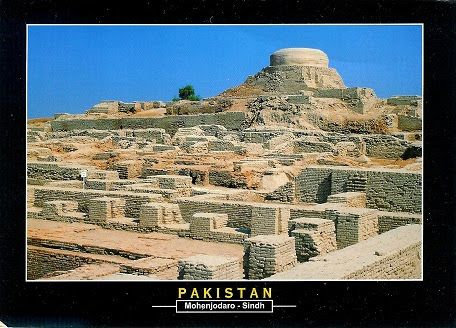
Foto Bank
The archaeological ruins are located on the right bank of the Indus River, 510 km north-east from Karachi, and 28 km from Larkana city, Larkana District in Pakistan’s Sindh Province. The property represents the metropolis of Indus civilization, which flourished between 2,500-1,500 BC in the Indus valley and is one of the world’s three great ancient civilizations.
The discovery of Moenjodaro in 1922 revealed evidence of the customs, art, religion and administrative abilities of its inhabitants. The well planned city mostly built with baked bricks and having public baths; a college of priests; an elaborate drainage system; wells, soak pits for disposal of sewage, and a large granary, bears testimony that it was a metropolis of great importance, enjoying a well organized civic, economic, social and cultural system.
Moenjodaro comprises two sectors: a citadel area in the west where the Buddhist stupa was constructed with unbaked brick over the ruins of Moenjodaro in the 2nd century AD, and to the east, the lower city ruins spread out along the banks of the Indus. Here buildings are laid out along streets intersecting each other at right angles, in a highly orderly form of city planning that also incorporated systems of sanitation and drainage. - in: https://whc.unesco.org/en/list/138

Saturday, June 16, 2012

Lahore Fort - Pakistan

This lovely Unesco card from Pakistan was a surprise from Rita Simões. When i say Unesco, i mean new Unesco site in my collection, my 2nd from there. The card is great, i just love it.

 Produced by Foto Bank
The Lahore Fort, locally referred to as Shahi Qila, is citadel of the city of Lahore, Punjab, Pakistan. It is located in the northwestern corner of the Walled City of Lahore. The trapezoidal composition is spread over 20 hectares.
Origins of the fort go as far back as antiquity, however, the existing base structure was built during the reign of Mughal Emperor Akbar between 1556–1605 and was regularly upgraded by subsequent Mughal, Sikh and British rulers.It has two gates one is known as Alamgiri Gate build by Emperor Aurangzeb which opens towards Badshahi Mosque and other older one known as Maseeti (Punjabi language word means of Masjid) or Masjidi Gate which opens towards Masti Gate Area of Walled City and was built by Emperor Akbar. Currently Alamgiri Gate is used as the principal entrance while Masti Gate is permanently closed .The fort manifests the rich traditions of Mughal architecture. Some of the famous sites inside the fort include: Sheesh Mahal, Alamgiri Gate, Naulakha pavilion, and Moti Masjid. In 1981, the fort was inscribed as a UNESCO World Heritage Site along with the Shalimar Gardens (Lahore). - in: wikipedia

Monday, April 12, 2010

Historical Monuments at Makli, Thatta - Pakistan

This is also a card from a new country, Pakistan, and also a new unesco site, Historical Monuments at Makli, Thatta.
A double thank you to Huang from China.


"One of the largest necropolises in the world, with a diameter of approximately 8 kilometers, Makli Hill is supposed to be the burial place of some 125,000 Sufi saints. It is located on the outskirts of Thatta, the capital of lower Sind until the seventeenth century, in what is the southeastern province of present-day Pakistan.
Legends abound about its inception, but it is generally believed that the cemetery grew around the shrine of the fourteenth-century Sufi, Hamad Jamali. The tombs and gravestones spread over the cemetery are material documents marking the social and political history of Sind.
Imperial mausoleums are divided into two major groups, those from the Samma (1352–1520) and Tarkhan (1556–1592) periods. The tomb of the Samma king, Jam Nizamuddin II (reigned 1461–1509), is an impressive square structure built of sandstone and decorated with floral and geometric medallions. Similar to this is the mausoleum of Isa Khan Tarkhan II (d. 1651), a two-story stone building with majestic cupolas and balconies. In contrast to the syncretic architecture of these two monuments, which integrate Hindu and Islamic motifs, are mausoleums that clearly show the Central Asian roots of the later dynasty. An example is the tomb of Jan Beg Tarkhan (d. 1600), a typical octagonal brick structure whose dome is covered in blue and turquoise glazed tiles. Today, Makli Hill is a United Nations World Heritage Site that is visited by both pilgrims and tourists." - in: wikipedia