Showing posts with label Turkey. Show all posts

Saturday, August 26, 2023

Cappadocia - Turkey

One last post with cards from Turkey. 
Cappadocia is also a popular tourist destination, as it has many areas with unique geological, historic, and cultural features. 
The Rock Sites of Cappadocia and the Goreme National Park became a UNESCO World Heritage Site in 1985.
 
TR-36930, sent by Zeynep.
"Cappadocia is a region in central Turkey, largely in Nevsehir Province.
The Cappadocia region is largely underlain by sedimentary rocks formed in lakes and streams, and ignimbrite deposits erupted from ancient volcanoes approximately 9 to 3 million years ago, during the late Miocene to Pliocene epochs. The rocks of Cappadocia near Göreme eroded into hundreds of spectacular pillars and minaret-like forms. The volcanic deposits are soft rocks that the people of the villages at the heart of the Cappadocia Region carved out to form houses, churches and monasteries." - in: wikipedia

© BKG - Bilintur, exclusive design
One of the most famous geographical structures of Cappadocia are the fairy chimneys. Fairy Chimneys are unique formations that were produced by volcanic explosions. Tuff rock, which was created by the lava flows, was carved by wind and rain into serpentine valleys with curved cliff sides and sharp fairy chimneys. Fairy Chimneys are famous because they are unique, and beautiful and have important roles in the history of the people living there, especially early Christians.
Fairy chimneys in Turkey are around 14 million years old but the formation continues with wind and rain. So it is an ongoing process. - in: https://cappadociatravelpass.com

Pamukkale - Turkey

An unusual natural and historical site with the sparkling white castle -like cascades, Pamukkale is one of the most important highlights of Turkey..
Pamukkale, meaning "cotton castle" in Turkish, is a natural site in Denizli Province in southwestern Turkey. The area was declared a World Heritage Site in 1988, together with Hierapolis.

Waters in the terraces are the sediments of the springs with calcium bicarbonate in 33C. Waters, containing mainly calcium salts and carbon-dioxide, run off the plateau's by depositing calcium while carbon-dioxide disappearing.
 
TR-114994, sent by Cuneyt.
The marvelous landscape of Pamukkale has been created by this gradual formation, leaving a cotton-like image. The water of Pamukkale is famous for its benefits to the eyes and skin; and its curing properties to the ills of asthma, rheumatism, as well. The fairyland Pamukkale is a must-see traveling through this region, during a holiday in Turkey.2 - in: http://www.kusadasi.biz/pamukkale/

Blue Mosque - Turkey

Also known as the Sultan Ahmet Camii (or Sultan Ahmed Mosque), this breath-taking building is one of the most majestic Ottoman mosques in all of Turkey.

The Blue Mosque was built between 1609 and 1616, by the architect Mehmet Ağa, instructed by Sultan Ahmed I. It was designed as an imperial show of strength to complement the imposing Hagia Sophia Mosque, which faces it across Sultanahmet Square. Unlike the Hagia Sophia, however, it is supported by four "elephant foot" pillars and the central dome (23.5m in diameter and 43m high) is flanked by four semi-domes, making it nearly a square in shape. It is dubbed the Blue Mosque because of over 20,000 handmade ceramic Iznik tiles that decorate the interior, featuring many different tulips, rose, carnation, and lily designs, well lit by 260 windows.

 © Copyright by KESKIN COLOR KARTPOSTALCILIK A. S.
TR-144214, sent by Ece.
Aside from its staggering size and exquisite beauty, one of the most distinctive elements of this Istanbul mosque is that it has six minarets, as opposed to the usual two or four of most of the city’s mosques. In the history of the Blue Mosque, legend has it that this is because of a misunderstanding – when the Sultan decreed there should be altın minaret (gold minarets), the architect heard altı minaret (six minarets) – an easy mistake to make! This caused some controversy, as the only other mosque with six minarets at that time was the Prophet’s mosque in Mecca – a problem the sultan overcame by ordering a seventh to be added in Mecca. - in: https://istanbultourstudio.com
 
If you're planning to go to Istanbul and want to visit the Blue Mosque, there are a few useful  things you'd better know before visiting it.
* Pray happens five times a day with the first call to prayer at sunrise and the last one at nightfall.The mosque closes for 90 minutes at each pray time.Avoid visiting a mosque at pray time (Especially Midday praying on Friday) or within a half hour after the ezan is chanted from the Mosque minarets.
* Before step in to Mosque, take off your shoes and put in plastic bags provided at the entrance (free of charge). This is required of all persons as part of Muslim tradition when entering a mosque. There is also no charge to enter the Blue Mosque.
* If you are women wear a head covering when entering to Blue Mosque. Head coverings are available at the Blue Mosque entrance for free. Place the fabric cover on top of your head with equal portions hanging on both sides. Take one side and wrap it around your neck, tossing it behind your back with covering your shoulders. Don't cover your face, the covering is meant to hide your hair only.
* When you are inside the mosque, remain quiet and don't use flash photography. Since this  is a place of worship, avoid staring or taking picture of those who are praying. Visit the mosque respectfully and quietly. At the Mosque exit, you can put used plastic bags in designated bin bags and return head covers to duty staff. - in: http://www.bluemosque.co/

Friday, August 25, 2023

Hagia Sophia - Turkey

The Hagia Sophia is among Istanbul's most popular and iconic historic sites – and for good reason. The massive, transcendent dome is breathtaking and can easily be gazed at for hours. A true architectural marvel, the walls are adorned by Byzantine mosaics featuring portraits of bygone emperors and representations of Christ.
 
Completed in the 6th century on the orders of the Byzantine Emperor Justinian I, Hagia Sophia remained the world’s largest cathedral for nearly a millennium until the completion of Seville Cathedral in 1520. Before being converted into a mosque in the 15th century and later into a museum in 1935, Hagia Sophia served as the centre of the Eastern Orthodox Church. - in: https://www.timeout.com
 

"The church was richly decorated with mosaics throughout the centuries. They either depicted the Virgin Mother, Jesus, saints, or emperors and empresses. Other parts were decorated in a purely decorative style with geometric patterns.
The Comnenus mosaics, located on the eastern wall of the southern gallery, date from 1122. The Virgin Mary is standing in the middle, depicted, as usual in Byzantine art, in a dark blue gown. She holds the Child Christ on her lap. He gives His blessing with His right hand while holding a scroll in His left hand. On her right side stands emperor John II Comnenus, represented in a garb embellished with precious stones. He holds a purse, symbol of an imperial donation to the church. Empress Irene stands on the left side of the Virgin, wearing ceremonial garments and offering a document. He is shown as a beardless youth, probably representing his appearance at his coronation aged seventeen. In this panel one can already see a difference with the Empress Zoe mosaics that is one century older. There is a more realistic expression in the portraits instead of an idealized representation. The empress is shown with plaited blond hair, rosy cheeks and grey eyes, revealing her Hungarian descent. The emperor is depicted in a dignified manner." - in:
wikipedia

Sunday, August 20, 2023

Turkey

Packed to the brim with ancient monuments left by different empires, and breathtaking scenery that never fails to impress, Turkey is a dazzling destination and a unique blend of Eastern and Western culture and tradition.

These cards, with some of the country's top-rated attractions, were sent many, many years ago by Gokçe and Manuela.

Clock wise: Hagia Sofia in Istanbul; Kekova in Kas, Antalya; Hadrian Temple in Ephesus; Kusadasi in Aydin; Düden Waterfall in Antalya; Perge also in Antalya; Abant in Bolu; Alanya.
In the middle: Cappadocia. 
 
Hitit Color
 Yivli Minare, a landmark and Antalya 's symbol; a fishermen in Balikçi; Bodrum; an windmil in Bodrum and Fairy Chimneys rock formation  in Cappadocia.
 

Wednesday, October 19, 2022

Ishak Pasha Palace - Turkey

A few days ago I traveled to Bordeaux, France and of course I bought some cards there. However, most of the cards I bought weren't french. On my 1st day in Bordeaux I was lucky to find a flea market and a particular stand with boxes and boxes of old cards. I bought a few old french cards, mostly of castles and churches but the real treasure were a collection of cards of the world with cards from different countries, some of them quite rare, such as Yemen, Qatar, Burkina Faso, Georgia, Ecuador, Guinea, etc. In the next days I'll share a few that I like the most. I'll start with this one from Turkey. 
 
This card deserves my attention not only because it depicts a beautiful palace but also because Ishak Pasha in on the UNESCO Tentative list. Some of the cards are from UNESCO sites but I already had all of them. Getting sites on the Tentative list is almost as good as getting sites that already are on the WHS list. 
The small city of Doğubeyazıt, situated on the Silk Route near the Iranian frontier, is home to one of the finest examples of Ottoman palace architecture. The palace is such a unique Ottoman piece of architecture because it borrows heavily from Anatolian, Persian and North Mesopotamian styles and traditions. It fuses all of them together in a mesmerizing fashion that is also influenced largely by Seljuk architecture.

 
It stands on a vast platform of 7,600 square meters (81,805 square feet), near the Iranian frontier of the Ottoman Empire, and as such its high elevation offers a unique strategic importance to the Empire.
The construction of the palace began in 1685 by Çolak Abdi Pasha. The completion of it took 99 years and was finally finished in 1784 by Ishak Pasha, a descendant of Çolak Abdi Pasha.
The palace was damaged by an earthquake in 1840 and for some time abandoned, but partly restored over the next 20 years. It was again damaged during the Russo-Turkish War (1877-1878). The structure was later used by Russians and during World War I when it was damaged by gunfire.
Later, the palace was used as the administrative centre for the area, and later as a military fort until 1937. Additional damage was caused later when stone from the building was taken for use to build new homes. 
In 2000, the palace was added to the UNESCO Tentative List of World Heritage Sites.

Monday, March 14, 2022

FOTW Turkey

A new and unexpected FOTW card for my collection.This not the first time Eric surprises me with a card missing in my collections. Thank you very much 😃

 
© concept by Postcardsmarket.com
Turkey has an area of 783.356 km², a population of 79.463.663 and its capital is Ankara. 
 Unique: 
 * Historical Bizantium - Istanbul is the only city in the world located on 2 continents - Europe and Asia; 
 * Founded in 660 BC, it has been the Capital of the Roman, Byzantine, Latin and Ottoman Empires; 
 Famous:  
* The Tunel Railway Line - since 1875, the oldest surviving underground rail line in Europe;
* The Grand Bazaar, Istanbul - one of the largest and oldest covered markets in the world, with 61 covered streets and over 4000 shops; 
 History:  
* Ottoman Empire: 1299-1923, Motto: "The Eternal State."
* The Anatolian Peninsula: comprising most of the modern Turkey, is one of the oldest permanently settled regions in the world.

Saturday, August 14, 2021

Pergamon - Turkey

Another new UNESCO site in my collection and a few more will arrive in the coming weeks!! Óscar noticed that Pergamon was still missing in my collection and kindly sent me this card depicting the theater.

Ancient Pergamon settlement at the top of the Kale Hill, the capital of Hellenistic Attalid Dynasty, represents the outstanding example of urban planning of the Hellenistic period with its monumental architecture.
Temple of Athena, the steepest theatre of the Hellenistic period, library, Great Altar of Pergamon, Dionysus Temple, agora, gymnasiums and high pressured water pipeline system are the most outstanding examples of this period. The city has the most famous and well known sculpture school of Hellenistic period, which created the Great Altar that has been accepted as one of the wonders of the world since 2nd century BC. Great Altar of Pergamon and many other works produced by Pergamon School of Sculpture represent the climax in the art of sculpture in Hellenistic period.

The city, continuing its leading role in the cultural and scientific life in Roman period has become one of the most important metropolises of the ancient world. Outstanding masterpieces of the Roman Period, such as Sarapeion, Asclepius, Temple of Trajan, the theatre, amphitheatre and aqueduct are the representatives of the highest level in architecture, planning and engineering of the period. - inhttps://www.goturkeytourism.com

The Hellenistic Theatre was built into the hillside to conserve space and take maximum advantage of the spectacular views. The design are not typical round and wide proportions, but instead dramatically higher, with a seating capacity of 10,000; the steepest theatre known in the ancient world. - in: https://www.alaturkaturkey.com

Tuesday, March 9, 2021

Monthly Fav. Surprise RR * January '21

January and February's MFS RR cards didn't took that long to arrive to my mailbox but 2 of my cards are still traveling, both to USA. My last cards to USA took forever to get there, more than a month but these cards are taking even more than that!! 

Frankfurt am Main has Germany’s largest Christmas market as well as its tallest Christmas tree. The tallestt houses in Germany are in Frankfurt, which is why the tree should always be the tallest in the country. It is usually 30 meters high and over 100 years old. 
This winter view of Romerberg was sent by Birgit.

Photo: Taneli Eskola 2010
Sofiankatu is a short alley between the Senate Square and Market Square, and among the oldest streets in Helsinki dating back to 1640's.
I've been there in 2019, trying to take a picture like this one sent by Mari.

Iris said she already sent me all her church cards, now she sent a mosque. Church, mosque, I don't mind, any religious building is ok for me.
Blue Mosque (Sultanahmet Mosque) is one of the most beautiful mosques and landmarks in both Istanbul and the world. Blue Mosque was built in the 17th century (1603-1617) by Sedefkar Mehmet Aga with the order of Sultan Ahmet I.
Located in the Sultanahmet neighborhood of Fatih district, along the Sultanahmet Sqaure, the Blue Mosque is a great sample of the Turkish and Islamic architecture and one of the most visited sights and mosques in Istanbul . It can also be considered as a triumph of harmony, proportion and elegance. - in: https://istanbeautiful.com

Photo: Jonathan (?)
I believe this is my 1st card from this American National Park. Kae has been there on hiking trip. 
At 110 feet high, Otter Cliff, in Acadia National Park, is one of the most spectacular sights along the North Atlantic Seaboard. 
The park is located along the mid-section of the Maine coast, southwest of Bar Harbor. It preserves about half of Mount Desert Island, part of the Isle au Haut, the tip of the Schoodic Peninsula, and portions of 16 smaller outlying islands. The park preserves the natural beauty of the rocky headlands, including the highest mountains along the Atlantic coast. The park boasts a glaciated coastal and island landscape, an abundance of habitats, a high level of biodiversity, clean air and water, and a rich cultural heritage. - in: wikipedia

Monday, July 8, 2019

Konya - Turkey

Third and last card sent by Muanmer. Konya is also on the UNESCO Tentative List. 
Konya is a major city in south western edge of the Central Anantolian Plateau and is the 7th most populous city in Turkey. 

PTT
The Mevlâna Museum is the mausoleum of Jalal ad-Din Muhammad Rumi, a Persian Sufi mystic also known as Mevlâna or Rumi. It was also the dervish lodge (tekke) of the Mevlevi order, better known as the whirling dervishes.
Sultan 'Ala' al-Din Kayqubad, the Seljuk sultan who had invited Mevlâna to Konya, offered his rose garden as a fitting place to bury Rumi's father, Baha' ud-Din Walad (also written as Bahaeddin Veled), when he died on 12 January 1231. When Mevlâna died on 17 December 1273 he was buried next to his father.
Mevlâna's successor Hüsamettin Çelebi decided to build a mausoleum (Kubbe-i-Hadra) over the grave of his master. The Seljuk construction, under architect Badr al-Din Tabrizi, was finished in 1274. Gürcü Hatun, the wife of the Seljuk Emir Suleyman Pervane, and Emir Alameddin Kayser funded the construction. The cylindrical drum of the dome originally rested on four pillars. The conical dome is covered with turquoise faience.
The decree of 6 April 1926 confirmed that the mausoleum and the dervish lodge (Dergah) were to be turned into a museum. The museum opened on 2 March 1927. In 1954 it was renamed as "Mevlâna Museum". - in: wikipedia

Sunday, July 7, 2019

Aspendos - Turkey

The ancient city of Aspendos, approximately 50 kilometers east of Antalya, is one of the big-hitter historic attractions in Turkey's Turquoise Coast region. The local theater is of the Roman Empire's greatest remaining pieces of architecture. 
The Theatre and Aqueducts of this ancient city are on the UNESCO Tentative List. 

www.guneykartpostal.com
Aspendos' theater is one of the largest ever built by the Romans in Asia Minor, and today it is one of the best preserved examples of Roman theater architecture. Located in the lower town area of the site, the theater was built in the 2nd century AD during Marcus Aurelius' reign.
The mammoth seating plan could fit an audience of between 15,000 and 20,000. It has been thoroughly restored and is now used for music and drama festivals, including Turkey's famous annual Aspendos Opera Festival.
The semi-circular auditorium, divided into two sections by a broad passage halfway up, has 20 tiers of seating, with 10 staircases in the lower half and 19 tiers with 21 staircases in the upper part. Round the top runs a barrel-vaulted colonnade.
At either end of the stage are vaulted passages giving access to the orchestra. The two-story stage wall was articulated by slender double columns with Ionic capitals on the lower order and Corinthian capitals on the upper one. The double column flanking the central entrance to the stage had a common broken pediment. The stage itself had a wooden roof suspended by ropes, and the auditorium, too, was probably covered by an awning. - in: https://www.planetware.com/antalya/aspendos-tr-ant-sda.htm

Diyarbakır Fortress - Turkey

Since the last day of June, the UNESCO World Heritage Committee has been discussing the inscription of new sites. This morning Portugal received wonderful news from Baku. Our 2 candidates were inscribed ツ The Royal Building of Mafra – Palace, Basilica, Convent, Cerco Garden and Hunting Park (Tapada) and Sanctuary of Bom Jesus in Braga are now on the UNESCO WHS list. 

In 2015 Turkey had Diyarbakir Fortress inscribed. I got this card thanks to Muanmer.

Foto: Mehmet Masun Süer
Located on an escarpment of the Upper Tigris River Basin that is part of the so-called Fertile Crescent, the fortified city of Diyarbakır and the landscape around has been an important centre since the Hellenistic period, through the Roman, Sassanid, Byzantine, Islamic and Ottoman times to the present. The site encompasses the Inner castle, known as İçkale and including the Amida Mound, and the 5.8 km-long city walls of Diyarbakır with their numerous towers, gates, buttresses, and 63 inscriptions. The site also includes the Hevsel Gardens, a green link between the city and the Tigris that supplied the city with food and water, the Anzele water source and the Ten-Eyed Bridge. - in: https://whc.unesco.org/en/list/1488

Monday, September 10, 2018

Great Mosque and Hospital of Divriği - Turkey

Getting a card from this turkish site seemed quite difficult, I've actually never seen any cards with these buildings. Thanks to Ercan, I've finally seen and got a card with the the first turkish buildings  inscribed on the World Heritage List.  
Renowned for its monumental architecture and traditional stone carving decorations of Anatolia, this masterpiece, with its two-domed mosque, hospital and tomb, was placed on the UNESCO World Heritage List in 1985.

This building complex was commissioned in the 13th century by Ahmet Shah and his wife Melike Turan of the Principality of Mengüçlü. 
The Great Mosque and Hospital have plain facades. Their status as a unique masterpiece rests on the merits of the stone carving decorations that adorn the great portal of the Hospital, the northern portal of the Mosque, the western portal of the Mosque and the portal of Shah’s dais. Each and every figure in the decoration is a unique marvel of art and architecture, as well as a feat of engineering.

Tire Cards & Printing Office
The Great Mosque of Divriği is the most splendid example of the mosques built during the Seljuk Period in Anatolia. Art historians and architects agree that there are no other examples of the three dimensional and intricate geometric styles and flowing figures of plants.
Its portals appear to be a mixture of Baroque, Seljuk and Gothic styles, but nevertheless represent a unique and distinct style of their own. All figures carved on the portals and walls are asymmetrical and each square has thousand of stone carved figures. The most prominent characteristic of the designs featured in the portals is their uniqueness: each is distinct from other decorations. For example, the wreath of life used on the portal on the north facade is noteworthy, as it depicts an imaginary plant world that only existed in the imagination of the craftsman.
In addition to the portals, all bases, shafts and capitals of the columns, as well as the inner surface of the dome, are decorated with a different, distinct and unique style. The hospital, situated next to the Great Mosque is, in itself, a masterpiece of stone carving. It shares a splendid unity with the Great Mosque. The hospital is a two-story building with a central courtyard surrounded by porticoes, and designed as a hospital where cures included the soothing sound of flowing water from the fountains. - in: http://www.turkishculture.org/general/unesco-world-heritage/great-mosque-and-1037.htm

Saturday, November 4, 2017

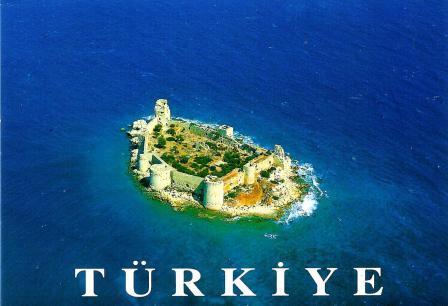
Kizkalesi Castle - Turkey

I absolutely love this card. It was in my favorites for so long, I'm glad I finally got it. Teşekkür ederim Helen.

Kizkalesi means Maiden’s Castle which is a romantic name for the crusader Castle situated on a small island in Mersin Province of Turkey. The total area of the island is about 15,000 square metres (160,000 sq ft) and the castle covers most of this area. 

The fortress on the sea was built in 1104 by the Byzantine admiral Eustathious. It is about 200 yards away from the shore and was initially connected to the mainland by a land bridge. Here, you can find watch towers on its walls, a reservoir and in the courtyard you will see a Byzantine basilica. The castle of Kizkalesi has an interesting tale just like most of the castles here in Turkey. 
The tale of the castle started when a fortune teller told the king of Korykos that his only and most loved daughter would be killed through a bite of a snake. The king decided to built his castle in the sea and let his daughter live in the castle in order to prevent the dreadful fate of his daughter. But unfortunately even the king can’t change what is destined to happen. A snake was brought into the island through a basket filled with fruits bit his daughter and died. - in: http://www.bigloveturkey.com/pages/kizkalesi.asp

Thursday, April 6, 2017

Archaeological Site of Ani - Turkey

This site is located on a secluded plateau of northeast Turkey overlooking a ravine that forms a natural border with Armenia. This medieval city combines residential, religious and military structures, characteristic of a medieval urbanism built up over the centuries by Christian and then Muslim dynasties. The city flourished in the 10th and 11th centuries CE when it became the capital of the medieval Armenian kingdom of the Bagratides and profited from control of one branch of the Silk Road. Later, under Byzantine, Seljuk and Georgian sovereignty, it maintained its status as an important crossroads for merchant caravans. The Mongol invasion and a devastating earthquake in 1319 marked the beginning of the city’s decline. The site presents a comprehensive overview of the evolution of medieval architecture through examples of almost all the different architectural innovations of the region between the 7th and 13th centuries. - in: http://whc.unesco.org/en/list/1518

This site was added to the WHS list in 2016 and the card was sent by Gökçe.

The church of St Gregory of Tigran Honents, finished in 1215, is the best-preserved monument at Ani. It was built during the rule of the Zakarids and was commissioned by the wealthy Armenian merchant Tigran Honents. Its plan is of a type called a domed hall. In front of its entrance are the ruins of a narthex and a small chapel that are from a slightly later period. The exterior of the church is spectacularly decorated. Ornate stone carvings of real and imaginary animals fill the spandrels between blind arcade that runs around all four sides of the church. The interior contains an important and unique series of frescoes cycles that depict two main themes. In the eastern third of the church is depicted the Life of Saint Gregory the Illuminator, in the middle third of the church is depicted the Life of Christ. Such extensive fresco cycles are rare features in Armenian architecture – it is believed that these ones were executed by Georgian artists, and the cycle also includes scenes from the life of St. Nino, who converted the Georgians to Christianity. In the narthex and its chapel survive fragmentary frescoes that are more Byzantine in style. - in: wikipedia

Tuesday, June 14, 2016

Hippodrome - Istanbul

Damien has been to Istanbul last November, he sent me a 1st card from there in January and in March he sent me another card.
The Hippodrome of Constantinople was a circus that was the sporting and social centre of Constantinople, capital of the Byzantine Empire. Today it is a square named Sultanahmet Meydanı (Sultan Ahmet Square) in the Turkish city of Istanbul, with a few fragments of the original structure surviving. - in: wikipedia

 © Copyright by KESKIN COLOR KARTPOSTALCILIK A. S.
The original Hippodrome was constructed in 200 AD. by Emperor Septimus Severus, when he rebuilt the town of Byzantium. After Severus, Constantine the Great made Constantinople new capital and gave much more importance to this area. The Hippodrome was the heart of the civil activities. Propaganda activities, rebellions, fighting's and eventually chariot races took place in this area. The Hippodrome continued to serve as primarily a sports center as well as a gathering place of the people for centuries during the Byzantium Era. After the Ottomans took over, it was also used for the same purpose. - in: http://www.letsgoistanbul.com/hippodrome.htm

Friday, January 22, 2016

Istanbul - Turkey

Ana has been to Turkey in August, Damien has been there in November and I haven't been there but someday I want to visit this country too. 

© Copyright Ipekyolu Turistik Yayinlan - Her Hakki Mahfuzdur
Many visitors to İstanbul never make it out of Sultanahmet, which is not a surprise because this neighbourhood is a showcase of the city's glorious past, crammed with mosques, palaces, churches and houses dating from the Roman, Byzantine and Ottoman periods. On the card is possible to see the Blue Mosque, Hagia Sophia and the Cistern Basilica. 

Thursday, January 21, 2016

Ephesus - Turkey

Ephesus, an ancient city in the turkish İzmir Province, was one of the last sites to be added to the UNESCO WHS and it was also one of the last to me added to my collection. Last August Ana visited this site and couldn't decided which of these cards she would send me so she sent both!! Both are great, thank you so much.

Located within what was once the estuary of the River Kaystros, Ephesus comprises successive Hellenistic and Roman settlements founded on new locations, which followed the coastline as it retreated westward. Excavations have revealed grand monuments of the Roman Imperial period including the Library of Celsus and the Great Theatre.
 The Ancient City of Ephesus is an outstanding example of a Roman port city, with sea channel and harbour basin. - inhttp://whc.unesco.org/en/list/1018

 © Copyright by KESKIN COLOR KARTPOSTALCILIK A. S.
The Great Theatre was built on the foot of Panayir mountain and its façade faced the Harbour street, in the first century AD and later on it was renovated by several Roman Emperors. It is considered to be the most imposing and the most impressive structure of Ephesus city. It could host up to 25,000 spectators.
Apart from the theatrical plays and the music performances that took place in the theatre, political and religious events were carried out in it as well. Among the most important of them is the conflict between Christians and the followers of Artemis during which Saint Paul was judged and sent to prison as he was accused of hurting Artemis.
The Great Theatre of Ephesus was destroyed due to an earthquake in the 4th century AD and only a part of it was repaired. In the 8th century AD it had been incorporated into the defense system of the city. - in: http://www.ephesus.ws/the-great-theatre-of-ephesus.html

www.guneykartpostal.com
The Library was built by Gaius Julius Aquila to honor his father Julius Celsus Polemaenus, General Governor of the roman province of Asia, in 135 AD, designed by the architect Vitruoya. It was one of the largest libraries of the ancient world and it could host more than 12,000 scrolls. Celsus died when he was 70 years old and hw was buried in a marble sarcophagus in a cellar under an arched ceiling under the ground floor of the Library. It can be accessed through some stairs and then a narrow corridor which leads to the sarcophagus that has been adorned with nice sculptures.
There were nine steps leading to the entrance of the library which consisted of three large doors. The thick columns between the doors had been adorned with statues depicting the Wisdom, the Knowledge, the Intelligence and the Fortune.
The library was burnt during the 3rd century by the Goths who attacked Ephesus. Fortunately, a great part of its façade was not damaged seriously, so it has survived nowadays in a pretty good condition. - in: http://www.ephesus.ws/the-library-of-celsus-ephesus.html

Monday, January 5, 2015

3 IN 1 RR - Special Surprise * group 01

To celebrate Christmas, Staša created this special surprise group. In this group we had to send 10 surprise cards to one person but we couldn't mention to whom. I've received this cards from Staša but my envelope is still travelling and I'm getting worried about it. I hope it arrives in the next days. 

Photo © Bernie Jungkind/Woods Bros., 1989
The Ozark Mountains are a physiographic and geologic highland region of the central United States. It covers much of the southern half of Missouri and an extensive portion of northwestern and north central Arkansas. The region also extends westward into northeastern Oklahoma and extreme southeastern Kansas. - in: wikipedia

www.tkv.at
View from Bergisel stadium towards the Nordkette. 
The Nordkette is a range of mountains just north of the city of Innsbruck in Austria. It is the southernmost of the four great mountain chains in the Karwendel. - in: wkipedia

Copyright und Verlag: Studio Tanner
Breitachklamm gorge, in Bavaria, Germany, is the deepest and one of the most impressive rocky gorges in middle Europe. 
Formation of the Breitachklamm started approximately 10,000 years ago when the melting Breitach glacier began to saw its way through the chalk of the Engenkopf and the water slowly eroded the stone.
In 1905, this natural wonder of attractive beauty and dimension became accessible with the help of the priest Johannes Schiebel from Tiefenbach. Today, the Breitachklamm fascinates more than 300,000 visitors per year. - in: http://www.breitachklamm.com/en/history/

Photos, layout, printing and sales FIN©RIGINAL
The Suomenlinna Church in Finland was built as an Eastern Orthodox garrison church for the Russian troops of Suomenlinna sea fortress.
The Orthodox church was converted into an Evangelical Lutheran church during the 1920s.
Today its central dome doubles as a lighthouse making it one of only a few churches in the world that double as a lighthouse. The signal blink is the Morse code for the letter "H" for Helsinki. It is a very popular wedding church and one of the first landmarks for people arriving in Helsinki by sea. - in: wikipedia

Foto: M. Sükrü Denizkuslari
Alanya is a beach resort city and a component district of Antalya Province in the Mediterranean Region of Turkey. 
The Mediterranean climate, natural attractions, and historic heritage makes Alanya a popular destination for tourism, and responsible for nine percent of Turkey's tourism sector and thirty percent of foreign purchases of real estate in Turkey. - in: wikipedia

Ars Una Studio
The Chain Bridge was the first permanent stone-bridge connecting Pest and Buda, and only the second permanent crossing on the whole length of the river Danube. It is one of the symbolic buildings of Budapest, the most widely known bridge of the Hungarian capital. - in: http://www.bridgesofbudapest.com/bridge/chain_bridge

Foto: Dariusz Krakowiak 
The Roman-Catholic Cathedral in Przemyśl was erected in Gothic style in the 15th and 16th centuries and then rebuilt in the 18th century in a Baroque style.