This is not exactly a beautiful card but when it comes to cards from missing UNESCO sites, i'm not very picky. These are fragments of architectural décor of the Red Building, one of the two buildings in the main central complex of the city's citadel.
The card was sent by Emerich.
Nisa (also Parthaunisa) was an ancient city, located near modern-day Bagir village, 18 km southwest of Ashgabat, Turkmenistan.
Nisa is one of the most important sites of the Parthian Empire. The Parthians ruled in Persia from 247 BC to 228 AD. They defeated the Seleucids (successors of Alexander the Great) and conquered great parts of the Middle East and southwest Asia.
The earliest settlements in the area of Nissa date back to the 4th millenium BC. In the 3rd century BC the Parthians built an impressive fortress at Old Nisa and erected a royal residence, which probably was the first royal residence of the Parthian kings. The city was named Mithradatkert (fortress of Mithradates) during the reign of King Mithradates the Great (174-138 BC). Greek sources refer to the city as administrative and economic centre during the reign of the Arsacid dynasty. The Arsacid dynasty conquered a huge area from the Indus to the Euphrates and Nisa became an important city on the crossroads of many cultures from Persia, Greece and Central Asia.
New Nisa was conquered by the Arabian Caliphate in the 7th century and became part of the Seljuk Empire in the 11th century.
Archaeological research at the site began in the 1930s. Since 1990 it is excavated by the University of Torino, Italy (Centro Scavi di Torino). In 2007, the fortresses of Nissa were declared a UNESCO World Heritage Site. - in: wikitravel


.jpg)
 Tyurabek-khanym was a real historic figure, a Mongolian princess,
the favorite daughter of the governor of Golden Horde - Uzbek-khan and
the spouse of his deputy in Khoresm Kutlug Timur . Tyurabek - khanym was
the patroness of women. Eventually she was canonized and declared a
saint.
Tyurabek-khanym was a real historic figure, a Mongolian princess,
the favorite daughter of the governor of Golden Horde - Uzbek-khan and
the spouse of his deputy in Khoresm Kutlug Timur . Tyurabek - khanym was
the patroness of women. Eventually she was canonized and declared a
saint..jpg)

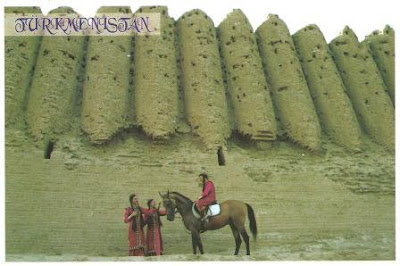
 'Kyz Kala" means 'Girls' Castle': one story runs that forty girls hid in the Greater Kyz Kala at the time of the Mongol invasion. When they saw what the Mongols had done to the inhabitants of the city of Merv they committed suicide by jumping from the roof. Another local tale identifies the Greater Kyz Kala as the castle for the girls; its smaller neighbour as the boys' castle. It is said that young men wishing 10 marry the girl of their dreams should fire a projectile from the southern castle, to land in the northern one. Given the distance between the two, there are presumably many local bachelors.

