Showing posts with label Georgia. Show all posts

Monday, December 12, 2022

Uplistsikhe Cave Town - Georgia

When you already have cards from almost 1000 UNESCO sites, it is hard to get cards from new ones. Getting cards from places on the Tentative list is the next best thing. I was more than happy when I realized that this card from Georgia is from a place on that list.
 
Uplistsikhe Cave Town-Fortress is situated on a rocky massif in 15 km eastwards to town Gori on the left bank of the river Mtkvari. Its history begins in the I-II millennium B.C. Uplistsikhe was an important religious, political and cultural centre in the Hellenistic and the late Antique periods (IV c. B.C. - IV c. A.D.).  The town was in its heyday as far back as the 9th - 11th centuries. In 13th century, it was ravaged by Mongols. 
 
 Living quarters and premises for communal purposes occupy a cliff territory of almost 8 hectares and are connected by footways. The majority of the caves are devoid of any decorations. The central ensemble, a big hall with coffered tunnel-vaulted ceiling, and the palace complex, is the most interesting one architecturally. The natural rock easily lent itself to various kinds of treatment, making it possible to create complex decorative compositions. The ribbed ceiling with an aperture, a smoke outlet which also admitted light, was supported by two columns carved from the living rock; the hall had niches-loggias on three sides. Next to this hall, a three-nave basilica was hewn from rock in the second half of the 6th century, and to the east of it, a three-church basilica of brick was built in the 9th - 10th centuries. The cave complexes dating to high medieval times usually included a number of small hall-churches beside the dwellings. - in: https://whc.unesco.org

Saturday, May 15, 2021

RU-8433495

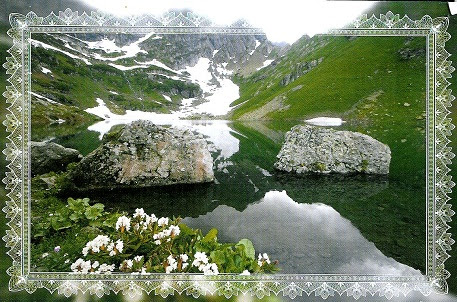
An official from Russia but the card is actually from Abkhazia, an autonomous republic in the northwestern corner of Georgia. This region declared independence in 1999 but only a few countries, most notably Russia, recognize its independence. 

Lake Mzy is one of the great natural attractions of Abkhazia. 

RU-8433495, sent by Julia. 
Mzy lake is located high in the Caucasus Mountains at an altitude of 2000 meters above sea level. Its size is small, only 100 to 45 meters, but the depth of as much as 40 meters (according to other sources 16 meters). It is formed from the waters of the melting glaciers, so the size and temperature depends on the time of year. 

Sunday, September 3, 2017

Gelati Monastery - Georgia

Until last July, Gelati Monastery and Bagrati Cathedral composed a UNESCO site in Georgia. I already had a card of the cathedral but in July the committee introduced a major reduction in the boundaries of the this site, inscribed on the World Heritage List in 1994 and on the List in Danger in 2010. The new boundaries exclude Bagrati Cathedral, which has undergone major reconstruction detrimental to its integrity and authenticity. This means Gelati Monastery was missing in my collection. I've traded again with Sini and received this nice card.

Founded in 1106 in the west of Georgia, the Monastery of Gelati is a masterpiece of the Golden Age of medieval Georgia, a period of political strength and economic growth between the 11th and 13th centuries. It is characterized by the facades of smoothly hewn large blocks, balanced proportions and blind arches for exterior decoration. The Gelati monastery, one of the largest medieval Orthodox monasteries, was also a centre of science and education and the Academy it housed was one of the most important centres of culture in ancient Georgia. - in: http://whc.unesco.org/en/list/710

Tuesday, February 28, 2017

Monthly Fav. Surprise RR - November'16

Time now for some monthly favorite RR cards. In November I've got cards from Germany, Spain, Estonia, Japan and Georgia. 

© Schöning GmbH & Co. KG
Some german lighthouses in the North Sea. Obereversand in Dorum; Arngast Lighthouse in Dangast; New Lighthouse on Wangerooge island; Roter Sand in the Weser estuary; Hamburger Lighthouse in Cuxhaven; Juist island lighthouse; Heligoland lighthouse; Geestemünde North Mole Light in Bremenhaven; Norderney island lighthouse; Pilsum Lighthouse; Borkum Großer Light and Wremen lighthouse. 
The card was sent by Steffi.

Yoland also sent a card with a lighthouse, Fangar lighthouse located in Ebro Delta. 
The Ebro Delta is located in Tarragona. It covers an area of 320 square kilometres, of which 80 comprise the Ebro Delta nature reserve. It has a great ornithological richness and is internationally important due to the presence here of over 400 species and some of the most important breeding colonies in the Mediterranean.
These flat lands give the Ebro Delta its unique landscape, which varies according to the season of the year. It is home to everything from market gardens and orchards to rice fields, while in the coastal area there are large lakes fringed by rush and reed beds. The area around this nature reserve is characterised by its saline soils, and extensive deserted sandy beaches with dune systems. . in: http://www.spain.info/en/que-quieres/naturaleza/espacios-naturales/parque_natural_del_delta_de_l_ebre.html

A new estonian castle in my collection thanks to Ella. 
Kuressaare Episcopal Castle, also known as Kuressaare Castle, was built in the 14th century. Today, the Castle houses Saaremaa Museum with its permanent exhibition and sundry temporary exhibitions. 
The convent building of the Kuressaare Episcopal Castle is the only surviving medieval fortification in the Baltic countries that has not been significantly reconstructed. - in: https://www.visitestonia.com/en/kuressaare-episcopal-castle

Tomoko got my address again and this time she sent me this Tofukuji Temple card with a view of the Tsutenkyo Bridge.
Tofukuji is a large Zen temple in southeastern Kyoto that is particularly famous for its spectacular autumn colors. The temple was founded in 1236 at the behest of the powerful Fujiwara clan. 
In autumn, people come from all over Japan to see Tofukuji's autumn colors. The most popular view is of the Tsutenkyo Bridge, which spans a valley of lush maple trees. The view from the bridge is equally spectacular, and the 100 meter long, covered walkway becomes extremely crowded when the colors reach their peak, usually around mid to late November. - in: http://www.japan-guide.com/e/e3930.html

Foto by Goga Chanadiri
Another bridge, Rkoni Bridge in Georgia. The card was sent from Ukraine by Yulia. 
Rkoni bridge is one of the best examples of medieval bridges in Georgia. It is located in the municipality of Kaspi, near the monastery complex of Rkoni. The one-hinged vault bridge dates back to the 12th-13th centuries. 

Monday, July 29, 2013

Upper Svaneti - Georgia

Another week starts, hopefully with more cards than the last one. I'll check the mailbox in the next hour.
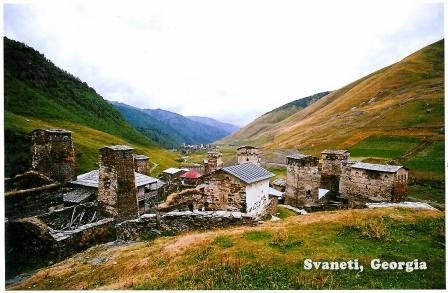
The 1st post of this week in a great adition to my UNESCO collection. Upper Svaneti is one of the three WHS in Georgia and with this card, sent by Sini, i've all of them!!
The card shows the Ushguli, the most picturesque Svan village.

Photo by Miriam Kiladze 
Svaneti is a historic province in Georgia, in the northwestern part of the country. It is inhabited by the Svans, an ethnic subgroup of the Georgians.
Surrounded by 3,000–5,000 meter peaks, Svaneti is the highest inhabited area in the Caucasus.
Svanetia is known for their architectural treasures and picturesque landscapes. The botany of Svanetia is legendary among travelers.
The famous Svanetian towers erected mainly in the 9th-12th centuries, make the region’s villages more attractive. In the province are dozens of Georgian orthodox churches and various fortified buildings. Architectural monuments of Upper Svanetia are included in a list of UNESCO World Heritage Sites. - in: wikipedia

Thursday, October 25, 2012

Bagrati Cathedral - Georgia

Another great card, this one from Georgia, the country, not the US state. It was kindly sent by Sini, after her holidays in Georgia. The Bagrati Cathedral was one of the monuments she visited. She says that the cathedral is a bit different than it looks on the card. Now it has a green roof and the building is surrounded by a fence, which makes impossible to visit the interior of the cathedral.
This is only my 2nd card from Georgia and my 2nd Unesco site from there.

 Photo by Tornike Turabelidze
The Cathedral of the Dormition, or the Kutaisi Cathedral, more commonly known as Bagrati Cathedral is the 11th-century cathedral church in the city of Kutaisi, the region of Imereti, Georgia. The cathedral, rebuilt officially on September 16th, 2012 after heavy damage ages ago,served as a masterpiece in the history of modern and medieval Georgan architecture.
A distinct landmark in the scenery of central Kutaisi, the cathedral rests upon the top of Uk’imerioni Hill. It was built in the early years of the 11th century, during the reign of King Bagrat III due to which it was called "Bagrati" Cathedral, i.e., Bagrat’s cathedral. In 1692, it was devastated in an explosion by the Ottoman troops, which had invaded the Kingdom of Imereti. The incident caused the cupola and ceiling to collapse.
The conservation and restoration are at works, as well as archaeological studies, which began in 1952, are finally finished. In 1994, the Bagrati Cathedral, together with the Gelati Monastery, was included in the UNESCO World Heritage Site list as a single entity. In 2001, the cathedral was restored to the Georgian Orthodox Church. It is now of limited use for worship services, but attracts many pilgrims and tourists. It is also frequently used as a symbol of the whole city of Kutaisi, being one of its main tourist attractions. - in: wikipedia

Thursday, October 13, 2011

Mtskheta - Georgia

Georgia is a new country in my collection and Mtskheta is a new Unesco site. Due to its historical significance and numerous ancient monuments, the Historical Monuments of Mtskheta became a UNESCO World Heritage Site in 1994.
Mtskheta is one of the oldest cities in Georgia and is located approximately 20 kilometers north of Tbilisi.


On this card, sent by Lídia, there's the Samtavro Monastery Bell Tower. According to legend, St. Nino actually lived on this site and prayed within the smaller of its two extant churches. This small church dates from the 4th century. The larger church on this site was built in the 11th century and contains the graves of Mirian, the Georgian king who adopted Christianity, and his wife. - in: http://wikitravel.org/en/Mtskheta