Showing posts with label Argentina. Show all posts

Tuesday, November 14, 2017

Perino Moreno Glacier - Argentina

In January of 2013 Jusseli visited Ushuaia, the southernmost city in the world, and she sent one of these Perito Moreno Glacier cards from there. The other card was sent by the same person who sent me one of the Iguazu Falls cards in the previous post. 

® www.180sur.com
The Perito Moreno Glacier is a glacier located in the Los Glaciares National Park in southwest Santa Cruz Province, Argentina. It is one of the most important tourist attractions in the Argentinian Patagonia. 
The 250 km2 (97 sq mi) ice formation, and 30 km (19 mi) in length, is one of 48 glaciers fed by the Southern Patagonian Ice Field located in the Andes system shared with Chile. This ice field is the world's third largest reserve of fresh water.

The Perito Moreno Glacier, located 78 kilometres (48 mi) from El Calafate, was named after the explorer Francisco Moreno, a pioneer who studied the region in the 19th century and played a major role in defending the territory of Argentina in the conflict surrounding the international border dispute with Chile. - in: wikipedia

Monday, November 13, 2017

Iguazu Falls - Argentina

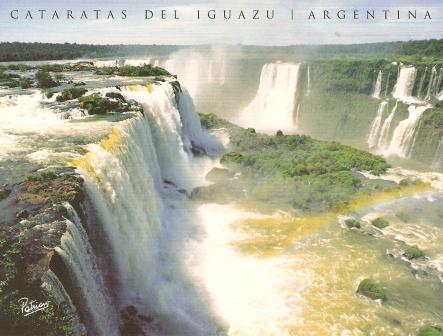
Last month Luzia went to Argentina to talk about Postcrossing. He talked about Postcrossing and met two local postcrossers with whom he had the 1st Postcrossing meeting in Argentina. What do you do in a meeting of these besides talking about postcards ?? Send postcards. So did Luzia. Shee sent the postcard with Devil's Throat where you can also see an image of the ruins of the Jesuit Mission of San Ignacio, one of Argentina's UNESCO sites.
I can not remember who sent the first postcard.

The Iguazu Falls are waterfalls of the Iguazu River on the border of the Argentine province of Misiones and the Brazilian state of Paraná. They are the largest waterfalls system in the world. 
The Iguazu River rises near the city of Curitiba, in Brazil. For most of its course, the river flows through Brazil; however, most of the falls are on the Argentine side. 
The falls are shared by the Iguazú National Park (Argentina) and Iguaçu National Park (Brazil). The two parks were designated UNESCO World Heritage Sites in 1984 and 1987, respectively.

Foto: Alberto Patrian © 2007 Argentina
The border between Brazil and Argentina runs through the Devil's Throat (spanish: Garganta del Diablo). On the right bank is the Brazilian territory, which has just over 20% of the jumps of these falls, and the left side jumps are Argentine, which make up almost 80% of the falls. - in: wikipedia

Saturday, November 10, 2012

Unesco TN cards from Argentina

These are the last touchnote cards sent by Paula, all of them showing Unesco sites in Argentina. I already had cards from these 3 places.

Photo by Alicia Nijdam
Badlands of the Valle de la Luna in Ischigualasto Provincial Park, an Unesco World Heritage Site since 2000.  

 Photo by Luca Galuzzi
Perito Moreno Glacier is found in Argentina located in the Los Glaciares National Park. The glacier is 97 square miles (250 sq km) and measures 19 miles (30 km) in length. Additionally, the glacier measures 3 miles (5 km) wide with a total ice depth of 558 feet (170 m). The deepest part of the glacier measures 2,297 feet (700 m).
Perito Moreno Glacier is one of three Patagonian glaciers that is not retreating. This ice field accounts for the world's third largest reserve of fresh water. - in: http://sevennaturalwonders.org/south-america/perito-moreno-glacier/

 Photo by Jahn Reinhard
Valdes Peninsula was listed as a World Heritage Site by UNESCO in 1999.
To watch sea-lions in this peninsula, the best time of the year is October as this is the time of procreation.

Sunday, August 26, 2012

Jacarandas Trees in Buenos Aires

This card from Argentina was in my PC favorites wall. Claus send it to me as an extra card the last time he tagged me.
That's a lovely card!!

Photo by Jose Luis Funes © Magiart
November is the best time of the year to see the jacarandá trees in bloom.
The first specimen of jacarandá, a tree original from the North-west of Argentina, was planted in Buenos Aires in 1875 with the inauguration of the 3 de Febrero Park, and it was then spread all over the city for its ornamental value in the different plantation programs. Some of the most beautiful specimens can be admired in Plaza San Martin, the Botanical Garden, along Avenida Figueroa Alcorta, Plaza Italia, Plaza Alemania. - in: http://timeandplace.com/blog/?paged=2

Unesco cards from Argentina

These 2 cards came from Finland, sent by Sini, but they're from two Unesco sites in Argentina, Peninsula Valdés and Cueva de las Manos, Río Pinturas, both inscribed on the Unesco World Heritage List in 1999.

 Photo by Alberto Patrian © 2006 Argentina
 The Valdes Peninsula is an important nature reserve on the Atlantic coast in the Viedma Department in the north east of Chubut Province.
The coastline is inhabited by marine mammals, like sea lions, elephant seals and fur seals. Southern right whales can be found in Golfo Nuevo and Golfo San José, protected bodies of water located between the peninsula and the Patagonian mainland. These baleen whales come here between May and December, for mating and giving birth, because the water in the gulf is quieter and warmer than in the open sea. Orcas can be found off the coast, in the open sea off the peninsula. In this area, they are known to beach themselves on shore to capture sea lions and elephant seals.
The inner part of the peninsula is inhabited by rheas, guanacos and maras. A high diversity and range of birds live in the peninsula as well; at least 181 bird species, 66 of which migratory, live in the area, including the Antarctic Pigeon. - in: wikipedia

 Serie Argentina © Claudio Suter Fotografia
The Cueva de las Manos, Río Pinturas, contains an exceptional assemblage of cave art, executed between 13,000 and 9,500 years ago. It takes its name (Cave of the Hands) from the stencilled outlines of human hands in the cave, but there are also many depictions of animals, such as guanacos (Lama guanicoe ), still commonly found in the region, as well as hunting scenes. The people responsible for the paintings may have been the ancestors of the historic hunter-gatherer communities of Patagonia found by European settlers in the 19th century. - in: http://whc.unesco.org/en/list/936

Thursday, March 22, 2012

Nothern Argentina

Jusseli is a brazilian lady who discovered my blog some time ago and kindly offered me a few cards from a trip in South America. She visited and sent me cards from Argentina, Chile, Bolivia and Peru.

© Marco Guoli


The cards shows three famous attraction Jujuy and Salta provinces in nothern Argentina.

Salinas Grandes (Big Salt Flats) is one of the most extensive salt flats in Argentina.

Iruya, a population of prehispanic origins, lives at the feet of the Sierra San Victoria.

Cierro de los Siete Colores, one of the icons at Quebrada de Humahuaca.

Monday, January 2, 2012

Purmamarca - Argentina

This card from Argentina, sent by Nicole, is another great Unesco acquisition for my collection. The card shows the Cerro de los Siete Colores, Seven Colours Hill, in Purmamarca, part of the Quebrada de Humahuaca, on the Unesco World Heritage List, for its cultural and historical and its stunning scenery, since 2003.

The word “quebrada” means deep valley or ravine. It’s famous for its multi-coloured mountains: each colour is the result of a different layer of sediments deposited over the last 600 million years. Successive tectonic plate movements gave them the shapes we see today.

One of the most important geomorphologic unit in Jujuy is EL Cerro de los siete Colores, located in Purmamarca. (The Seven Colours Hill) The Seven Colours Hill The multi-coulored sediments from the Mesozoic have been folded and eroded into strange shapes on this hill. Colour 1: light orange; composed with red clay, mud and sand; Age: 3 - 4 million years. Colour 2: white, composed with lime rock. Age: 400 million years. Colour 3: brown, purple and violet. The violet is composed with lead and the others are rich in calcium. Age: 80 – 90 million years. Colour 4: red, composed with clay & iron. Age: 3 – 4 million years. Colour 5: Green, composed with copper oxide. Colour 6: brown, composed by rock with manganese. Age: 1 – 2 million years. Colour 7: Yellow, composed with brimstone. Age: 80 – 90 million years. - http://www.quebradadehumahuaca.com/en

Sunday, October 2, 2011

Buenos Aires - Argentina

Julio contacted me via FB because he wanted to trade cards with me. So far i've received these two from Buenos Aires.


The Teatro Colón (Spanish) (Columbus Theatre) is the main opera house in Buenos Aires, Argentina, acousticly considered to be amongst the five best concert venues in the world.

The present Colón replaced an original theatre which opened in 1857. Towards the end of the century it became clear that a new theatre was needed and, after a 20-year process, the present theatre opened on May 25, 1908, with Giuseppe Verdi's Aïda.

The Teatro Colón was visited by the foremost singers and opera companies of the time, who would sometimes go on to other cities including Montevideo, Rio de Janeiro and São Paulo.

After this period of huge international success, the theatre's decline became clear and plans were made for massive renovations. After an initial start of works to restore the landmark in 2005, the theatre was closed for refurbishment from October 2006 to May 2010. It re-opened on May 24, 2010, with a program for the 2010 season. - in: wikipedia


Up to the year 1821, the Cabildo - opposite Mayo Square - was the seat of the city's government and law courts. The original building was demolished in the 18th century, the new one being finished in 1751 following the design of the Juesuit Father Andrés Blanqui. Between the years 1812 and 1931 the building underwent numerous transformations. Finally, in 1940, the architect Mario Buschiazzo did some refurbishings that returned the Cabildo to its original colonial appearence, the one that the building shows now.

The 1st Argentine government (Primera Junta) held its sessions there. Nowadays the cabildo building hosts the National Museums and Monuments Board and the May Revolution Museum.

Friday, July 29, 2011

Ischigualasto National Park - Argentina

Another Unesco card, Ischigualasto National Park in Argentina, sent by Nicole "sternchen86". Together with the Talampaya National Park, Ischigualasto was designated a Unesco World Heritage site in 2000.


Ischigualasto or Valle de la Luna (Valley of the moon) as it's often called, is one of the most important paleontologic sites in Argentina and the world.
It has fossil remains of vertebrates, foot prints of dinosaurs and petrified araucaria trunks that go back to the Mesozoic era, some 180 million years ago.
It's located in the NE of San Juan province, Argentina, near the border with Chile.
This is a major tourist attraction in Argentina you wouldn't want to miss: its impressive scenery and unspoiled beauty are unique and totally different from other natural areas in the country. "The mushroom", "The submarine", "The parrot" and "Alladin's lamp", are peculiar grey-green rock formations sculpted by the constant action of wind erosion over a period of millions of years. - in:
http://www.unique-southamerica-travel-experience.com/ischigualasto.html

Friday, November 28, 2008

Turkey, Germany, Argentina

I've received these great cards today. After an holiday, is always good to find nice cards in the mailbox.

This one was a complete surprise sent by Gokçe from Turkey.
This is the Suleiman The Magnificent Mosque, an Ottoman imperial mosque located on the Third Hill of Istanbul. "It is the second largest mosque in the city, and one of the best-known sights of Istanbul.
The Süleymaniye Mosque was built on the order of Sultan Suleiman I (Suleiman the Magnificent) and was constructed by the great Ottoman architect Mimar Sinan. The construction work began in 1550 and the mosque was finished in 1557.
Sinan considered the design to be an architectural counterpoint to the Byzantine Hagia Sophia. The Hagia Sophia, converted into a mosque under Mehmed II, served as a model to many Ottoman mosques in Istanbul. However, Sinan's Süleymaniye is a more symmetrical, rationalized and light-filled interpretation of earlier Ottoman precedents, as well as the Hagia Sophia." - in:
wikipedia


A card from Essen sent by Brigitte "apperveilchen", showing images of the city and the Zollverein Coal Mine Industrial Complex, a large former industrial site. It has been inscribed into the UNESCO list of World Heritage Sites since 2001 and is one of the anchor points of the European Route of Industrial Heritage.
The first coal mine on the premises was founded in 1847, mining activities took place from 1851 until December 23, 1986. For decades starting in the late 1950s, the two parts of the site, Zollverein Coal Mine and Zollverein Coking Plant (erected 1957−1961, closed on June 30, 1993), ranked among the largest of their kinds in Europe. Shaft 12, built in Bauhaus style, was opened in 1932 and is considered an architectural and technical masterpiece and earned reputation as the “most beautiful coal mine in the world”. - in:
wikipedia

And this is my 3rd card from Argentina, the 1st written and stamped from there. I won it on a lottery in the portuguese community forum and it was sent by Tereza "sati".
Onte the card we see the Recoleta, a neighbourhood; the Obelisk; Caminito Street; Casa Rosada (Pink House), Tango; Palermo neighbourhood, Mayo Square; Puerto Madero and Palermo neighbourhood again.

Monday, September 1, 2008

Buenos Aires - Argentina

This is a lottery card i got today. It was sent from Brazil by Carolina "caroulina".

On the back of the card: Also a museum, Caminito Street, is a must in every tourist's itinerary of Buenos Aires. It was inaugureted in 1959 to large the city's historical heritage. Nowadays it serves as a stage for different manifestations of the city culture. Amidst a setting of brughtly caloured houses made of wood and metal plate, tourists can daily appeciate the works of painters, sculptors and artisans and delight in the performances of tango dancers and actors.

Sunday, January 20, 2008

Buenos Aires - Argentina

My 1st and only card from Argentina and it shows San Telmo district in Buenos Aires. It was sent by Priscila.

San Telmo is a popular and typical district; at the 19th century it was a district for the richest families of Buenos Aires, and nowadays, ancient houses, restaurants and tango music give this place a very particular atmosphere. On Sunday mornings, there is a flea market at Plaza Dorrego, where you can find all kind of antiques and handicrafts, and a lot of peculiar characters.