Monday, September 9, 2013

St. Saphorin - Switzerland

And again, cards sent by Emerich and Grace. 

Considered one of the ten most beautiful villages in Switzerland, St. Saphorin has seen several famous writers and artists pass through its cobblestoned streets. 
St. Saphorin sits perched on one of the steeper slopes of the Lavaux region and affords visitors with a spectacular view of both the French and Swiss Alps. The village is well-known for its white wine, terraced vineyards and its picturesque, winding streets.

 Like most of the villages at the upper end of Lake Geneva (lac Léman), St. Saphorin was founded around the turn of the century and inhabited by Romans. One of the village’s most distinguishing features is the existence of a thousand-year-old stone, inscribed with the date 53 AD. At this time, the village was called Glerula.

 © Photoglob Zürich * Photo: R. Gerth
According to St. Saphorin’s local website, in its early days, the village was nearly completely destroyed by rising water following a landslide. This resulted in the reconstruction on higher ground of the main church, called St. Symphoriem, which would eventually give its name to the village. Winemaking has been the main industry of this village since its founding and the steep terraced layout of the entire village reflects this focus. - in:  https://suite101.com/a/visiting-the-swiss-village-of-st-saphorin-a140588

Matterhorn - Switzerland

Two swiss cards from the same place but in different seasons. The 1st was sent by Emerich and posted here months ago, the 2nd was sent by Grace. 

 The Matterhorn (German), Monte Cervino (Italian) or Mont Cervin (French), is a mountain in the Pennine Alps on the border between Switzerland and Italy. Its summit is 4,478 metres (14,690 ft) high, making it one of the highest peaks in the Alps. The four steep faces, rising above the surrounding glaciers, face the four compass points. The mountain overlooks the town of Zermatt in the canton of Valais to north-east and Breuil-Cervinia in the Aosta Valley to the south. The Theodul Pass, located at the eastern base of the peak, is the lowest passage between its north and south side.

                                        © Photoglob Zürich
The Matterhorn was the last great Alpine peak to be climbed and its first ascent marked the end of the golden age of alpinism. It was made in 1865 by a party led by Edward Whymper and ended tragically when four of its members fell to their deaths on the descent. The north face was not climbed until 1931, and is amongst the six great north faces of the Alps. The Matterhorn is one of the deadliest peaks in the Alps: from 1865 – when it was first climbed – to 1995, 500 alpinists died on it.
The Matterhorn has become an iconic emblem of the Swiss Alps and the Alps in general. Since the end of the 19th century, when railways were built, it attracted more and more visitors and climbers. Each summer a large number of mountaineers try to climb the Matterhorn via the northeast Hörnli ridge, the most popular route to the summit. - in: wikipedia 

Saturday, September 7, 2013

Bern - Switzerland

The 1st of these cards were also sent by Grace but the 2nd arrived this week, sent by Óscar. 

The city of Bern is Switzerland's capital. 
Bern lies on the Swiss plateau in the Canton of Bern, slightly west of the centre of Switzerland and 20 km (12 mi) north of the Bernese Alps. 
The city was originally built on a hilly peninsula surrounded by the River Aare, but outgrew the natural boundaries by the 19th century. A number of bridges have been built to allow the city to expand beyond the Aare.

 © Photoglob Zürich
The Old City of Bern is the medieval city center of Bern, Switzerland. Built on a narrow hill surrounded on three sides by the Aare River, its compact layout has remained essentially unchanged since its construction during the 12th to the 15th century. Despite a major fire in 1405, after which much of the city was rebuilt in sandstone, and substantial construction efforts in the 18th century, Bern's old city has retained its medieval character.
The Old City is home to Switzerland's tallest cathedral as well as other churches, bridges and a large collection of Renaissance fountains. In addition to many historical buildings, the seats of the federal, cantonal and municipal government are also situated in the Old City. It is a UNESCO Cultural World Heritage Site since 1983 due to the compact and generally intact medieval core and is an excellent example of incorporating the modern world into a medieval city. Numerous buildings in the Old City have been designated as Swiss Cultural Properties of National Significance, as well as the entire Old City. - in: wikipedia


Copyright by Wefo-Verlag AG
The Cathedral of Bern (Das Berner Münster) is Switzerland's largest ecclesiastical building. Construction started in 1421 and continued under a series of different builders for generations.
The spire was finally completed in 1893. The portal with its depiction of the Last Judgment is a remarkable feature. The vantage point of this masterpiece is located 344 steps above the entrance, in the 100m-high cathedral spire.
From Switzerland's highest church tower visitors can enjoy magnificent views across the city and into the Bernese Mittelland and the snow-capped mountains of the Bernese Oberland.

The Cathedral is Switzerland's largest and most significant church from the Late Middle Ages. As the dominant structure in Bern's Old Town, (...) the Cathedral plays a pivotal role in the city's architecture. - in: http://www.bern.com/en/city-of-bern/attractions/cathedral-of-bern

Tuesday, September 3, 2013

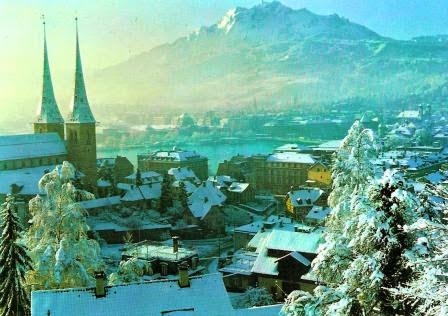
Luzern - Switzerland

I'll visit Luzern again one day. 

Luzern, the gateway to central Switzerland, sited on Lake Luzern, is embedded within an impressive mountainous panorama. Thanks to its attractions, its souvenir and watch shops, the beautiful lakeside setting and the nearby excursion mountains of the Rigi, Pilatus and Stanserhorn, the town is a destination for many travel groups and individuals on their journey through central Switzerland. - in: http://www.myswitzerland.com/en/lucerne.html

© Photoglob Zürich
On this card a view of the city with Mount Pilatus.
Mount Pilatus is a mountain overlooking Lucerne in Central Switzerland. It is composed of several summits of which the highest (The top can be reached with the Pilatus Railway, the world’s steepest cogwheel railway from Alpnachstad, operating from May to N2,128 m) is named Tomlishorn. 
ovember (depending on snow conditions), and the whole year with the aerial panorama gondolas and aerial cableways from Kriens. Both summits of Tomlishorn and Esel can be reached with a trail. Mount Pilatus has the longest summer toboggan track in Switzerland (0.88 miles or 1,350 m) and the biggest suspension rope park in Central Switzerland.
During the summer, the "Golden Round Trip" - a popular route for tourists - involves taking a boat from Lucerne across Lake Lucerne to Alpnachstad, going up on the cogwheel railway, coming down on the aerial cableways and panorama gondolas, and taking a bus back to Lucerne.
A few different local legends about the origin of the name exist. One claims that Mount Pilatus was named so because Pontius Pilate was buried there.
 Another is that the mountain looks like the belly of a large man, Pilate, lying on his back and was thus named for him.
Numbered amongst those who have reached its summit are Conrad Gessner, Theodore Roosevelt, Arthur Schopenhauer (1804), Queen Victoria and Julia Ward Howe (1867). - in: wikipedia

Murten - Switzerland

Murten (French: Morat) is a municipality in the See district of the canton of Fribourg in Switzerland.
It is located on the southern shores of Lake Morat. Morat is situated between Bern and Lausanne and is the capital of the See/Lac District of the canton of Fribourg. It is one of the municipalities with a large majority (about 75%) of German speakers in the mostly French speaking Canton of Fribourg.

 © Engadin Press Verlag, Samadan/Balgach * Foto: D. Tschantz
A town wall encircles the little town protectively. However, for a long time now the almost entirely preserved wall, the only one in Switzerland which you can walk all the way round, has not had to resist attackers, but rather has offered visitors a magnificent view of the nearby lake and the roofs of the Old Town. - http://www.myswitzerland.com/en/murten.html

© Photoglob Zürich
This building is the Rübenloch, a late Gothic-styled jewel located in the town’s main street (Hauptgasse).
The building was acquired by the town in 1874. It was to be demolished in order to provide direct access to the new railway station (the Broye Valley railway was inaugurated in 1876). Fortunately, due to lack of funds, the project was abandoned and the Rubenloch was left standing. - in: http://www.murtentourismus.ch/en/ruebenloch 
 

Monday, September 2, 2013

Fribourg - Switzerland

A nice view of Fribourg's Old City. 
Fribourg is the capital of the Swiss canton of Fribourg and the district of Sarine. It is located on both sides of the river Saane/Sarine, on the Swiss plateau, and is an important economic, administrative and educational center on the cultural border between German and French Switzerland (Romandy). Its Old City, one of the best maintained in Switzerland, sits on a small rocky hill above the valley of the Sarine. 

© Photoglob Zürich
Fribourg has preserved its medieval center as a whole that is now one of the largest in Europe. It is located on a spectacular peninsula, surrounded on three sides by the Saane/Sarine river. The architecture of the Old City date primarily from the Gothic period; it was built predominately before the 16th century. Most houses are built of the local molasse stone. Consisting of the neighborhoods Bourg, Auge and Neuveville, its old town is rich in fountains and churches dating from the 12th century until the 17th century. Its cathedral, reaching 76 metres (249 ft) in height, was built between 1283 and 1490. The fortifications of Fribourg form the most important medieval military architecture of Switzerland: 2 kilometres (1.2 mi) of ramparts, 14 towers and one big bulwark. The protections are especially well preserved east and south of the city. - in: wikipedia

Sunday, September 1, 2013

Val Müstair - Switzerland

Val Müstair is also a mountain valley in the canton of Graubünden. 

 © Foto Furter
The card shows the Ofen Pass, the Stelvio Pass, Lai da Rims Lake, Valchava Chasa Jura Museum, a castle ruins, the Benedictine Convent of Saint John and a view over Stª Maria, Valchava and Fuldera.