Friday, March 20, 2015

Uglich - Russia

Uglich Kremlin is on UNESCO Tentative List and that's why this card on in my favorites wall. The card was sent by Svetalana and it shows the 
Palace of Tsarevich Dmitry and the Resurrection Cathedral of the Resurrection Monastery. 

Uglich is a historical town in Yaroslavl oblast of Russia situated on the Volga river. The town was founded in 937 as a border fortress of Moscovy Principality.
The end of XVI century was memorized as a favorable time for Uglich when it became to be the town where major events in Russian history took place. When Prince Dmitry died, the dynasty of Ryurik was replaced by the dynasty of Romanovs whose members of the family originated from Uglich.
Uglich is one of the most precious towns of the Golden Ring as it has numerous buildings of ancient architecture. Uglich has preserved both historical and cultural traditions of Russia. - in: http://www.taritravel.com/programms/1303218969/1303302572.htm

Both the Palace of Tsarevich Dmitry and the Resurrection Cathedral are located within the territory of the Kremlin.
The palace of Tsarevich Dmitry, Ivan the Terrible's son, is the oldest building in Uglich. The palace dated back to 1480.  It is one of the few medieval Russian palaces that survived. Dmitri lived here from 1584 until 1591. It's an interesting brick building with simple but beautiful decorations. In the past the palace was a part of the ensemble of prince's residence, today the palace is a small museum. - in: http://www.intourist.com/Obj.aspx?id=569920&idr=2&ref=&currency=USD
The Resurrection Monastery is one of the most impressive sights in Uglich. Dating back to 1647, the Monastery is comprised of an enormous cathedral, refectory, belfry, and a summer church, all standing in a single row. - in: http://www.rivercruiseadvisor.com/city-guide/russia-city-guides/uglich-russia/

Thursday, March 19, 2015

Veliky Novgorod - Russia

This is the St. Peter and Paul Church in Kozhevniki, Veliky Novgorod. The card was sent by Tatiana. 

This is a marvellous church which is distinctive for the mature and complete architectural design. It is a fine example of the architecture of the early 15th century.
The church is made of large limestone blocks while its fine decorative elements are made of brick. The building is not plastered, which makes it look like Russian churches used to do centuries ago. Its trefoil arches made of aspen boards and the red colour of unplastered facades provides an amazing colour effect, and thus, the church perfectly harmonizes with the landscape. - in: http://visitnovgorod.com/sights/church_sts_peter_paul_kozhevniki.html

Tuesday, March 17, 2015

RU-3337233


After almost a week travelling in the Netherlands, I'm back. I've already requested a few official cards, sent thank you messages, scanned almost the cards I got in the Netherlands and now is time for some updates. Lets start with russian cards. 

RU-3337233, sent by Nat.
This St. Petersburg card is showing the Admiralty Building, the yellow building in the middle with a gilded sprire, St. Isaac's Cathedral dome in the back and one of Peter and Paul Cathedral's domes in the front.

Wednesday, March 4, 2015

DE-3972687

An austrian card sent as official from Germany. It shows the Steinhof Church in Vienna. 

© Popp-Hackner photography
DE-3972687, sent by Eberhard.
Otto Wagner designed this church, which was built between 1904 and 1907, on the grounds of the Lower Austrian State Asylum, now the Psychatric Hospital of the City of Vienna. 
 The copper-covered dome of this prime example of Viennese Art Nouveau architecture is visible from quite a distance, as the church stands high on the crest of the hill.
The interior design was adjusted to the requirements of the handicapped parishioners attending services here. The glass mosaics in the windows were designed by Kolo Moser. The inside of the church can be seen only once a week in a guided tour. - in: http://www.wien.info/en/sightseeing/sights/from-g-to-k/church-steinhof

Tuesday, March 3, 2015

Snowy Crans-Montana - Switzerland

 I didn't post much last month and this month I won't post much either because I'll go on holidays next week.  Snowy Crans-Montana won't be my destination but visiting a place with this much of snow would be great. Not this time though. 
These cards were sent by Óscar. 

© Photo Edition Darbellay CH-Martigny
The Plaine Morte is a glacier located at an elevation of 2,750 m (9,020 ft), in the canton of Bern in Switzerland. The ice field, which covers 10 square kilometres (3.9 sq mi), is located below the mountain of Wildstrubel in the Bernese Alps.
The area of Plaine Morte is easily accessible from Crans-Montana by cable car and the practice of cross-country skiing is possible throughout the year. The summit of the Pointe de la Plaine Morte offers impressive views of the Valais Alps. - in: wikipedia

© Photo Edition Darbellay CH-Martigny
Etang Grenon or Lac Grenon is a lake at Montana in the canton of Valais, Switzerland. Located at an elevation of 1497 m, its surface area is 3.5 ha. - in: wikipedia

Monday, March 2, 2015

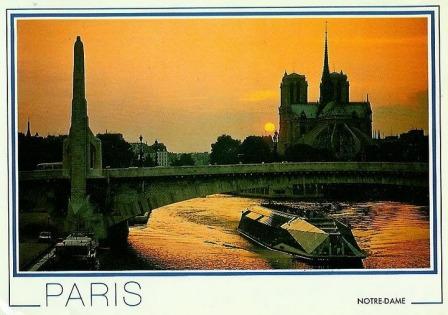
The Seine & Notre-Dame Cathedral - France

When I get a card similar to other cards that I already have, I mean, cards from the same place but with a different view, I like to post them together. I think is kind of interresting to see how different a place can be in different seasons, from different view points or different hours of the day. 
All these cards were sent as officials and all show the Notre Dame Cathedral seen from the Seine. 

FR-487942, sent by Patricia.
The Notre Dame Cathedral in Paris  is a Gothic cathedral on the eastern half of the Île de la Cité in the fourth arrondissement of Paris, France.
Notre Dame Cathedral is widely considered one of the finest examples of French Gothic architecture in the world. It was restored and saved from destruction by Eugène Viollet-le-Duc, one of France's most famous architects. The name Notre Dame means "Our Lady" in French, and is frequently used in the names of Catholic church buildings in Francophone countries.

Photo: Nicholas Keil
FR-360277, sent by Chris.
The Notre Dame Cathedral was one of the first Gothic cathedrals, and its construction spanned the Gothic period. Its sculptures and stained glass show the heavy influence of naturalism, unlike that of earlier Romanesque architecture.

 Foto: Karel A. DE GENDRE
FR-288619, sent by Cyrille. 
The Notre Dame Cathedral Paris was among the first buildings in the world to use the flying buttress (arched exterior supports). The building was not originally designed to include the flying buttresses around the choir and nave. 

FR-51330, sent by Alexandra.
 After the construction began and the thinner walls (popularized in the Gothic style) grew ever higher, stress fractures began to occur as the walls pushed outward. In response, the cathedral's architects built supports around the outside walls, and later additions continued the pattern.

DE-3953090, sent by Lisa.
The cathedral suffered desecration during the radical phase of the French Revolution in the 1790s, when much of its religious imagery was damaged or destroyed. During the 19th century, an extensive restoration project was completed, returning the cathedral to its previous state. - in: http://www.notredamecathedralparis.com/

Montalegre - Portugal

Manú visited Montalegre, a city in northern Portugal, a few weeks ago and sent me these 4 cards from there. Just a few days later, Gracinha, also sent me one of these cards, the last one. 

Edição: Câmara Municipal de Montalegre
This 1st card is showing a "chega de bois", a bulls fight. This is an important part of the cattle breeders  activity in the portuguese region of Trás-os-Montes. Of ancestral origins, these bull fights were driven in the last decades as an incentive to the creation of the Portuguese breeds, especially the Mirandesa and Barrosã breeds.
Every year, during summer, is held in Montalegre the Barrosã's breed National Bull Fight Championship and the Mirandesa's breed National Bull Fight Championship in Vinhais
The idea of these fights is to approach two males, which will keep their heads against each other to determine the strongest. These fights rarely imply some kind of injury to any of the animals. 


Edição: Câmara Municipal de Montalegre
A lady shepherd with her herd in Larouco mountain. 

Edição: Câmara Municipal de Montalegre
Montalegre Castle is a portuguese National Monument situated at a place inhabited by Lusitanian people, Romans, Suevi and Visigoths in ancient times. It was built between 1279-1325. Under D. Afonso IV ruling, the still existing keep was erected. This castle is about 21m high and it has a cistern covered by carved stone. 

Edição: Câmara Municipal de Montalegre
This historical structure, popularly named as “Roman Fountain”, is situated in the picturesque small village of Arcos, in Montalegre municipality. 
This is a region with quite ancient human occupancy, rich in archaeological vestiges, many of them dated from the Roman occupancy of the territory. 
The region is also characterized by its astonishing natural landscapes, rich in fresh and pure mountain water. 
Many small villages and settlements in the region have taken advantage of this precious good. In most of the places one can find fountains that for centuries have supplied the populations with the freshest waters. 
That’s the case of this granite structure, that supplied Arcos population for centuries.