Saturday, November 2, 2019

Sheki Khans' Palace - Azerbaijan

The 43rd Session of the UNESCO World Heritage Committee was held in Baku, Azerbaijan and the country had Sheki Khans' Palace added to the WHS list. This is the third case of an Azerbaijani historical monument making its way onto the UNESCO World Heritage List. 
This is my 2nd Unesco card from Azerbaijan but my 1st written and stamped from the country. Thanks to Olga. 

At the crossroads of Europe and Asia, bordered by the Caspian Sea and the Caucasus Mountains, it was an important thoroughfare on the Silk Road, the ancient web of trade routes linking East and West.
By the 19th century, Sheki, on the Silk Road path through northwest Azerbaijan, was an international center for silk production.
Today, it's one of Azerbaijan's most picturesque towns, filled with cobbled streets and medieval architecture: a fresh, bucolic retreat from the more arid south.
It's largely been off most tourists' radar, but that could be set to change: In July 2019, its historic center and Khan Palace were added to the UNESCO World Heritage list. - in: https://edition.cnn.com

A unique architectural monument of the khanate, the Sheki Khans' Palace was built in 1762 by Huseyn khan and sits shaded by huge chinar trees within the khan's fortress at the top of this charming Silk Road city. The palace windows are stunning examples of the ancient art of 'shebeke' – wooden lattices filled with stained glass and put together without glue or nails! - in: https://azerbaijan.travel/en/

Friday, November 1, 2019

Western Caucasus - Russia

I've been on holidays this last week and I was hoping to find many cards waiting for me at home. I actually received a few, including officials. One of them was from a Russian UNESCO site, Western Caucasus, added to the WHS list in 1999, exactly when I got my 1st card from there, sent by Polina. 

Photo by Yuri Avakyan
RU-7578182, sent by Natalia.
"The Western Caucasus, extending over 275,000 ha of the extreme western end of the Caucasus mountains and located 50 km north-east of the Black Sea, is one of the few large mountain areas of Europe that has not experienced significant human impact. 


Its subalpine and alpine pastures have only been grazed by wild animals, and its extensive tracts of undisturbed mountain forests, extending from the lowlands to the subalpine zone, are unique in Europe. The site has a great diversity of ecosystems, with important endemic plants and wildlife, and is the place of origin and reintroduction of the mountain subspecies of the European bison." - in: http://whs.unesco.org/en/list/900

Saturday, October 19, 2019

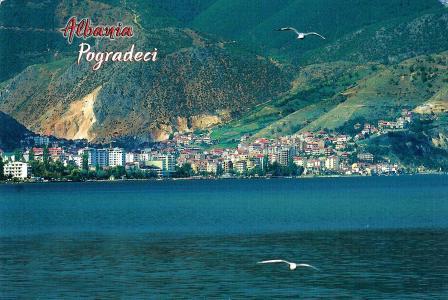
Pogradec - Albania

The Macedonian side of Lake Ohrid was declared a World Heritage Site by UNESCO in 1979, with the site being extended to also include the cultural and historic area of Ohrid in 1980. The Albanian side of Lake Ohrid was also designated UNESCO world heritage status in 2019.
The towns situated at the lakeside are Ohrid and Struga in Macedonia along with Pogradec in Albania. - in: wikipedia
This card was also sent by Boris.

Photo: Armando Baguca
The city of Pogradec lies on the western shore of Lake Ohrid, which is the heart and soul of this city. 
Ohrid is the deepest (285m) lake in the Balkans, and is split between Macedonia (in Ohrid and Struga), and Albania. It took around 4 million years for this lake to form its present shape, from the moment the soil began to shift on the western side of the Dinaric Alps. Now, it is a veritable, picture-perfect swan lake, as well as an ecosystem that includes over 200 species – making it a real national treasure. - in: https://www.intoalbania.com

Valbona Valley National Park - Albania

Last month, I think, Boris went on a trip to Albania, hoping to visit all the UNESCO sites in the country. That's my kind of trip. He wanted to visit and, of course, get and send cards from the sites, I can relate to that too. 
In 2017, the Gashi River, located within the Valbona National Park, was listed as part of the Ancient and Primeval Beech Forests of the Carpathians and Other Regions of Europe. However, there are other rivers within the park and this card doesn't identify which of them is this one. Anyway, even though I'm not sure this is a card from a missing site, I like it a lot!!

Photo: Armando Baguca
Situated in the far north of Albania, Valbona Valley National Park borders Montenegro to the north and Theth National Park to the west. 
With its dramatic, barren summits and forested valleys, glacial springs and waterfalls, it's an heavenly place both for humans and animals. The park's Gashi River is part of the multi-unit UNESCO Primeval Beech Forests World Heritage Site. In addition to floral diversity, Valbona Valley is also home to lots of wildlife. This includes brown bears, lynx, chamois, grey wolves, wild goats and countless bird species. 

Friday, October 18, 2019

MD-60462

This is my 2nd official from Moldova, only my 5th card from this country. 
The building on the card is Chişinău City Hall.

Photo: Igor Sirbu
MD-60462, sent by Kate.
Chişinău City Hall is a historical and architectural monument built in Italian Gothic style located in Central Chişinău, Moldova. Originally constructed to house the city Duma in 1901, the building was nearly destroyed during World War II. It was rebuilt in the postwar period based on surviving images and construction plans. - in: wikipedia

Monday, October 14, 2019

Häme Castle - Finland

One of the things I learnt in Finland is that if a city name ends in linna, that means there is a castle there. Thus, in Hämeenlina we find Häme Castle, which was part of the program of postcard meeting that took place in September. In the last of the 3 days there was a guided tour to the castle.
Over 100 people attended this meeting, including Heidi and Anna-Maria who sent me one of the official postcards of the meeting.

Postcrossing logo is a registered trademark * Photo: Taneli Eskola
Häme Castle is one of Finland’s medieval royal castles. It is believed to have been built at the end of the 13th century, following the crusade by Swedish Earl Birger to Häme region. During the Middle Ages the original fortified camp was built into a residential castle for its commandant. In the 18th century a third storey was built and curtain wall buildings partly replaced the original outer walls. The castle and its surroundings were in prison use from 1837 to 1972. The main castle is now presented as a historical monument.

FI-753195, sent by dubbu with a special hologram stamp.
The Häme Castle and its redbrick barracks are on the shore of Lake Vanajavesi. The promontary has been a meeting place for centuries, and the walls almost echo the voices from the Middle Ages." - in: www.nba.fi/en/hame_castle

FI-3569291

I definitely need to travel to northern Europe in winter. I want to see the northern lights and I want lots of snow. These snow-covered trees in Kuusamo look so pretty and magical. I just want snow but for those who like winter sports, Kuusamo is a place to go. This city in the Northern Ostrobothnia region is a major center for winter sports and receives approximately a million tourists every year. One of the largest ski resorts in Finland, Ruka, is situated in Kuusamo. 

Foto: Keijo Penttinen
FI-3569291, sent by Iiris.
The average annual temperature in Kuusamo is −0.37 °C (...). The warmest month is July with an average temperature of +14.3 °C, coldest January with −13.2 °C. 
Kuusamo is one of the snowiest areas in Finland: the ground is snow-covered for about 200 days a year, from late October until mid-May, with a thickness of 80–90 centimetres (31–35 in).
The center of Kuusamo is located approximately 60 km (37 mi) south of the Arctic Circle, thus polar day and night play a major role. From 14 to 29 June Kuusamo has midnight sun. - in: wikipedia