Sunday, July 1, 2012

Krak des Chevaliers - Syria

The Unesco Commitee has been choosing the new Unesco sites and Portugal has a new one, Garrison Border Town of Elvas and its Fortifications!! That's really good news. Not so good news are the other sites, some are really hard to get, i only have 2 sites and they already nominated 25 sites.

This card is also from an Unesco site, this one nominated in 2006. Krak des Chevaliers  is a Crusader castle in Syria and one of the most important preserved medieval castles in the world.
I like to watch Globetrekker and one of the episodes is about Syria. In this episode, the presenter, Holly Morris, explores some of the country's most famous sites and cities including this castle and other syrian Unesco sites.
The card was sent by Constanze.


The site was first inhabited in the 11th century by a settlement of Kurds; as a result it was known as Hisn al Akrad, meaning the "Castle of the Kurds". In 1142 it was given by Raymond II, Count of Tripoli, to the Knights Hospitaller. It remained in their possession until it fell in 1271. It became known as Crac de l'Ospital; the name Krak des Chevaliers was coined in the 19th century.
The Hospitallers began rebuilding the castle in the 1140s and were finished by 1170 when an earthquake damaged the castle. The order controlled a number of castles along the border of the County of Tripoli, a state founded after the First Crusade. Krak des Chevaliers was amongst the most important and acted as a centre of administration as well as a military base. After a second phase of building was undertaken in the 13th century, Krak des Chevaliers became a concentric castle. This phase created the outer wall and gave the castle its current appearance. The first half of the century has been described as Krak des Chevaliers' "golden age". At its peak, Krak des Chevaliers housed a garrison of around 2,000. Such a large garrison allowed the Hospitallers to extract tribute from a wide area. From the 1250s the fortunes of the Knights Hospitaller took a turn for the worse and in 1271 Krak des Chevaliers was captured by the Mamluk Sultan Baibars after a siege lasting 36 days. - in: wikipedia

Saturday, June 30, 2012

GR-25367

My very 1st official from Greece.

 Photo: S. Mamidis Photography © 20102
GR-25367, sent by Dora.
Ermoupolis is a town on the island of Syros, located 78 nautical miles (144 km) south-east of Athens, in the Cyclades. The city was founded during the Greek Revolution in the 1820s.

CZ-193833

An official from Czech Republic. I don't get many officials from there.

 Argus
CZ-193833, sent by Pavla.
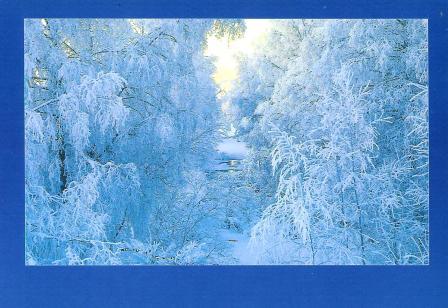
A snowy view somewhere in the world.

Friday, June 29, 2012

PL-464414

Another painting card, this one from Białystok, in northeastern Poland.

 Author: Jaroslaw Glod
PL-464414, sent by Justyna.
Białystok is the largest city in northeastern Poland and the capital of the Podlaskie Voivodeship. The card shows the Market Square.

RU-973163, RU-979952 & ES-167275

Two russian and one spanish officials cards but all the card are from Russia and the last two were both sent by forum members.


 RU-973163, sent by Maria.
This is a painting of the Alexander Nevsky Chapel in Krasnodar by Konstantin Pechurichko.


 RU-979952, sent by Anasty.
I've traded before with Anastasia, mostly Unesco cards. This time she sent me this lovely bridge located in the Tsaritsyno Park in Moscow.
The estate is known from the late 16th century, when it belonged to Tsarina Irina, sister of Tsar Boris Godunov. At that time it was called Bogorodskoye. In 1775, when the estate was bought by empress Catherine the Great, it received its present name, which means “Tsarina’s”.
The 18th-century architecture ensemble was built (though not finished) following the order of Catherine II in pseudo-Gothic style, after projects of the Bazhenov and Kazakov, and it is the only 18th-century architectural ensemble of such dimensions in Russia.
Around the palace, in the park there are a number of pavilions, pergolas, arbours, artificial grottos, decorative bridges (early 19th century, architect I. Yegotov), and a Russian Orthodox temple “Source of Life”, as well as a modern recreation center with an upscale restaurant. - in: wikipedia


ES-167275, sent by Anna.
Anna is known in the forum as "bogdanovskaya" and i've also traded with a few time. She sent me my 1st St. Petersburg cards. I've many from there but none with the St. Nicholas Naval Cathedral.
St. Nicholas Naval Cathedral is a large Orthodox church in the style of the Elizabeth Baroque, located in Saint Petersburg.
The Cathedral was built in 1753–1762 by architect Savva Chevakinsky as a marine regimental church on the sea regimental court in place of a earlier wooden church. Freestanding four story bell tower with a tall gilded spire was built in in 1755–1758.
St. Nicholas Naval Cathedral consists of two separate churches. The lower Saint Nicholas Church is located on the first floor, while the upper Epiphany Church is on the second floor. The altar of the upper church was consecrated in the presence of the Empress Catherine II, who told the newly built church to be called a cathedral. The main shrine of the cathedral—a Greek icon of St. Nicholas made in the XVII century with a portion of his relics—is located in the lower church. - in: wikipedia

Lighthouses

A few days ago i've decided to get rid of some cards and opened a thread offering 3 of my cards for 1 card macthing my wishlist. I've received very good offer and the 1st cards started to arrive last week. 
These 2 were sent by Annina from Finland and show lighthouses in Sweden and France.  

 Aquarupella © Inger Perron
Tylön is situated in Halmstad Municipality, Halland County, Sweden, just off the coast from Halmstad. The Tylön island is mainly covered by green meadows and is a nature reserve well known among nesting birds like eider, black-backed gull and herring gull. Tern, eared owl and peregrine falcon are also among the visitors.
The lighthouse was built 1870 but is no longer in use, it was closed 1968.
The island was used by fishermen during the seventeenhundreds and there are also ancient remnants on the island dating back to the bronze age.Visits to Tylön is prohibited during most of the year for the protection of the birds. - in: http://nokotahorse.wordpress.com/2012/03/16/west-coast-lighthouses/

Aquarupella © Yann Arthus-Bertrand - Altitude
This is my 2nd card of the de la Vieille lighthouse in Brittany, France.
"La Vieille" lighthouse, located in Finistère region was built from 1882 to 1887 on the Gorlebella  rock ("the farthest rock" in Breton language).
It gives security to the Sein current crossing, together with La Plate tower.
Located on Plogoff city limits, it is state owned.
La Vieille's "hell" is famous for its isolated location at sea in a rough zone.On top of that, it took almost ten years to build and was the penultimate french lighthouse to be automated resulting in the relief refusal by its keepers in 1995, as a protest. - in:
http://www.alrocreation.fr/en/Vieille_EN.html

Thursday, June 28, 2012

FI-1446041, FI-1455404 & FI-1461326

Summer is finally here but this high temperatures make me wish for a colder weather. I really don't like summer, i'm a winter kind of person and that's maybe why i like snowy views.

 RP Studio
 FI-1446041, sent by Minna.
Winter is the longest season in Finland.  Winter usually begins in mid-October in Lapland and during November in the rest of Finland, though not until December in the southwestern archipelago. It thus takes about two months for winter to proceed from Lapland to Åland.

 Photo by LKA / Lassa Rautiainen
 FI-1455404, sent by Niina.
Permanent snow covers open grounds about two weeks after winter begins. The snow cover is deepest around mid-March, with an average of 60 to 90 cm of snow in eastern and northern Finland and 20 to 30 cm in southwestern Finland. The lakes freeze over in late November and early December. The ice is thickest in early April, at about 50 to 65 cm. In severe winters, the Baltic Sea may ice over almost completely, but in mild winters it remains open except for the far ends of the Gulf of Bothnia and the Gulf of Finland.
 Karto
FI-1461326, sent by Esa.
In summer the mean daily temperature is consistently above 10°C. Summer usually begins in late May in southern Finland and lasts until mid-September. Summer in Lapland starts about one month later and ends a month earlier than the south coast.
The regions north of the Arctic Circle are characterized by "polar days", when the sun does not set at all. The northernmost parts of Finland have 73 such days every year. Even in southern Finland, the longest day (around Midsummer) is nearly 19 hours long. The warmest day of the year comes about one month after aphelion, i.e. around July 20, in the whole of Finland. - in:
http://en.ilmatieteenlaitos.fi/seasons-in-finland