Monday, March 30, 2015

AU-405427

Mountain ash and tree ferns in Sherbrooke Forrest, Dandenong Ranges National Park, Victoria. 

© Steve Parish Publishing PTY LTD
AU-405427, sent by Carolyn.
Sherbrooke Forest lies at an altitude of 300 m within the Dandenong Ranges, 40 km east of Melbourne, in Victoria, Australia, close to the suburb of Belgrave. The vegetation is classified as wet sclerophyll forest with the dominant tree species the Mountain Ash, Eucalyptus regnans, the tallest flowering plant in the world. From the mid 19th century until 1930 it was logged. In 1958 it was gazetted as a park, and in 1987 it was merged with Doongalla Reserve and Ferntree Gully National Park to form the 32.15 km² Dandenong Ranges National Park.
Sherbrooke Forest is famous for its population of Superb Lyrebirds and was an early, and still important, site for the study and conservation of this species. - in: wikipedia

Namhansanseong - South Korea

Namhansanseong was one of the new sites added last year to the WHS list and this card was the last surprise sent by Claus. He really made my day. Thank you so much!!! 

Namhansanseong was designed as an emergency capital for the Joseon dynasty (1392–1910), in a mountainous site 25 km south-east of Seoul. Built and defended by Buddhist monk-soldiers, it could accommodate 4,000 people and fulfilled important administrative and military functions. Its earliest remains date from the 7th century, but it was rebuilt several times, notably in the early 17th century in anticipation of an attack from the Sino-Manchu Qing dynasty. The city embodies a synthesis of the defensive military engineering concepts of the period, based on Chinese and Japanese influences, and changes in the art of fortification following the introduction from the West of weapons using gunpowder. A city that has always been inhabited, and which was the provincial capital over a long period, it contains evidence of a variety of military, civil and religious buildings and has become a symbol of Korean sovereignty. - in: http://whc.unesco.org/en/list/1439

Thursday, March 26, 2015

JP-642768

First built as a fortress on the top of Mt. Kinka in 1201, Gifu Castle has a history of about 800 years.

JP-642768, sent by Mary. 
ODA Nobunaga, a famous general in Sengoku period, occupied the castle and became its master in 1567. At this time, ODA changed the name of this area from “Inokuchi” to “Gifu” and of the castle itself from “Inabayama Castle” to “Gifu Castle”. As ODA expanded his empire and unified the nation with his fresh ideas and unique politics, Gifu Castle became a bustling center of activity.
The ODA family lost the castle after Hidenobu, Nobunaga's grandson, allied his clan with the losing side of the decisive Battle of Sekigahara in 1600 that resulted in over 250 years of Edo Shogunate rule of Japan.
The present three-story and four-floor castle was rebuilt with ferroconcrete construction in 1956 and has been a popular symbol of Gifu City ever since. - in: http://www.gifucvb.or.jp/en/01_sightseeing/01_02.html

Wednesday, March 25, 2015

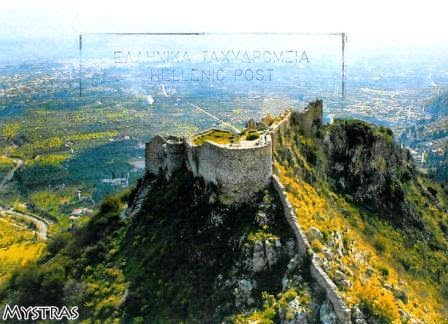
Mystras - Greece

The Archaeological Site of Mystras was added to the World Heritage List in 1989 and it was added to my collection last week thanks to Elena. Its the 819th site in my UNESCO collection. 

Mystras, the 'Wonder of the Morea', was built as an amphitheatre around the fortress erected in 1249 by William of Villehardouin. Reconquered by the Byzantines, then occupied by the Turks and the Venetians, the city was abandoned in 1832, leaving only the breathtaking medieval ruins, standing in a beautiful landscape. The complex of the ruins of Mystras offers the image of a city with a brilliant destiny that was deserted by men and threatened by the return of encroaching vegetation, which is splitting the walls and covering the slopes, thus destroying here and there fragile traces of history. - in: http://whc.unesco.org/en/list/511

Budapest - Hungary

It was in January that Ara visited Budapest. She said it's a beautiful city and I believe her, it's one of the cities on my must visit list. 

© Photo Huber Pál Kolozs
The card shows the Parliament Building and the Fisherman's Bastion.

Friday, March 20, 2015

LT-425959

Netherlands is already in the past and now its time to think about the next destination. Lithunia is on the top of the list for my trip in september. If I really can travel there, these are two of the churches I'll see in Vilnius. St. Anne's Church (on the left) and Bernardine's Church (on the right). 

Foto: © Antanas Varanka
LT-425959, sent by Ieva. 
Church of Francis from Assisi or Bernardine church is located in Vilnius old-town on the bank of Vilnelė river. Church of Francis from Assisi together with St. Anne’s church makes up a very impressive gothic architecture ensemble.
Once forming part of the city’s original defensive walls and constructed on the site of an earlier wooden church dating from the middle of the 15th century at the behest of an order of Bernadine monks, the current vast Gothic church with Baroque and Renaissance additions dates from the early part of the 16th century onwards. - in: http://www.inyourpocket.com/lithuania/vilnius/sightseeing/churches/Bernardine-Church-and-Monastery_12589v
St. Anne's Church, built between 1495-1500, is a Roman Catholic church in Vilnius' Old Town. It is a prominent example of both Flamboyant Gothic and Brick Gothic styles.

Eurasian Linx - Belarus

These cards are so beautiful, I really like them. I've received the 2nd card in 2013 and the 1st arrived a couple of weeks ago. 

The Eurasian lynx (Lynx lynx) is the biggest of the lynxes. It is native to European and Siberian forests. While its conservation status has been classified as "Least Concern", populations of Eurasian lynx have been reduced or extirpated from western Europe, where it is now being reintroduced.

The Eurasian Lynx is the third largest predator in Europe after the brown bear and the grey wolf. Out of the four lynx species, the Eurasian Lynx is the largest in size. It is a strict carnivore, consuming about one or two kilograms of meat every day. The Eurasian Lynx is one of the widest-ranging, and is found in forests of western Europe, Russia, and Central Asia. - in: wikipedia