Thursday, May 28, 2015

Canela - Brazil

Two different cards of the same cathedral in Canela, Rio Grande do Sul state in Brazil. Yes, it snows in Brazil!!
Both cards are sent by Déa, my sweet brazilian friend. 

Foto: Ernani Marques
The Cathedral of Our Lady of Lourdes, also known as Cathedral of Stone, is considered one of the major tourist attraction in Canela.
Its characteristic style is English Gothic. The church has a tower with 65 meters high, and a carillon of 12 bells made of bronze by foundry Giacomo Crespi, Italy. In its interior are three panels consisting of painted canvases by the gaucho artist Marciano Schmitz, depicting the "Apparition of Our Lady", the "Allegory of the Angels", and "Annunciation". 

The paintings of Via Sacra were made by Pablo Herrera, a Uruguayan sculptor and restorer of Sacred Art. Wood and clay were used, with the background painting having superimposed images in clay.
Its stained glasses represent the litany of Our Lady. The altar, whose theme is the Last Supper, is a work of art carved in by wood Julius Tixe, a Uruguayan sculptor. - in: wikipedia
In 2010 it was classified as one of the 7 Wonders of Brazil. 

Churches in Minas Gerais - Brazil

A few weeks ago I agreed on a trade with Sílvia. We traded 8 cards in an envelope and most of the card I picked from her albuns were churches cards. All these 5 churches are located in different places around the Minas Gerais state. 

Foto: Sérgio Mourão
This is the Church of Our Lady of the Rosary in Cocais. Although there is not much information about the date of construction of this church and who participated in the works, is believed that it has been built in the 18th century by a group of former black slaves.

Foto: Sérgio Mourão
There was not much information about the previous church but there's even less information about this one in Itamonte. I only know its name, Church of Our Lady of Conceição and it was under renovation works not so long ago. 

Sérgio Ricardo de Freitas
The parish church of St. Anthony in Tiradentes is one of the most beautiful Baroque buildings in Brazil. It was built in 1710. Inside there is an organ dating from 1788, considered one of the fifteen most important in the world.

Sérgio Ricardo de Freitas
The Church of Our Lady of Carmo in Ouro Preto was one of the last projects of the architect Manuel Francisco Lisboa, Aleijadinho's father. The church was built in Rococo style - the last phase of the Baroque, less laden with gold. It is the only church in state with Portuguese tile panels. Its construction took place between 1766 and 1772.

Foto: Sérgio Mourão
This is the beautiful Church of Our Lady of Mercy, in São João Del Rei, built in 1853 to replace a chapel built in 1751.

Itu - Brazil

The next posts will be dedicated to brazilian cards, I've received a lot in the last weeks. This one was sent by Luzia.
Itu is a city in the state of São Paulo. It was founded in 1610 by the portuguese Domingos Fernandes. Itu was the birthplace of the brazilian republic. 

Foto: Cândido Mariano

I didn't find much about this church! It was built by Father Jesuíno do Monte Carmelo and his sons and it was inaugurated in 1819. 

Monday, May 25, 2015

Tamarindos Beach - São Tomé and Príncipe

This is not my 1st card from São Tomé and Príncipe but its the 1st I'm posting here. It was also sent by Paulo. 

Foto: Direcção de Turismo e Hotelaria de São Tomé e Príncipe
Tamarindos Beach is located in the north coast of São Tomé island, 15 kms from the capital city. 

Sunday, May 24, 2015

Sabratha - Libya

Getting 135 is great and it gets even greater when you find out that one of the cards is from a missing UNESCO site, an hard to get one. This card is showing the theatre of Sabratha, an archaeological site  inscribed as a UNESCO World Heritage Site in 1982.
Sabratha in the northwestern corner of modern Libya, was the westernmost of the "three cities" (Sabratha, Oea and Leptis Magna) of ancient Tripolitania. It lies on the Mediterranean coast about 66 km (41 mi) west of Tripoli. 

© High Aothority for Tourism and Antiquities
The theatre was built in 175-200 AD, so it was started by Emperor Marcus Aurelius; the construction was continued by his son Commodus and completed with a lavish proscaenium by Emperor Septimius Severus who was born in Leptis Magna; this time frame is applicable also to the enlargement of the theatre of Ostia. 
The area which best survived to our time is the base of the stage which was decorated with reliefs portraying gods and scenes from comedies and dances; the image used as background for this page shows a relief portraying Paris being asked by Hermes which of three goddesses was the fairest. - in: http://romeartlover.tripod.com/Sabrata2.html

Cards from Cyprus

A few months ago I met Paulo and he gave me a bag full of cards. A few days ago I've got another gift from him, an envelope with 135 cards. How nice is that?? These 4 are from Cyprus. 

© Omnicard Photobank
Limassol is a city on the southern coast of Cyprus and capital of the eponymous district. Limassol is the second largest urban area in Cyprus. 
The Port of Limassol is one of the busiest ports in the Mediterranean transit trade and the largest port in Cyprus. It has also become one of the most important tourism, trade, and service-providing centres in the area. 
 A wide spectrum of activities and a number of museums and archaeological sites are available to the interested visitor. Consequently, Limassol attracts a wide range of tourists mostly during an extended summer season to be accommodated in a wide range of hotels and apartments. A large marina is currently being constructed near the old town.
Limassol was built between two ancient cities, Amathus and Kourion, and during Byzantine rule it was known as Neapolis (new town). Limassol's historical centre is located around its medieval Limassol Castle and the Old Port. Today the city spreads along the Mediterranean coast and has extended much farther than the castle and port, with its suburbs stretching along the coast to Amathus. - in: wikipedia

© Omnicard Photobank
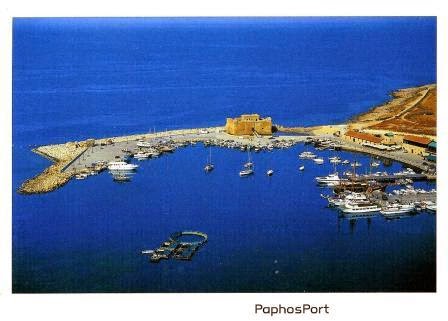
 Pafos castle was originally a Byzantine fort built to protect the harbour. It was rebuilt by the Lusignans in the 13th century, dismantled by the Venetians in 1570 during the Ottoman invasion and rebuilt by the Ottomans after they captured the island in the 16th century. Originally, this role was served by the Saranta Kolones fort, the ruins of which lie a few hundred meters to the north. During its long history, the Pafos Castle was used, as well as for protection, as prison cells, and even as a storage area for salt when the island was a British colony. In 1935 it was declared an ancient monument and today is considered as one of the hallmarks of the Pafos region.
Many cultural events take place in the square just in front of the castle, while during September each year the Pafos Aphrodite Festival which presents a different opera every year staged here by world famous artists with the castle building usually acting as part of the scenery. - in: http://www.visitpafos.org.cy/Medieval_Castle_of_Paphos.aspx

© George Hadjimenikou
Located in the heart of Kato Paphos, the Byzantine-style Agia Kyriaki church was built around the 13th Century on the site of an earlier Basilica and is surrounded by Roman ruins and mosaics. Ayia Kyriaki lends a real sense of tradition and history to the occasion.
The floor of the basilica was covered with colourful mosaics, some of which are still preserved.

© George Hadjimenikou
The Stavrovouni Monastery, located on the summit of lonely mountain ca 17 km NW of Larnaca, is the oldest and probably also the most important Orthodox monastery on Cyprus.
The Stavrovouni Monastery, as the name already says, is dedicated to the Holy Cross.  According to legend, the monastery was founded by St. Helena, the mother of the Byzantine Emperor Constantine I (she also discovered and bring into monastery a piece of the super-relics, Holy Cross). 
Stavrovouni, the oldest documented monastery on Cyprus (326 AD), had been an important religious centre since the 4th century. In its long history, Stavrovouni went through times of great poverty and hardship caused by the most varied invasions by foreigners on the island. The walls , the church, the iconostasis and monks' cells in Stavrovouni were almost completely destroyed during a great fire in 1888.
Recently, the monastery underwent a complete renovation. Its small church was restored again with frescoes and icons by well-known painter, Fr. Kallinikos, a monk from Stavrovouni. The present monks in Stavrovouni live a very strict form of monastic life, similar to that of the monks on Mount Athos. The rule of their first abbot , Dyonisios, forms the basis of this. Perhaps that is why it is still forbidden even today for women to visit Stavrovouni. - in: http://www.waymarking.com/waymarks/WMJDB7_Stavrovouni_Monastery_Larnaca_Cyprus

Thursday, May 21, 2015

TW-1578515

This is an official from Taiwan but the card is actually from Japan, it shows the Matsuyama Castle. 

TW-1578515, sent by Ellie.
Matsuyama Castle is one of Japan's twelve "original castles", i.e. castles which have survived the post-feudal era since 1868 intact. It is also one of the most complex and interesting castles in the country. It is located on Mount Katsuyama, a steep hill in the city center that provides visitors with a bird's eye view of Matsuyama and the Seto Inland Sea. There are about 200 cherry trees on the castle grounds, making this a lovely cherry blossom spot typically around late March to early April each year.
Matsuyama Castle was constructed between 1602 and 1628. In 1635, the castle got assigned to a branch of the Matsudaira family, relatives of the nation ruling Tokugawa, and it remained in their hands until the end of the feudal era. The current three storied castle tower was constructed in 1820 after the original five storied one had been destroyed by lightning.
Matsuyama Castle provides an excellent example of a feudal castle. The main circle of defense (Honmaru) is located on the top of the hill, accessible through multiple, well defended gates. The main keep is one of only a few in the country that boast multiple wings. The complex also includes a secondary keep and multiple turrets, giving Matsuyama Castle a grand appearance and making it interesting to explore. Inside the castle, some exhibits offer information on Matsuyama's history and the feudal period. - in: http://www.japan-guide.com/e/e5501.html