Sunday, July 21, 2013

Russian officials and BY-935800

Great russian cards!

 RU-1806708, sent by Julia.
This is a card from Izhevsk, the capital city of the Udmurt Republic, Russia, situated in the Western Urals. The cathedral on the card is the Orthodox Alexander Nevsky's Cathedral. The Neoclassical building was erected between 1818 and 1823.
In the Soviet years the building stood domeless and was used as a cinema.

RU-1780077, sent by Olga.
I've many cards from Moscow but this is my 1st one of this tower.
 Ostankino Tower is a television and radio tower in Moscow, Russia, owned by Moscow branch of unitary enterprise Russian TV and Radio Broadcasting Network. Standing 540.1 metres (1,772 ft) tall, Ostankino was designed by Nikolai Nikitin. It is currently the tallest freestanding structure in Europe and seventh tallest in the world. The tower was the first free-standing structure to exceed 500 m (1,600 ft) in height. Ostankino was built to mark the 50th anniversary of the October Revolution. It is named after the Ostankino district of Moscow in which it is located.
Construction began in 1963 and was completed in 1967. Extensive use of prestressed concrete resulted in a simple and sturdy structure. It surpassed the Empire State Building and was a masterpiece of Soviet engineering in the time period it was built, to become the tallest free-standing structure in the world. It held this record for nine years until the CN Tower was completed in Toronto, Canada in 1976, which surpassed its height by 13 metres (43 ft). The Ostankino Tower remained the second-tallest structure in the world for another 31 years until the Burj Khalifa surpassed both it and the CN Tower in height in 2007. The Ostankino Tower has remained the tallest structure in Europe for 46 years. - in: wikipedia

 RU-1742920, sent by Masha.
Different Moscow's views.

RU-1714898, sent by Elena.
A card from Yaroslav showing the Tolga Monastery. The monastery is almost 700 years old but the present buildings date from about 1670.
Legends hold that in 1314 Bishop Trifon of Yaroslavl, spending the night at the site awoke to see a pillar of fire which led him to an icon of the Virgin and the monastery was established at this location.
The soviets closed the monastery in 1926 and used the building for various purposes including an educational center, a World war II hospital and a correctional center for juvenile delinquents. It was returned to the Russian Orthodox Church in 1987. There has been considerable restoration done and it is now operated as a nunnery. - in: http://www.flickr.com/photos/jenny_rainbow/5912898834/

 RU-1674612, sent by Svetlana.
Another monastery but this one is located 100 km from Nizhny Novgorod.
Zheltovodsky Makaryev Convent (formerly Monastery) of the Holy Trinity is one of the convents of Russian Orthodox Church.
The Makaryev (Makaryevsky) Convent was founded originally as a men's monastery. According to the legend, it was founded by the missionary Saint Macarius (Makary) in the early 15th century.
In 1439, the monastery was burned by Tatar Khan Ulu Mukhammed. Macarius was taken prisoner, but released by the Khan on the condition that he not rebuild the monastery.
In 1620, the monk Avramy (Abraham) from Murom came to this place to rebuild the monastery, and soon he was surrounded by other monks.
Most of the existing major monastery buildings were constructed of stone between 1651 and 1667. The entire complex is surrounded by a fotress-like stone wall with towers, forming a square with each side being about 200 meters long.
The monastery lost importance and its main source of income when the Makaryev Fair was moved to Nizhny Novgorod and monks started leaving. Besides, in the early 19th century the Volga had shifted its course. The monastery buildings were now threatened by the waters of the great river, with its annual spring floods. First, parts of the monastery walls fell due to erosion of the shore. Concerned with the monks' security, the Nizhny Novgorod Eparchy (Orthodox Diocese) and the local authorities decided to abolish the monastery. In 1869, the monastic community was dissolved;
A few years later, the Volga shifted its course again, and now was almost a kilometer away from the monastery buildings, not endangering them anymore. In 1882, the old monastery was resurrected, now as a women's convent.
After the October Revolution, the Bolsheviks nationalized monastic properties. In 1927, the nuns were expelled from the convent. In 1928–1929, the buildings were used for an orphanage, and later rented out to various institutions. The premises were used by a military hospital during World War II, and in 1943 they were transferred to the Lyskovo College of Animal Husbandry and Veterinary Medicine.
In January 1992, Zheltovodsky Makaryev Convent of Holy Trinity was restored to the Nizhny Novgorod Orthodox Diocese. As of 2006, twenty-two nuns live there. - in: wikipedia

BY-935800, sent by Alena.
This is a russian card but sent as an official from Belarus.
Smolensk Kremlin is a kremlin (a fortress) enclosing the center of the city of Smolensk in western part of Russia. The partially preserved fortress wall was built between 1595 and 1602, during the reign of Tsars Fyodor I Ioannovich and Boris Godunov. The length of the walls is about 6.5 kilometres (4.0 mi), of which less than the half was preserved. The fortifications were built under supervision of the architect Fyodor Kon. The Smolensk Kremlin is classified as an architectural monument protected at the federal level, and also has a great historical significance, in particular, as the fortress protecting the Russian state from the west over centuries. - in: wikipedia

Church of Protection of Holy Virgin - Belarus

The favorites tags are the best way to get our favorites cards. Every now and then I try to tag and the last time I did that, I got this beautiful card from Belarus.

This is the Church of Protection of Holy Virgin in the State Museum of Folk Architecture and  Rural Life.
The museum is located 4 km on southwest of  Minsk and it was opened in 1976. The museum presents 35 monuments of folk architecture of the late XVII - early XX centuries, from different historical and ethnographic regions of Belarus.

Wednesday, July 17, 2013

Officials from Ukraine

Different, new and not so new, officials from Ukraine.

 Author: Oleg Totskiy
UA-610034, sent by Anna.
Anna sent me a sunrise in Kiev with the Pechersk Lavra.
The word pechera means cave. The word lavra is used to describe high-ranking monasteries for monks of the Eastern Orthodox Church. Therefore the name of the monastery is also translated as Kiev Cave Monastery, Kiev Caves Monastery or the Kiev Monastery of the Caves.
It was named one of the Seven Wonders of Ukraine on 21 August 2007, based on voting by experts and the internet community. - in: wikipedia

 UA-658427, sent by Sergey.
On this card there's the Exaltation of the Holy Cross Church in Kamianets-Podilskyi and part of the castle. Kamianets-Podilskyi is a city in western Ukraine.
The church was built between 1799 - 1801 and the castle is a candidate UNESCO World Heritage Site,  and also one of the Seven Wonders of Ukraine.

Photo by My Postcard Studio
UA-630904, sent by Valeria.
Valeria sent me this great card of the Medzhybizh Fortress in Western Ukraine.
It was built as a bulwark against Ottoman expansion in the 1540s.
The history of this building keeps memories about the confrontation between the Ukrainians and the Polish gentry, architectural remains of Kiev Rus times, and even late Paleolithic tools and fragments of Tripoli culture (V century B C). According to the legend in the underground passages of the fortress there are hidden golden carriage and wagons with silver. - in: http://citycard-ua.com/ukraine/interestplaces/medzhybizh-fortress

Sunday, July 14, 2013

MO-21175

I've already sent 1 or 2 officials to Moldava but this is the 1st i received from there. 
This is the orthodox Church of St. Mary in Orheiul Vechi.

Foto: V. Galperin
MO-21175, sent by Vladimir.
St. Mary Church is part of the Orheiul Vechi Monastery Complex, located 10 kilometres to the southeast of Orhei city.
This monastery was carved into a massive limestone cliff.  The Cave Monastery, inside a cliff overlooking the gently meandering “Răut River”, was dug by Orthodox monks in the 13th century. It remained inhabited until the 18th century, and in 1996 a handful of monks returned to this secluded place of worship and are slowly restoring it. 
The cliff face is dotted with what seem to be holes; most of these are other caves and places of worship dug over the millennia, as this region was a place of worship for Geto-Dacian tribes from before Christ’s time. In all, the huge cliff has six complexes of interlocking caves, most of which are accessible only by experienced rock climbers and many of which are out-of-bounds for tourists.
In the 18th century the cave-church was taken over by villagers from neighbouring Butuceni. In 1905 they built a church above ground dedicated to the Ascension of St Mary. The church was shut down by the Soviets in 1944 and remained abandoned throughout the communist regime. Services resumed in 1996, though it still looks abandoned. - in: http://liviudumitru.eu/2012/02/26/old-orhei-orheiul-vechi/#

RO-63952

Today is Postcrossing Birthday!!! 8 years later that's amazing how this project touched and changed millions of lives around the world. 
I've joined postcrossing almost 7 years ago and i can't imagine my life without it. Postcards and my postcrosser friends make me a very happy person. 
Thank you Postcrossing and Happy Birthday. 

RO-63952, sent by Elena.
A wonderful official from Romania showing the Putna Monastery.
The Putna monastery is a Romanian Orthodox monastery, one of the most important cultural, religious and artistic centers established in medieval Moldavia; as with many others, it was built and dedicated by Prince Stephen the Great. The Putna Monastery houses the tombs of Stephen —nowadays, a place of pilgrimage —, and several of his family members. The icon veils and tombstones are held as fine examples of Moldavian art in Stephen the Great’s time.
Right after Stephen the Great won the battle in which he conquered the Kilia citadel, he began work on the monastery as a means to give thanks to God, on July 10, 1466 - the church was to be dedicated to the Virgin Mary.
Putna was completed in three years, but was consecrated only after one more year passed, given that the Moldavians engaged in other battles. On September 3, 1470, during a ceremony attended by Stephen and all his family, the monastery was consecrated, and subsequently became the most important religious site in the area.
The present church was practically rebuilt between 1653 and 1662 by Vasile Lupu and his successors. Although the building follows the ground plan of a typical 15th and 16th century Moldavian church, it has many architectural and decorative features that are characteristic of 17th century architecture. - in: wikipedia

Saturday, July 13, 2013

Magura Cave - Bulgaria

This cave from Bulgaria is not an UNESCO WHS but was added to the tentative list in 1984. 
This is one of the largest and most beautiful caves in Bulgaria. It consists of the main gallery and three side branches. The overall length of the cave is approximately 2500 meters.

UNICART
The cave is located near the village of Rabisha, in the district of Vidin. The beginnings of the formation of the cave go back 15 million years ago on a hill which is 461 meters high. The cave has a number of accessible halls and galleries which were inhabited during the Bronze Age and which contain remnants of settlements and drawings on the walls. The remnants in the largest hall bear evidence to the existence of life from 3100 years to 900 years before our era - i.e. the early Iron Age. In one of the side galleries a large number of ritual drawings can be seen, which are among the masterpieces of late prehistoric art in Europe. In all probability, this gallery was a cult shrine of the cave prehistoric settlement. The Magoura Cave has been declared a monument of culture and a remarkable natural site. - in: http://whc.unesco.org/en/tentativelists/45/

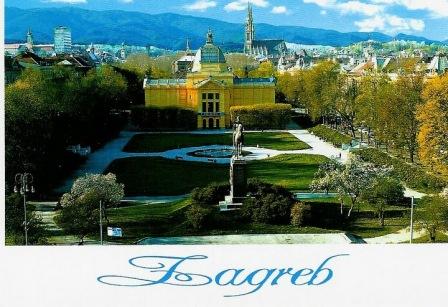
King Tomislav Square - Zagreb

Both of these cards show the King Tomislav square in Zagreb. The 1st card was bought by me in 2006 and the 2nd was sent by Manuela. 

 King Tomislav Square is, dominated by a monument to the first Croatian king.  He reigned from 910 until 928, first as Duke (dux Croatorum) of Dalmatian Croatia in 910–925, and then became first King (rex Croatorum) of the Croatian Kingdom in 925–928.

In addition to the monument, is located in the square, the main train station, the largest railway station in Croatia, and also the Art Pavilion.  The pavilion was built in 1898 of the iron skeleton of the Croatian pavilion at the Millennium Exhibition in Budapest. The style blends the elements of a classical appearance with a hint of Art Nouveau.
It is the oldest gallery in the Southeast Europe and the only purpose-built gallery in Zagreb designed specifically to accommodate large scale exhibitions.