Wednesday, November 23, 2022

German Postcrossing stamp

Last month the German post office launched a Postcrossing stamp and the event was celebrated with much deserved pomp and circumstance. 
In addition to the launch of the stamp itself, there was also a Postcrossing meeting with a Portuguese delegation, Paulo, Ana, Paula, Xana and Fernanda.

 Design of special postage stamp by Greta Gröttrup
So many countries already have Postcrossing stamps, but in Portugal, where the project was created, the mail services show no desire nor interrest on launching one. Shame on CTT!!

Friday, November 18, 2022

Orange - France

Orange is a city in the Provence-Alpes-Côte d'Azur region in southeastern France.  The is city incredibly rich in history, from its Celtic fortifications to its Roman monuments. Two of the most remarkable monuments are the Roman amphitheatre and the Triumphal Arch, both listed as World Heritage Sites by UNESCO. 
The card of the theatre was sent by Nancy, who also sent me one of the Saint.Emilion cards in the previous post. Óscar sent the arch card.
 
Built in the beginning of the Christian era, the ancient theatre presents all the components of the Latin Theatre according to Vitruvius: the cavea (semicircular tiers), the lateral accesses and the surprisingly preserved stage wall flanked by parascenia. Columns and numerous statues in niches originally decorated the stage. Only a few vestiges remain of this original decoration, including the statue of Augustus displaced to the large central niche. Closed by Imperial decree in 391, the theatre was abandoned and, later, ransacked and looted by Barbarians. It was not until the 19th century that the ancient theatre was reborn thanks to the restoration work begun in 1825.

Edittions Cellard
Built between 10 and 25 AD, the Roman Triumphal arch of Orange is one of the most beautiful and interesting provincial triumphal arches of the Augustan Age that has come down to us, thanks to its low reliefs commemorating the establishment of the Pax Romana. On its north and south sides, Celtic weapons from the period of independence appear in fan shape on a wall; on its east and west sides, the Celts are represented in chains. In addition to this decoration, there are naval remains where prows, oars, anchors and aplustre, recall the control over the maritime world that the victory of Actium gave to Rome. Finally, on the upper attic, Roman and Celtic cavalrymen and infantrymen clash. Transformed into a fort in the 13th century, partially repaired in the 18th century, then restored in the 19th century, the Triumphal Arch of Orange remains one of the most remarkable monuments of Roman Gaul. - in: https://whc.unesco.org

Saint-Emilion - France

Last month, during my trip to France, I've been to the medieval village of Saint Emilion, located 40km north-east of Bordeaux. Saint-Emilion is one of those places I discovered through postcards and when I realized it was so close to Bordeaux, I had to put it in my itinerary. 

Saint-Emilion is a charming medieval village located in the heart of the famous Bordeaux wine area. It is a very unique site were world-famous wineries, fine wine, beautiful architecture and great monuments are a perfect match.

 The legend tells us about a monk from Brittany who fled from Vannes, his hometown, to seek refuge in one of the natural caves in a place called Ascum bas (former name of the village) in the 8th century.
His name was Emilion. Living the life of a hermit he accomplished a few miracles and rapidly became famous in the region and even far beyond its border s. Soon he had many disciples and with their help he evangelized that place and made it become a great religious center. Even after his death his followers carried on his legacy and even called the town after him: Saint-Emilion.
From the 9th century to the 19th century men had the will to mine the soil in order to standardize the whole architectural looking of not only the city of Saint-Emilion but also a few ones in the region (such as Bordeaux for instance).
Nowadays the extraction is over but there are still 200km of underground galleries under the village and its vineyard standing as a proof of that activity. 
Harmonious work of Men and Nature the landscapes of Saint-Emilion are testimonies of its History. In 1999 for the first time in the world a vineyard was written on the World Heritage List by the UNESCO as a Cultural Landscape, that is to say a historical landscape that remained intact but which is still carrying on its activity. - in: https://www.bordeaux-tourism.co.uk

Porte Cadène, a superb Gothic arched gate, spans the picturesque Rue Cadène, one of the lanes that lead to Place de l’Eglise Monolithe. It was built long after the ramparts and is located within the fortified village. 
On the left side of the gate there's the only timber-framed house in the village and has a facade dating from the very beginning of the 16th century,

Le Corbusier Works in France

Notre Dame du Haut Chapel and Quartiers Modernes Frugès are two of the 17 projects designed by the architect Le Corbusier, classified as UNESCO WHS in 2016.

DE-12144224, sent by Michael. 
In the city of Ronchamp, southeast of Paris, is located one of the most significant works of Le Corbusier's career, the Chapel Notre-Dame du Haut (Our Lady of the Heights). Built in 1955, this chapel was the architect's first project for a religious building. 
The site of Ronchamp had long been a place of pilgrimage that was deeply rooted in Catholic tradition, however its church was destroyed during German bombing in the autumn of 1944 during World War II. In 1950, Le Corbusier was commissioned to design a church to replace the one destroyed during the War. 
The fine, curvy architecture of the chapel is surprising from what one saw of Le Corbusier, a rationalist architect who believed only in the right angle. The chapel is full of architectural contradictions, at the same time square and round, elongated and restrained, low and high. Due to this contradiction to Corbusier's architecture of straight lines and the fact that he was an atheist, the chapel of Ronchamp was one of the works that caused the most controversy and difficulty of assimilation by critics, both by architects and by the public.
 
Ville de Pessac - Direction de la Communication 
Quartiers Modernes Frugès, a housing development located in Pessac, contained some 70 housing units, built as experimental housing for workers.
Le Corbusier took into account prevailing social and economic factors, and was determined to build the plan to provide people with low-cost, predetermined, homogeneous cubist structures.
The project originated in 1920 with 10 houses built at Lege, near Pessac, for the father of Henry Fruges. Following this initial phase, the project was extended to 200 houses. Only a quarter of this number were built by 1926. L-C painted panels of brown, blue, yellow and jade green in response to the clients request for 'decoration'.
The layout consists of a terrace of about 8 three storey houses with roof gardens. Behind them is a terrace of houses connected to each other with a concrete arch which provides a sheltered garden. In the middle of the development are the interlocking houses. - in: wikipedia

Tuesday, November 15, 2022

Winner of the Month - October

I had already been the false winner of this game a few months ago but in October I was the real winner and received these postcards.

It took me a while but I managed to find the exact location of the image of this postcard sent by Telma. Calanque D’En-Vau beach is one of the most beautiful beaches in the French Provence-Alpes-Côte d’Azur region. The calm and crystalline waters invite tourists to discover the small beach, but this is one of the most remote places in the Calanques National Park and it is not easy to get there. You have to walk, depending on the starting point, there are several trails to get there. For those who don't like to walk, the other option is to go by boat.
 

© Foto: Carlos Sarzedas * © Casa dos Postais
  
Aerial view of Cascais with St, Marta Lighthouse sent by Isabel.

Rui complained about the same thing I did about Águeda's postcards. They are not easy to find and they are expensive!! This city in the district of Aveiro is mainly known for the umbrellas sky project that decorate the city during summer.

 Foto: Matos Simões
Donkeys are not something that I associate with the Algarve but the truth is that I have a few postcards of donkeys from there and most of them, accompanied by old people.

 
© Michael Howard Photography * www.mikehowardohoto.com

It was just a coincidence that 2 postcrossers from Algarve, Tiago and Ana, have both sent donkey cards with elderlies.

Saturday, November 12, 2022

World Postcard Day 22

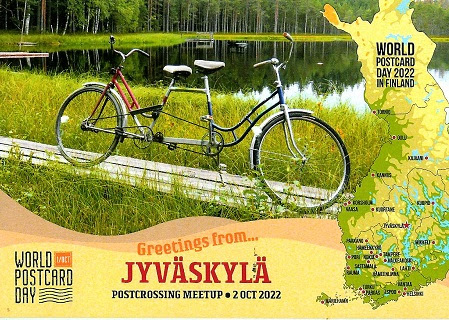
To celebrate World Postcard Day some creative minds around the world created dozens of beautiful cards. I've received these sent from meetings in Portugal, Brazil and Finland. 

 
Pauline Chrétien
I was lucky to be able to attend the Portuguese WPD meeting in Lisbon. Even though I had to leave a bit earlier, it was great to hang out with the Portuguese postcrossers friends and spend hours talking about cards. 
I sent this card to myself but it wasn't the only copy I got. Lurdes also sent me one. 
This card, the official World Postcard Day card was created by a French postcrosser paulinectart.

I've already mentioned a meeting in São Paulo but Rio de Janeiro also hosted one. This beautiful view of Corcovado Mountain and Christ the Redeemer was sent by Valéria.

Yes, I'm posting the same card twice. The other card was sent by Samara, this one is from Luzia. I've just noticed that she used a UNESCO stamp, Cais do Valongo, a site in Rio de Janeiro.

Photo: Riita Eskelinen
Heidi has been to a lot of meetings and she always sends me cards. This meeting in Jyväskylä was no exception.

Monday, November 7, 2022

PT RR - Surprise Group * October '22


World Postcard Day is in October and these postcards already celebrate it in some way.

Rui sent a card from sunny Algarve with a stamp cancelled with a WPD postmark. 
Once a fishing village of great importance, especially between the13th and 16th centuries, Praia da Luz is now very popular with tourists and one of the best beaches in the Algarve.  
A cobbled promenade along the sea front, offers sunny terraces and lots of entertainment during the summer. Flanked by large palm trees, this road merges to the west with the walls of the fortress originally built to protect the Church of Luz from attacks by pirates from North Africa.

Back in the days to travel by plane was glamorous, luxurious, comfortable and fun. It is always fun for me to fly but not always comfortable and definitely not glamorous and luxurious. This KLM picture shows a bit of how much flying has changed over the years. 
The postcard was sent by Pedro.
On October 1st, dozens of meetings took place all over the world. In Brazil there were at least two, one of them in São Paulo, from where Samara sent this postcard
 
  
Photo: @postcardsfromogait

This is how the traditional Portuguese mailboxes look like. The red one is for ordinary mail and the blue for priority mail. Although beautiful, I confess that I rarely drop my postcards in these boxes, I prefer to use the boxes at the post office. It feels safer. 
The card was sent by Nídia and the picture was taken by Tiago in Ponte de Lima.